



- Home
- /
- High Courts
- /
- Allahabad High Court
- /
- 'Punitive Demolitions Persist In UP...
'Punitive Demolitions Persist In UP Despite SC Ban': Allahabad High Court Asks If State Action Is A 'Colourable Exercise' Of Power
Sparsh Upadhyay
2 Feb 2026 9:45 PM IST
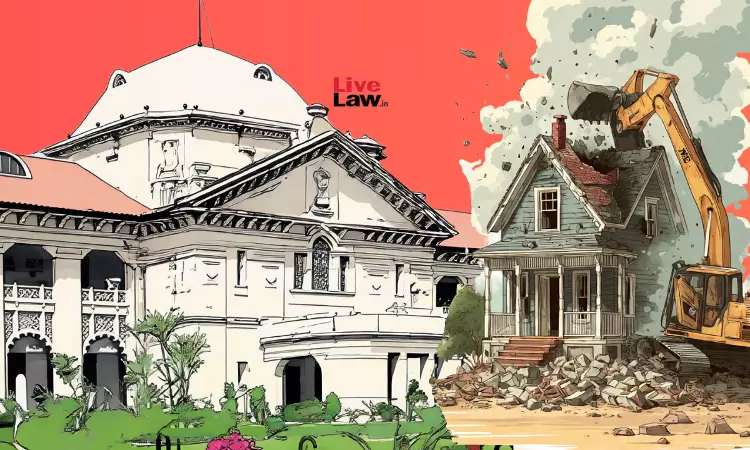
In a scathing observation regarding the alleged state of executive actions in Uttar Pradesh, the Allahabad High Court recently observed that punitive demolitions of structures continue to take place in the state despite the Supreme Court's November 2024 decision in 'Bulldozer Justice'. The Court further questioned the State Government as to whether demolishing a...
This is a premium content
Available exclusively to
Our subscribers
Subscribe Premium 
INR 1099+GST
Your support helps us to bring you more content at
an affordable subscription scheme !!!
All payment options available
In a scathing observation regarding the alleged state of executive actions in Uttar Pradesh, the Allahabad High Court recently observed that punitive demolitions of structures continue to take place in the state despite the Supreme Court's November 2024 decision in 'Bulldozer Justice'.
The Court further questioned the State Government as to whether demolishing a structure immediately following the commission of an offence is a colourable exercise of executive discretion.
A Division Bench of Justice Atul Sreedharan and Justice Siddharth Nandan observed that it has come across various such cases in which the notice for demolition was issued to the occupants immediately following the commission of an offence.
Thereafter, the dwelling places were demolished after the ostensible fulfilment of statutory requirements, the bench noted.
Therefore, bearing in mind the 'overarching' nature of the case spanning the right of the state to demolish a structure and the rights of its occupants under Articles 14 and 21, the Court framed the following 5 questions of law for the parties:
(1) Is there non-compliance of the judgement of the Supreme Court's November 2024 Judgment with specific reference to paragraphs 85 and 86 of that judgement?,
(2) Does the authority to demolish justify the act of demolishing a structure, or is there a duty on the anvil of parens patriae upon the State, not to demolish a dwelling place in the absence of public need/purpose?
(3) Are steps taken to demolish a structure immediately following the commission of an offence, a colourable exercise of executive discretion?
(4) How can High Court balance the conflicting interests between the statutory authority of the State to demolish a structure and the fundamental right of the average citizen under article 21 and 14, to prevent it?, and
(5) Can "reasonable apprehension" of demolition be a cause of action for a citizen to approach this Court and if 'yes', what is the bare minimum for this Court to hold the existence of such "reasonable apprehension"?
The matter will now be heard on February 9.
For context, the bench was hearing a writ petition filed by Faimuddeen and other who claimed that their relative (Aafan Khan), was named in an FIR under various sections of the BNS, POCSO Act, IT Act and the U.P. Prohibition of Unlawful Religious Conversion Act.
The petitioners alleged that, though they were not co-accused in the said FIR, they were targeted by a mob allegedly in collusion with the police.
Before the bench, they raised a reasonable apprehension that their properties (situated in Hamirpur), including a residential house, a commercial lodge and a saw mill, were marked for destruction by mechanical means by the authorities.
They claimed that the commercial lodge and saw mill have already been sealed by the respondent authorities. Therefore, they sought the intervention of the High Court to prevent the anticipated destruction of the properties.
The State Government, however, raised a preliminary objection that the petition is premature and that the Petitioners must respond to the notices issued to them.
In fact, an oral assurance was also given to the HC that no demolition would take place without adhering to the procedure established by law and without affording the Petitioners a due opportunity to place their case before the authorities concerned.
However, noting that such demolitions have continued in the state despite the Supreme Court's order, the bench deemed it appropriate to address the questions it has framed in the order passed on January 21.
Senior Advocate SFA Naqvi, assisted by Advocates Shamsuddin Khan, Syed Ahmed Faizan and Zaheer Asghar, appeared for the Petitioners.
Tags

Sparsh Upadhyay
Sparsh Upadhyay is an Associate Editor with LiveLaw.

