



- Home
- /
- High Courts
- /
- Allahabad High Court
- /
- Regular Congregational Religious...
Regular Congregational Religious Activities On Private Land Not Immune From State Regulations: Allahabad High Court
LIVELAW NEWS NETWORK
2 May 2026 9:44 AM IST
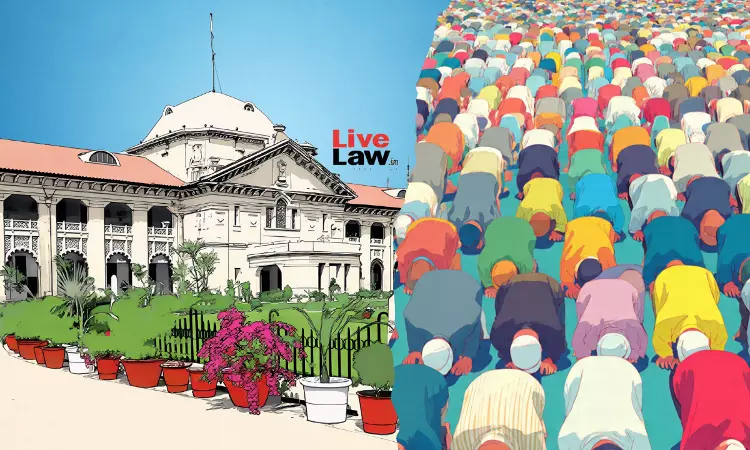
The Allahabad High Court recently observed that religious prayers can be organised on private property if they are occasional and non-disruptive, but when the property is used for regular or organised congregational activities, it may invite government regulation. A Bench of Justice Saral Srivastava and Justice Garima Prashad added that where such activity in the private property...
This is a premium content
Available exclusively to
Our subscribers
Subscribe Premium 
INR 1099+GST
Your support helps us to bring you more content at
an affordable subscription scheme !!!
All payment options available
The Allahabad High Court recently observed that religious prayers can be organised on private property if they are occasional and non-disruptive, but when the property is used for regular or organised congregational activities, it may invite government regulation.
A Bench of Justice Saral Srivastava and Justice Garima Prashad added that where such activity in the private property becomes regular, organised, or large in scale, it may amount to a change in the nature of use of the premises and will be subject to applicable laws, including planning and local regulations.
The bench further clarified that no individual or group can claim a right to use public land as an exclusive or recurring religious space and the State is bound to ensure equal access and cannot permit preferential or exclusive use of such land.
Importantly, in its order, the bench also gave clarification regarding HC's previous decisions (delivered by Justice Atul Sreedharan-led bench), including Munazir Khan vs State of U.P. & Others and Marantha Full Gospel Ministries vs State of UP. In these case, it was held that a citizen does not require any kind of permission under the law to offer religious prayers.
The High Court, in its latest decision, however, clarified that those decisions cannot be read as laying down that organised or regular congregational activity on private premises is wholly immune from regulation.
"They (verdicts) recognise a limited protection, namely where prayer remains confined to a private, non-disruptive setting. Where the activity extends beyond that sphere and begins to affect the public domain, lawful regulation follows. These decisions do not confer a right to convert private premises into an unregulated congregational space", the bench observed.
With these observations, the bench dismissed a writ petition filed by one Aseen, who had sought a direction to the authorities to provide security and permission to offer Namaz on a piece of land in a Village of District Sambhal.
He claimed ownership of the private property based on a June 2023 gift deed and argued that the respondent authorities were restraining such prayers, thereby violating his fundamental rights under Articles 25 and 26 of the Constitution.
The State, on the other hand, claimed that the land in question is recorded as Abadi land, which is land meant for public use and that the petitioner has no ownership rights over the same.
It was also apprised to the bench that Namaz has traditionally been offered at the said location only on the occasion of Eid, and that no restriction has been imposed on such established practice.
However, the state opposed the petitioner's attempt to introduce regular large-scale congregational prayers by inviting persons from within and outside the village.
Against the backdrop of these submissions, the bench noted that while the Constitution protects the right to practice religion, it also makes it clear that this right is subject to public order, morality and health.
The Court added that public land is meant for everyone and is controlled by law, and no individual can claim a right to use it for regular religious gatherings.
"Such use affects movement, access and safety, and in appropriate situations, communal equilibrium; it must therefore be regulated. It is the State's obligation to ensure equal access, civic order and nondiscriminatory administration", the bench remarked.
Regarding private religious activities on private land, the Court observed that private prayers, family worship, and other limited devotional activities ordinarily fall within the protected domain of religious freedoms under Articles 25 and 26 of the Constitution.
However, it clarified that this protection is confined to activity that is truly private, occasional, and non-disruptive and it does not extend to transforming any private premises into a de facto public religious venue.
"Once the activity assumes such a congregational character, it is no longer merely a matter of inward faith. It begins to produce external consequences: it may draw repeated attendance, including persons beyond the immediate household, affect ingress and egress, create traffic and parking concerns, alter the character of the locality, generate noise, require policing, and in sensitive areas, create the possibility of inter-community tension. At that stage, the activity assumes a public or quasi-public dimension. It is not that the private property loses all protection, but that the use of such property, to that extent, no longer remains purely private for constitutional purposes and becomes amenable to reasonable regulation", the bench remarked.
The Court noted that the law does not require the authorities to wait for an actual disturbance to occur and the is entitled to act in advance where an activity is likely to affect public order.
"The test is not the religious nature of the activity, but its public consequences. This approach is consistent with the constitutional principle of secularism, which requires equal treatment of all religions and equal application WRIC No. 10803 of 2026 5 of law. While the State must permit private worship, it is equally bound to regulate activities that affect public order, whether on public land or on private premises. Maintaining this balance is essential to the working of Articles 25 and 26 in a constitutional system", it noted.
On the merits of the case, the bench noted that the land in question is recorded as public land and the claim of ownership is based only on vague boundary descriptions.
Even otherwise, the Court said, if the land is assumed to be private, the petitioner is not entitled to the relief as he is introducing a new religious practice.
"The record shows that he is not protecting an existing practice, but seeking to introduce regular congregational gatherings, including persons from within and outside the village. It is admitted that Namaz was earlier offered only on specific occasions such as Eid. This expansion beyond a limited private sphere falls outside the protected domain and is subject to regulation"
In these circumstances, finding that no enforceable legal right is made out, the bench dismissed the writ petition.
Case title - Aseen vs State of UP and 3 Others 2026 LiveLaw (AB) 256
Case Citation: 2026 LiveLaw (AB) 256
Tags


