



- Home
- /
- High Courts
- /
- Allahabad High Court
- /
- S. 362 CrPC No Bar To Altering Bail...
S. 362 CrPC No Bar To Altering Bail Conditions: Allahabad High Court Revokes 'Onerous' ₹64 Lakh Deposit Condition After 12 Yrs
Sparsh Upadhyay
3 July 2026 4:35 PM IST
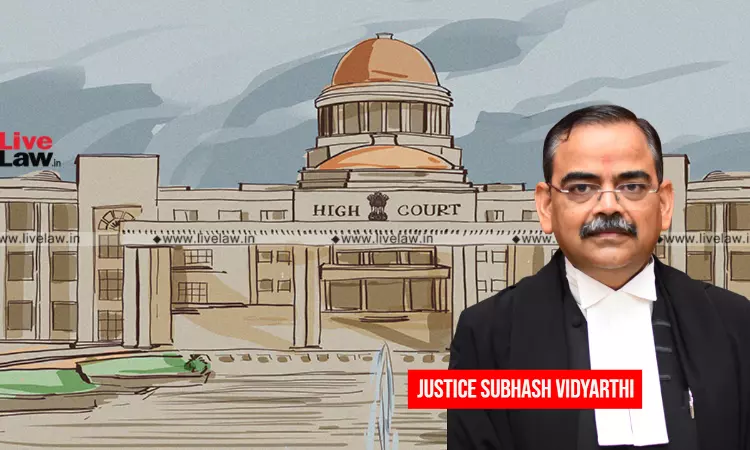
The Allahabad High Court has ruled that the statutory bar under Section 362 CrPC (Court not to alter judgment) does not apply to the modification or relaxation of conditions imposed in a bail order. "…an order granting bail is a merely an interlocutory order and it would not fall withing the scope and ambit of the phrase 'a judgment or final order disposing of a case' used in...
This is a premium content
Available exclusively to
Our subscribers
Subscribe Premium 
INR 1099+GST
Your support helps us to bring you more content at
an affordable subscription scheme !!!
All payment options available
The Allahabad High Court has ruled that the statutory bar under Section 362 CrPC (Court not to alter judgment) does not apply to the modification or relaxation of conditions imposed in a bail order.
"…an order granting bail is a merely an interlocutory order and it would not fall withing the scope and ambit of the phrase 'a judgment or final order disposing of a case' used in Section 362 Cr.P.C. Therefore, the bar contained in Section 362 Cr.P.C will not apply to alteration of a condition put in an order granting bail to an accused person", the Court specifically held.
A bench of Justice Subhash Vidyarthi thus allowed an application filed under Section 482 CrPC by a 77-year-old man who sought the revocation of an “unreasonably onerous” condition imposed 12 years ago in a December 2013 bail order.
The condition required him to deposit ₹64,00,000 as a fixed deposit (which had to be renewed from time to time till the conclusion of the trial)) in a nationalised bank in favour of the Airports Authority of India (AAI) as a precondition for his release.
Case in brief
Briefly put, in 2011, the Central Bureau of Investigation (CBI) lodged an FIR alleging that M/S Bright Aracon submitted inflated bills for cement supply during an apron expansion project at the Varanasi Airport, causing a wrongful loss of ₹25,74,065 to the exchequer.
Although the applicant was not named in the FIR, he was later charge-sheeted as a Director of M/s B. R. Arora Private Limited, a Constituent Member of M/s Bright Aracon.
The trial court later discharged him from all other charges, leaving only a single charge under Section 420 IPC. Furthermore, the prosecution sanction against the co-accused government servants was also quashed by the High Court in 2021, and the said order was upheld by the Supreme Court in October 2024.
As a result, the trial court closed the proceedings till further orders and ordered the record to be consigned (but not weeded out), so that the same can be called in case of a change of circumstances and the trial may commence again.
Opposing the petition, the CBI raised a preliminary objection while arguing that under Section 362 CrPC, a court cannot alter or review its final order once signed, except to correct clerical or arithmetical errors.
The CBI contended that once a bail application is decided, the High Court becomes functus officio and lacks the jurisdiction to modify its own conditions.
The CBI also relied upon a 2022 coordinate bench judgment in Aparna Purohit Vs. State of UP, wherein it was held that an application under Section 482 CrPC does not lie to modify bail conditions due to the Section 362 bar.
The petitioner's counsel, on the other hand, submitted that Section 482 CrPC protects the inherent powers of this court to secure the ends of justice, and that there are no limitations on this power to be exercised in an appropriate case.
High Court's observations
Against the backdrop of these submissions, Justice Vidyarthi, at the outset, referred to Section 362 CrPC to observe that it bars alteration or review of a judgment or final order disposing of a case, which includes a judgment mentioned in Section 353 CrPC or a final order mentioned in Sections 356 to 360 CrPC.
The bench further noted that as per the Supreme Court's judgments in Amar Nath v. State of Haryana 1997, VC Shukla v. State through CBI 1979 and Usmanbhai Dawoodbhai Memon v. State of Gujarat 1988, an order for release of the applicant on bail is neither a judgment nor a final order disposing off a case, rather it is an interlocutory order.
The bench also placed strong reliance on the Supreme Court's ruling in Ramadhar Sahu Vs. The State of Madhya Pradesh, 2023, LiveLaw (SC) 945, explicitly held that the prohibition contemplated in Section 362 CrPC does not apply when an accused seeks variation or alteration of bail conditions based on changed circumstances.
In view of this, the bench termed the decision in Aparna Purohit, relied upon by the CBI, to be per incuriam for failing to notice the Supreme Court judgements cited above.
About its jurisdiction, the High Court observed that its inherent powers to secure the ends of justice do not stem merely from Section 482 CrPC, but are constitutionally vested in it under Article 215 as a superior Court of Record.
Now, regarding the bail condition to submit Rs. 64 Lakhs FD, the bench referred to the Supreme Court's Judgments in Sumit Mehta v. State (NCT of Delhi) 2013 and Gajanan Dattatray Gore v. State of Maharashtra 2025, to stress that criminal proceedings are not meant for the realisation of disputed dues.
Thus, the bench found this condition, imposed without even recording a prima facie satisfaction as to the applicant's guilt, to be highly unreasonable and onerous.
Noting that the trial is not proceeding and the 77-year-old applicant is being deprived of his own money with no hope of trial conclusion anytime soon, the Court revoked the deposit condition.
It directed that the ₹64,00,000 fixed deposit, together with all accrued interest thereon, be released to the petitioner within 30 days.
Senior Advocate Purnendu Chakravarty, assisted by Advocates Pranjal Jain and Pratyush Shahi, appeared for the petitioner.
Advocate Aakash Prasad, assisted by Advocates Shashwat Dwivedi and Ishan Khanna, appeared for the opposite party-CBI.
Case title - Baldev Raj Arora vs. Cbi/ Acb Lko. 2026 LiveLaw (AB) 347
Case Citation: 2026 LiveLaw (AB) 347
Tags

Sparsh Upadhyay
Sparsh Upadhyay is an Associate Editor with LiveLaw.

