



- Home
- /
- High Courts
- /
- Allahabad High Court
- /
- S. 13 Of Public Gambling Act Is A...
S. 13 Of Public Gambling Act Is A Cognizable Offence; Police Can Arrest & Investigate Without A Warrant: Allahabad High Court
Sparsh Upadhyay
15 Dec 2025 3:38 PM IST
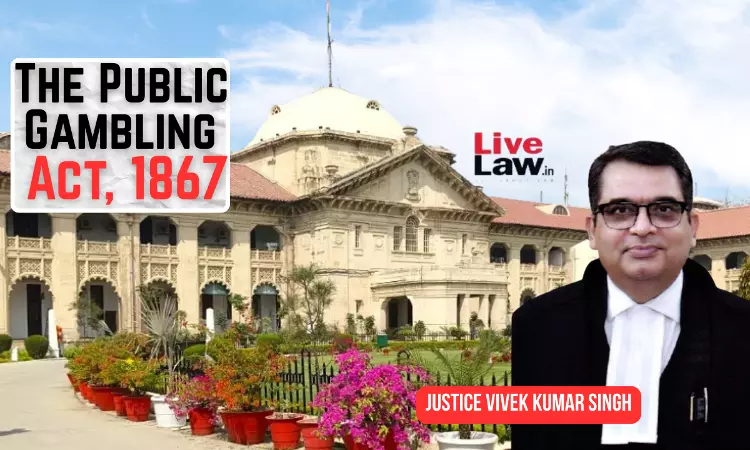
The Allahabad High Court recently ruled that the offence of gaming in a public street or place under Section 13 of the Public Gambling Act, 1867, is cognizable because the provision itself permits a police officer to apprehend the accused without a warrant.By necessary implication and in view of Section 2 (c) CrPC, the Court further held that the police may also register an FIR and...
This is a premium content
Available exclusively to
Our subscribers
Subscribe Premium 
INR 1099+GST
Your support helps us to bring you more content at
an affordable subscription scheme !!!
All payment options available
The Allahabad High Court recently ruled that the offence of gaming in a public street or place under Section 13 of the Public Gambling Act, 1867, is cognizable because the provision itself permits a police officer to apprehend the accused without a warrant.
By necessary implication and in view of Section 2 (c) CrPC, the Court further held that the police may also register an FIR and investigate the matter without prior permission from a Magistrate.
A Bench of Justice Vivek Kumar Singh thus dismissed an application filed under Section 528 BNSS by one Kamran seeking to quash criminal proceedings pending against him before the Special Chief Judicial Magistrate, Agra.
Case in brief
In December 2019, the accused was arrested for allegedly playing cards in a park in the Sikandara area of Agra with his co-accused. Police recovered Rs. 750 from their possession and subsequently filed a chargesheet under Section 13 of the 1867 Act, which penalises "gaming and setting birds and animals to fight in public streets."
The applicant approached the High Court, arguing that the proceedings were void ab initio. His counsel contended that, in Uttar Pradesh, the maximum punishment for a first offence under Section 13 is a term of imprisonment of up to one month.
Referring to the Code of Criminal Procedure (CrPC), the counsel argued that offences punishable with less than three years' imprisonment are generally "non-cognizable" and, thus, that the police could not have arrested the applicant or investigated the offence without a Magistrate's order.
In this regard, he referred to Section 155(2) of the CrPC, which provides that no Police Officer shall investigate a non-cognizable case without an order from a Magistrate having the power to try such a case or commit it for trial.
Thus, he argued that since, in the present case, the police did not take permission from the learned Magistrate to commence with the investigation, the entire proceedings commenced soon after registration of the FIR became void ab initio.
High Court's observations
Rejecting his plea, Justice Vivek Kumar Singh noted that Section 13 of the 1867 Act explicitly begins with the words: "A police officer may apprehend without warrant any person found playing for money..."
The Bench also referred to the definition of "cognizable offence" under Section 2(c) of the CrPC, which provides that a police officer may arrest without warrant in accordance with the First Schedule or under any other law for the time being in force.
Against this backdrop, Justice Singh observed thus:
"It is very clear from the above definition...that in a case of cognizable offences, a police officer may arrest any person without warrant...Section 13 of the Gambling Act authorise a police officer to arrest any person without warrant, therefore, it cannot be said that Section 13 of the Gambling Act is a non-cognizable offence."
The Court also rejected the argument of the counsel relying upon certain judgments where Section 3/4 of the Act (relating to keeping or being found in a common gaming house) were held to be non-cognizable. The Bench clarified that those judgments were based on "entirely different" facts and legal provisions.
The HC said that while Sections 3 and 4 may require different procedures, the specific authority granted to the police under Section 13 to arrest persons gambling in public streets renders it a cognizable offence.
Therefore, the Court opined that police were within their rights to register the FIR and submit a chargesheet without a Magistrate's order.
Consequently, finding no illegality in the Magistrate taking cognizance of the police report, the High Court dismissed the application.
However, considering the minor nature of the punishment involved, the Court directed the trial court to conclude the trial as expeditiously as possible, preferably within a period of three months.
Advocate Diwan Saifullah Khan, appeared for the applicant
Advocate Mohd. Afzal appeared for the state.
Case title - Kamran vs State of U.P. and Another
Citation :
Click Here To Read/Download order

Sparsh Upadhyay
Sparsh Upadhyay is an Associate Editor with LiveLaw.

