



- Home
- /
- High Courts
- /
- Allahabad High Court
- /
- S.528 BNSS | Can High Court Invoke...
S.528 BNSS | Can High Court Invoke Its Inherent Powers Suo Motu To Quash Criminal Case In A Complainant's Appeal? Allahabad HC Answers
Sparsh Upadhyay
26 July 2026 4:11 PM IST
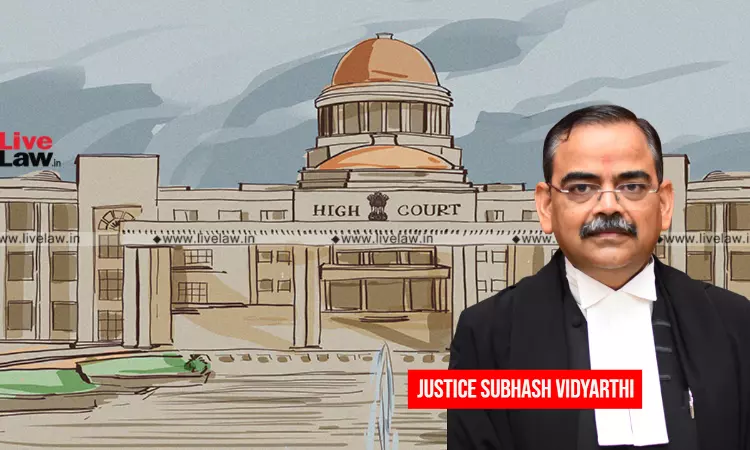
The Allahabad High Court has clarified that the HC can invoke its inherent powers under Section 528 BNSS (Section 482 CrPC) suo motu to quash criminal proceedings even while dealing with an appeal filed by the complainant where it finds that continuation of the proceedings would defeat the "ends of justice" or amount to an "abuse of the process of any Court".A bench of Justice Subhash...
This is a premium content
Available exclusively to
Our subscribers
Subscribe Premium 
INR 1099+GST
Your support helps us to bring you more content at
an affordable subscription scheme !!!
All payment options available
The Allahabad High Court has clarified that the HC can invoke its inherent powers under Section 528 BNSS (Section 482 CrPC) suo motu to quash criminal proceedings even while dealing with an appeal filed by the complainant where it finds that continuation of the proceedings would defeat the "ends of justice" or amount to an "abuse of the process of any Court".
A bench of Justice Subhash Vidyarthi made the observation while dealing with an appeal filed by a complainant challenging an order of the Special Judge whereby her application under Section 173 (4) BNSS was treated as a complaint instead of directing registration of an FIR on the application.
Although the appeal challenged the order refusing to direct registration of an FIR, the High Court found that the allegations contained in the complaint were "wholly improbable" and that even if accepted at face value, they did not disclose the commission of any cognizable offence.
Holding that continuation of the complaint proceedings would defeat the ends of justice and amount to an abuse of the process of the Courts and the law, the Court proceeded to invoke its inherent jurisdiction suo motu and quash the proceedings.
Case background
Briefly put, the complainant, a Scheduled Caste woman working as an Instructor in an Upper Primary School, alleged that she was residing as a tenant in the house of opposite party no 2 and her husband had purchased a plot from the opposite parties.
According to her, it was later discovered that the seller was not the owner of the plot. She alleged that although part of the money was recovered after the plot was resold, some amount remained unpaid.
She further alleged that taking advantage of the fact that her husband stayed away from her due to his work, the opposite party no 2 sexually exploited her on the pretext of helping her recover the unpaid money. Alleging commission of cognizable offences, she sought registration of an FIR.
When the police did not act, she approached the Special Judge under Section 173 (4) BNSS, who treated her application as a complaint instead of directing registration of an FIR. Aggrieved with the order, she filed the present appeal before the High Court.
High Court's observations
Dealing with her appeal, the Court noted that the dispute essentially arose out of a monetary transaction involving her husband, who had neither disclosed the alleged unpaid amount nor initiated any civil or criminal proceedings for its recovery.
The Court further noted that the complainant had also admitted that part of the consideration had already been refunded after settlement of an earlier criminal case relating to the same transaction.
It further observed that there was nothing on record to show that the opposite parties had prepared any forged document or that they had committed any act amounting to cheating or forgery.
Observing that the allegations were "wholly improbable", it observed thus:
"Assuming this allegation levelled in the application is true, it does not make out commission of any offence by the opposite party no 2. It appears that the petitioner is abusing the criminal justice system to blackmail the opposite Parties Nos 2 to 4 for recovering an undisclosed amount of unpaid money".
"...a 35-year-old married woman who is working as an instructor in an upper primary school...she has alleged that she allowed herself to be sexually exploited under allurement of recovering her husband's undisclosed amount of money, although her husband did not take any action for recovering his money. This allegation is wholly improbable," it further noted.
It added that assuming this allegation levelled in the application is true, it does not make out commission of any offence by the opposite party no 2.
The Court relied on the Supreme Court's decision in Dilip Singh v State of Madhya Pradesh 2021, to reiterate that criminal proceedings cannot be used for realisation of disputed dues.
Against this backdrop, the question before the Court therefore was: "whether it could exercise its inherent powers suo motu to quash the complaint proceedings after noticing abuse of the process of Court while hearing an appeal filed by the complainant herself even though the accused had not challenged the proceedings as they had not yet been summoned by the trial Court".
The bench noted that Section 528 BNSS merely recognises the inherent powers of the High Court and that those powers exist to give effect to any order under this Sanhita or to prevent abuse of the process of any Court or otherwise to secure the ends of justice.
The bench referred to the Supreme Court's judgments in State of Karnataka vs L Muniswamy 1977, State of Haryana vs Bhajan Lal 1990 and Som Mittal vs State of Karnataka 2008; the bench reiterated that the power can be exercised to quash criminal proceedings where continuation of the proceedings would amount to an abuse of the process of Court or defeat the ends of justice.
Furthermore, referring to the Supreme Court's decision in Popular Muthiah vs State 2006, the bench observed that the High Court is not powerless merely because no petition invoking Section 528 BNSS has been filed and that it can exercise its inherent powers suo motu even while exercising its appellate jurisdiction.
Justice Vidyarthi observed
"In appropriate cases this Court can exercise its inherent powers even suo motu even while exercising its appellate jurisdiction and filing of a petition under Section 482 CrPC 528 BNSS is not a condition precedent for exercising the inherent powe rs to secure the ends of justice or to prevent the abuse of the process of any Court Where even while exercising its appellate powers it appears to this Court that continuance of any criminal proceedings would defeat the ends of justice and would result in abuse of the process of any Court this Court not only has the power to interfere in exercise of its inherent powers but it has the duty to exercise that power in deserving cases so as to secure the ends of justice or to prevent the abuse of the process of any Court or law".
Accordingly, while exercising its inherent powers in the complainant's own appeal, the High Court set aside the Special Judge's order treating the application under Section 173 (4) BNSS as a complaint and quashed the entire complaint proceedings.
Case title - X Complainant Of Complaint Case No. 65/2026 2026 vs. State Of U.P. Thru. Prin. Secy. Home Civil Sectt. Lko. And 3 Others 2026 LiveLaw (AB) 467
Citation: 2026 LiveLaw (AB) 467
Tags

Sparsh Upadhyay
Sparsh Upadhyay is an Associate Editor with LiveLaw.

