



- Home
- /
- High Courts
- /
- Allahabad High Court
- /
- Suicide Abetment | 'Persistent...
Suicide Abetment | 'Persistent Humiliation Touching Domestic Life & Dignity Can Amount To Instigation': Allahabad High Court
Sparsh Upadhyay
16 July 2026 12:04 PM IST
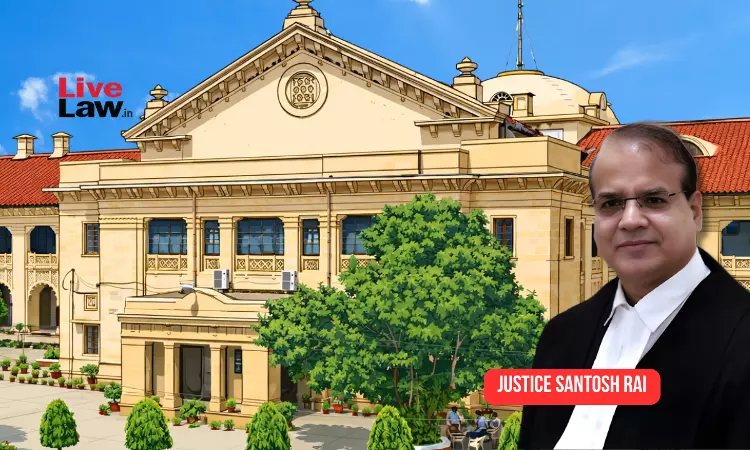
The Allahabad High Court last week refused to discharge a man accused of abetting the suicide of his alleged paramour's husband, observing that the persistent humiliation of a person, particularly when it touches upon their domestic life and dignity, can amount to instigation. A Bench of Justice Santosh Rai thus denied relief to appellant Chandrajeet Singh while taking into account...
This is a premium content
Available exclusively to
Our subscribers
Subscribe Premium 
INR 1099+GST
Your support helps us to bring you more content at
an affordable subscription scheme !!!
All payment options available
The Allahabad High Court last week refused to discharge a man accused of abetting the suicide of his alleged paramour's husband, observing that the persistent humiliation of a person, particularly when it touches upon their domestic life and dignity, can amount to instigation.
A Bench of Justice Santosh Rai thus denied relief to appellant Chandrajeet Singh while taking into account a suicide note that narrated a "systematic pattern of humiliation".
The bench thus dismissed his criminal appeal challenging the order of the Special Judge S.C.& S.T. Act Bareilly, refusing his discharge plea in connection with a case related to Section 306 IPC and Section 3(2)5 S.C. & S.T. Act.
The Court clarified that the scope of interference against an order rejecting a discharge application is extremely limited and that the veracity of the suicide note and the causal link between the accused's conduct and the suicide are matters to be tested during trial.
Case In Brief
According to the prosecution's case, the deceased (Somraj) was married to co-accused Priya @ Dolly in 2017. The co-accused allegedly maintained an illicit relationship with the appellant, Chandrajeet @ Aashi, and another co-accused, Gulshan.
Owing to the alleged relationship, matrimonial disputes frequently arose between the deceased and his wife. Despite repeated efforts by the deceased and his family members to persuade the accused persons, they continued to remain in contact with each other.
The prosecution further alleged that the accused repeatedly threatened, harassed and mentally tortured the deceased over the alleged illicit relationship, causing him severe mental distress.
On June 18, 2018, the deceased was found hanging inside his room. After breaking open the door, the family allegedly recovered handwritten suicide notes in which the deceased specifically held his wife, the appellant and Gulshan responsible for his death.
After the Special Judge, SC/ST Act, Bareilly, rejected the appellant's discharge application, he moved the High Court with the present appeal.
It was his case that the accused appellant had not been in contact with the deceased for 2-3 days prior to the incident and, therefore, there was no proximate nexus or immediate instigation to attract the offence of abetment of suicide.
High Court's observations
At the outset, the Court rejected the contention of the appellant as it noted that for the purpose of abetment of suicide, there is no requirement that the accused must not be in contact with the deceased just before the incident.
The Court further noted that the handwriting in the suicide note, which blamed the appellant, had been confirmed by the Forensic Science Laboratory (FSL).
Observing that the suicide note was a critical piece of evidence, the Court said:
"While "abetment" under Section 108 BNS requires mens rea and an active act of instigation, the persistent humiliation of a person, particularly when it touches upon their domestic life and dignity, can indeed amount to instigation".
Regarding the invocation of the SC/ST Act against the co-accused, the Court noted that the suicide note suggested that the accused had exploited the vulnerability of the deceased to commit the acts of humiliation.
The court said that a full trial is warranted to ascertain the intent and social context of the harassment. Therefore, finding sufficient material to frame charges and proceed, the bench rejected the criminal appeal.
Case Title - Chandrajeet Singh vs State of U.P. and Another 2026 LiveLaw (AB) 417
Case citation: 2026 LiveLaw (AB) 417
Tags

Sparsh Upadhyay
Sparsh Upadhyay is an Associate Editor with LiveLaw.

