



- Home
- /
- High Courts
- /
- Allahabad High Court
- /
- Sultanpur Bar Association...
Sultanpur Bar Association Elections: Allahabad High Court Orders 30% Reservation For Women, Sets Rotation For Key Posts
Sparsh Upadhyay
29 Aug 2026 8:46 PM IST
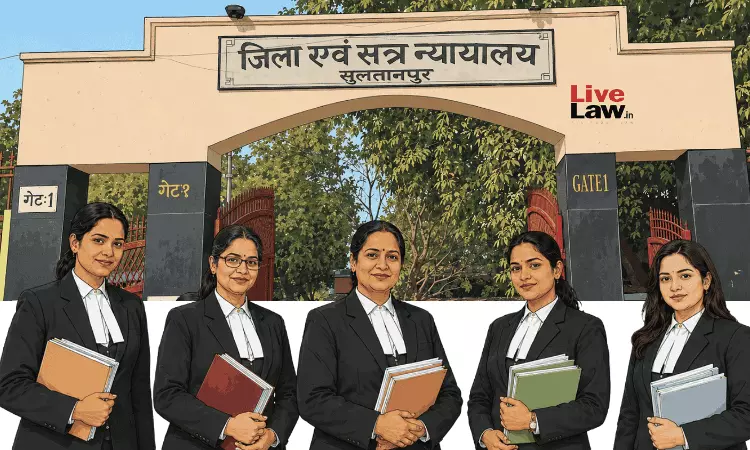
The Allahabad High Court earlier this month directed the Sultanpur Bar Association to implement a 30% reservation for women advocates in its Executive Committee and Governing Council. The Court ordered that key posts will be reserved for women candidates on a rotational basis in successive elections.A Bench of Justice Rajan Roy and Justice Manjive Shukla passed the directions in a Public...
This is a premium content
Available exclusively to
Our subscribers
Subscribe Premium 
INR 1099+GST
Your support helps us to bring you more content at
an affordable subscription scheme !!!
All payment options available
The Allahabad High Court earlier this month directed the Sultanpur Bar Association to implement a 30% reservation for women advocates in its Executive Committee and Governing Council. The Court ordered that key posts will be reserved for women candidates on a rotational basis in successive elections.
A Bench of Justice Rajan Roy and Justice Manjive Shukla passed the directions in a Public Interest Litigation (PIL) plea concerning compliance with the Supreme Court's recent directions in Deeksha N. Amruthesh v. State of Karnataka regarding representation of women advocates in Bar Associations.
The High Court noted that the Supreme Court had directed that 30% of posts in Bar Associations, whether in the Executive Body or Governing Council, be reserved for women.
The Court observed that these directions, issued under Article 142 of the Constitution, were binding on Bar Associations, subject to further orders of the Supreme Court.
Case background
A practising Advocate and member of the Sultanpur Bar Association, Shashi Mishra, had moved the High Court seeking directions after the Association allegedly proceeded towards elections without providing the requisite reservation for women.
The Bar Association had initially proposed amendments under which the sole post of Treasurer, 2 of 4 Senior Executive/Governing Council Member posts and 2 of 4 Junior Executive/Governing Council Member posts would be reserved for women.
High Court's directions
Hearing the matter on August 10, the High Court, however, found this arrangement inadequate as it observed thus:
"…this is not adequate representation of women, nor in accordance with the letter and spirit of the orders passed by Hon'ble Supreme Court. There has to be 30% reservation for women across the board i.e. in respect of all the posts".
The Court had further noted that the Executive Committee of the Sultanpur Bar Body comprises the posts of President, Senior Vice President, Vice President, General Secretary, Treasurer, 3 Joint Secretaries, 4 posts of Senior Governing Council (having practice of more than fifteen years) and 4 more posts of Junior Governing Council (having practice of less than fifteen years).
The Court thereafter prescribed a rotational mechanism to ensure the required representation across these posts.
Under the Court's directions, 1 of the 3 Joint Secretary posts is to be reserved for women on a rotating basis. For the 2026 election, the post of Joint Secretary (Administration) is reserved for women, followed by Joint Secretary (Library) in 2027 and Joint Secretary (Club) in 2028, with the rotation continuing thereafter.
The Treasurer post was initially earmarked for women in the 2027 election under the August 13 order. However, by its subsequent order dated August 25, the Court modified this arrangement and directed that the Treasurer post be reserved for a woman candidate in 2026, then again in 2029, 2032 and so on by rotation.
The General Secretary post will now be reserved for women in 2027, followed by 2030, 2033 and so on by rotation.
The Senior Vice President post is to be reserved for women in 2027, followed by 2030 and subsequent elections on the same rotational basis. The President post is to be reserved for women in 2028, followed by 2031, 2034 and so on.
1 post each among the 4 Junior Executive Members and 4 Senior Executive Members is to remain reserved for women.
Thus, the Court's arrangement provides for 5 of the 16 Executive Council posts to be reserved for women candidates, in accordance with the Supreme Court's 30% requirement.
During the proceedings, an intervener argued that 30% reservation was not justified since there were only 41 women members among 2,028 members of the Sultanpur Bar Association. The High Court rejected the argument by observing thus:
"We have passed orders only to facilitate implementation of the orders passed by Hon'ble Supreme Court of India in the proceedings referred in our order dated 10.08.2026 under Article 142 of the Constitution of India and keeping in mind the obligations under Article 144 thereof. All these pleas cannot be considered by us as we cannot vary the percentage of reservation".
Earlier, the Court had also clarified that it was "not the choice of the Bar Association whether to provide for the reservation or not", since it was bound by the Supreme Court's directions under Articles 141 and 144 of the Constitution.
Since fresh nominations would be required in light of the reservation directions, the High Court directed that the previously notified election schedule be reworked.
By its latest order passed on August 25, the Court directed the Elders' Committee to immediately issue the election schedule within 3 days and thereafter hold the elections within 3 weeks from the issuance of the schedule.
The Court made clear that the Elders' Committee was now in charge of conducting the elections and warned that any interference by outgoing office-bearers would be treated as an "affront and contempt of the Court", with proceedings liable to be initiated against them.
In another significant direction, the High Court ordered that all candidates contesting the Sultanpur Bar Association elections must disclose FIRs or criminal cases lodged or filed against them, along with their outcome, irrespective of whether the proceedings have concluded or remain pending.
The details are to be made available to voters, while candidates may offer their remarks or explanations regarding the cases.
The Court further directed that any concealment or misrepresentation could result in consideration of cancellation of the candidature or election on that ground, and that corresponding provisions be incorporated in the nomination papers.
The Court subsequently clarified that no further application for modification of its orders would be entertained.
Case title - Shashi Mishra vs. Bar Council Of U.P. Thru. Its Secy. And 2 Others 2026 LiveLaw (AB) 633
Case Citation: 2026 LiveLaw (AB) 633
Tags

Sparsh Upadhyay
Sparsh Upadhyay is an Associate Editor with LiveLaw.

