



- Home
- /
- High Courts
- /
- Allahabad High Court
- /
- Judicial Orders Of Criminal Courts...
Judicial Orders Of Criminal Courts Can't Be Challenged U/Art 226: Allahabad High Court Relies On SC's 'Neeta Singh' Ruling
Sparsh Upadhyay
27 March 2026 11:51 AM IST
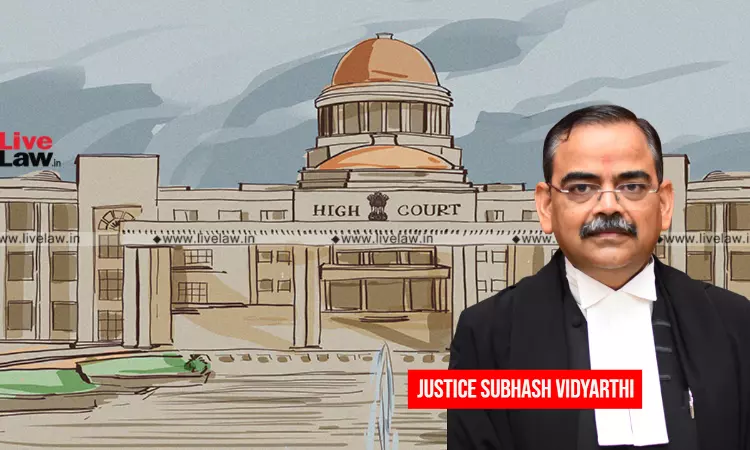
The Allahabad High Court has observed that a judicial order passed by a criminal court cannot be challenged by filing a writ petition under Article 226 of the Constitution of India. Relying on the Supreme Court's recent judgment in Neeta Singh 2024, a bench of Justice Subhash Vidyarthi dismissed a plea filed seeking the quashing of a February 2026 order passed by the Special Chief...
This is a premium content
Available exclusively to
Our subscribers
Subscribe Premium 
INR 1099+GST
Your support helps us to bring you more content at
an affordable subscription scheme !!!
All payment options available
The Allahabad High Court has observed that a judicial order passed by a criminal court cannot be challenged by filing a writ petition under Article 226 of the Constitution of India.
Relying on the Supreme Court's recent judgment in Neeta Singh 2024, a bench of Justice Subhash Vidyarthi dismissed a plea filed seeking the quashing of a February 2026 order passed by the Special Chief Judicial Magistrate (Custom), Lucknow.
During the hearing, the State raised a preliminary objection regarding the maintainability of the petition. The State relied on the Neeta Singh case to argue that high courts cannot entertain Article 226 petitions against judicial orders of criminal courts.
The State contended that the appropriate remedy in such cases lies strictly under Article 227.
On the other hand, the petitioner's counsel relied on the Radhey Shyam v. Chhabi Nath 2015 judgment to argue that a writ of certiorari can be granted when a subordinate court acts without jurisdiction or in excess of it.
Justice Vidyarthi, however, noted that the passage relied upon by the petitioner was actually from the 1954 case of TC Basappa v. T Nagappa, and the same had merely been referenced in the Radhey Shyam judgment.
The Court noted that the Supreme Court in the Radhey Shyam case did not follow or approve that older principle for judicial orders.
"After referring to the aforesaid judgment in the case of T.C. Basappa (Supra), the Hon'ble Supreme Court referred to numerous other subsequent judgments and concluded that the judicial orders of civil courts are not amenable to a writ of certiorari under Article 226 of the Constitution of India and jurisdiction under Article 227 of the Constitution of India is distinct from the jurisdiction under Article 226 of the Constitution of India".
Further, relying on the Neeta Singh case, the bench stated that the High Courts "stand disabled" from entertaining a writ petition seeking the issuance of a writ of certiorari and thereby examining the validity of a judicial order under Article 226 of the Constitution of India.
Accordingly, the Writ Petition was dismissed as not maintainable at the admission stage.
The bench, however, added that the petitioner shall have liberty to file a fresh petition under Article 227 of the Constitution of India.
Case title - Archana Mishra vs. State Of U.P. Thru. Prin. Secy. Deptt. Of Home Lko. And Another 2026 LiveLaw (AB) 143
Case citation : 2026 LiveLaw (AB) 143
Tags

Sparsh Upadhyay
Sparsh Upadhyay is an Associate Editor with LiveLaw.

