



- Home
- /
- High Courts
- /
- Allahabad High Court
- /
- 'Corruption Of Mind & Purse':...
'Corruption Of Mind & Purse': Allahabad HC Tells UP CM Time Has Come To Make Top Bureaucrats Criminally Liable; Here's Why
Sparsh Upadhyay
4 Jun 2026 2:58 PM IST
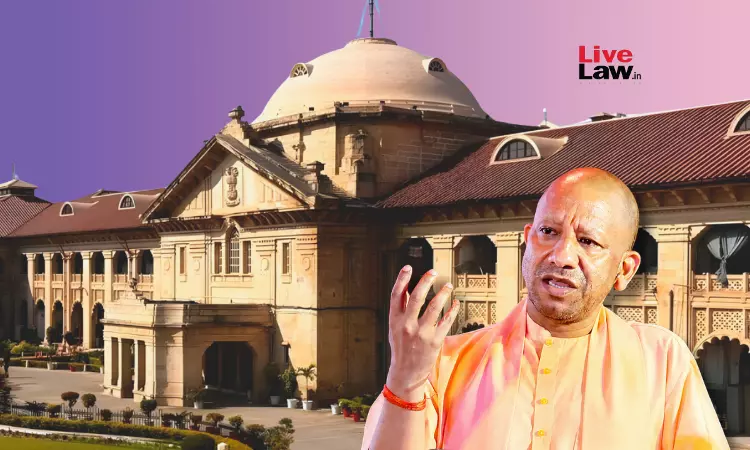
In a significant order passed on Wednesday, the Allahabad High Court has urged the UP Chief Minister to recognize that the time has come to hold senior Bureaucrats and top administrative heads accountable, and even criminally liable, for the lapses of their departments or subordinates. A bench of Justice Vinod Diwakar said that the State must adopt a doctrine of "superior...
This is a premium content
Available exclusively to
Our subscribers
Subscribe Premium 
INR 1099+GST
Your support helps us to bring you more content at
an affordable subscription scheme !!!
All payment options available
In a significant order passed on Wednesday, the Allahabad High Court has urged the UP Chief Minister to recognize that the time has come to hold senior Bureaucrats and top administrative heads accountable, and even criminally liable, for the lapses of their departments or subordinates.
A bench of Justice Vinod Diwakar said that the State must adopt a doctrine of "superior responsibility", under which the senior officers in an administrative hierarchy are held accountable.
The bench added that, in appropriate cases, they are also made criminally responsible for their failure to prevent or punish acts of commission or omission by their subordinates.
"Senior officers must be held accountable for the conduct and performance of their subordinates, as it is both their professional and administrative responsibility to ensure the effective delivery of public services", the bench observed in its 16-page order.
Importantly, the bench warned against two distinct forms of institutional decay: "corruption of the mind", whereby the decision-making process is deliberately perverted to serve private ends under the guise of official authority, and "corruption of the purse," whereby public office is converted into an instrument of personal pecuniary gain.
"Such accountability may legitimately be extended to criminal liability where the failure to prevent or punish leads to criminal acts such as corruption, fraud, willful suppression of records, contempt of government orders and Gazette Notifications, and failure to implement 'State policy', and 'Programmes', such as zero tolerance towards organised, institutionalised corruption…", the bench observed.
Background
These observations were made by the single judge while dealing with a plea filed by a businessman (petitioner-Avnesh Kumar Agarwal) challenging an order passed by a Special Court in Bareilly, which rejected his plea seeking a No Objection Certificate (NOC) for renewal of his passport.
Additionally, there were allegations of the destruction of official records by setting the government office on fire by "certain unknown miscreants".
Before the High Court, the petitioner submitted that the investigation in one FIR remained pending for nearly 2 decades, and in the other FIR, the charge-sheet was submitted only in the year 2024 after a delay of 18 years.
He also submitted that the allegations were levelled just to harass him and that a Co-ordinate Bench of the High Court had already stayed the proceedings against him.
Against this backdrop, the petitioner argued that he was entitled to an NOC. The Additional Government Advocate for the State, however, referred to the gravity of the allegations and opposed the relief sought in the petition.
High Court's observations
At the outset, the bench referred to a 2023 order of the High Court in Manish Kumar Singh vs State of UP, directing the State Government to constitute a High-Powered Committee to formulate guidelines for monitoring the investigation of FIRs registered by government departments in corruption and cheating cases.
In that case, in addition to issuing other directions, the division bench directed that the investigations be completed expeditiously in a phased manner.
In the present matter, the bench was apprised that, pursuant to the 2023 judgment, the High-Powered committee was formed only in December 2025, after an inordinate delay of nearly two years, and that too, when this Court took note of the present matter.
The bench, however, did not find it appropriate to escalate the matter and it left the issue with hope and expectation that the directions of the 2023 Judgment of the HC shall also be complied with in a time-bound manner.
Before parting, the bench, however, noted that a significant impediment to the effective implementation of Court-issued directions lies in the mindset of certain sections of the bureaucracy, whose approach is "not inclusive" and who tend to regard the retention of discretionary power "as an end in itself".
The Court added that this exact "apprehension of losing discretion" is the primary driver behind "red-tapism" in public administration. Rules and regulations, Justice Diwakar reminded the State, exist precisely to limit this unguided power and force a rule-bound culture.
The bench further noted that, after reserving judgment, it waited over three months for updates on the progress of decisions made by the High-Powered Committee, but received no information until the date of pronouncement.
Terming the situation as 'unfortunate', the bench reminded the AGA that the Chief Secretary is the keystone of the arch of State administration, requiring extraordinary vigilance from those who represent him.
"Learned Additional Advocate General, must appreciate that the Chief Secretary, functioning as the Secretary to the Cabinet and the Council of Ministers and serving, in that capacity, as the principal adviser to the Hon'ble Chief Minister and the Hon'ble Council of Ministers on all matters of civil administration, policy implementation, and inter-departmental coordination, occupies a special and privileged position and is, in every sense, the keystone of the arch of State administration. It is, therefore, imperative that the learned law officers conduct themselves with extraordinary vigilance, circumspection, and a heightened sense of institutional responsibility while discharging their duties", the Court observed.
With this, the bench directed its Registrar (Compliance) to immediately send a certified copy of the judgment to the Chief Secretary of Uttar Pradesh, with a direction that the proceedings of the High-Powered Committee be concluded in a timely and effective manner.
Most significantly, the Court directed the Chief Secretary to place the judgment directly before the Chief Minister of Uttar Pradesh for his personal perusal and his due consideration of the court's concerns.
On the merits of the case, the Court allowed the petition, directing the Regional Passport Authority, Bareilly, to issue/renew the passport in favour of the petitioner in accordance with the prescribed procedure.
Case citation: 2026 LiveLaw (AB) 311

Sparsh Upadhyay
Sparsh Upadhyay is an Associate Editor with LiveLaw.

