



- Home
- /
- High Courts
- /
- Allahabad High Court
- /
- No Constitutional Embargo:...
No Constitutional Embargo: Allahabad HC Upholds Validity Of UP Law Providing Allowances, Benefits To Sitting & Ex-MLAs/MLCs
Sparsh Upadhyay
18 May 2026 2:41 PM IST
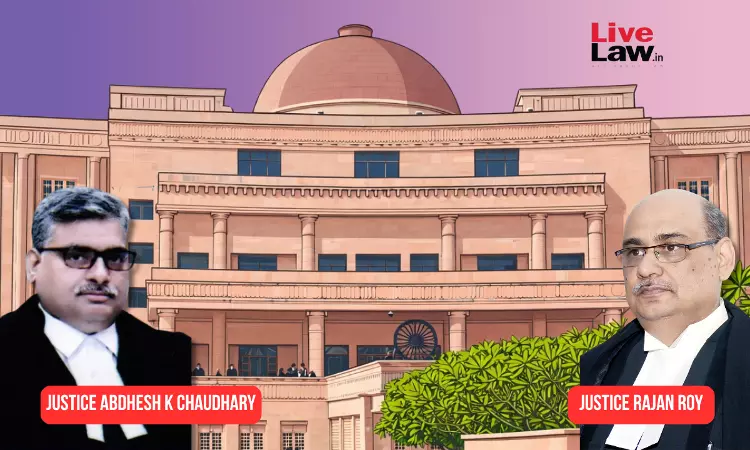
In a significant judgment, the Allahabad High Court recently upheld the constitutionality of certain provisions of the Uttar Pradesh State Legislature (Members' Emoluments and Pension) Act, 1980, which provide allowances, allied benefits and pensions for sitting legislators and pensions to former MLAs/MLCs. A bench of Justice Rajan Roy and Justice Abdhesh Kumar Chaudhary clarified...
This is a premium content
Available exclusively to
Our subscribers
Subscribe Premium 
INR 1099+GST
Your support helps us to bring you more content at
an affordable subscription scheme !!!
All payment options available
In a significant judgment, the Allahabad High Court recently upheld the constitutionality of certain provisions of the Uttar Pradesh State Legislature (Members' Emoluments and Pension) Act, 1980, which provide allowances, allied benefits and pensions for sitting legislators and pensions to former MLAs/MLCs.
A bench of Justice Rajan Roy and Justice Abdhesh Kumar Chaudhary clarified that there exists no Constitutional embargo upon the State Legislature in enacting a measure of social security for its 'Members', as well as 'former members'.
"In a democratic polity governed by the doctrine of separation of powers, such matters are best left to the wisdom and discretion of the Legislature, subject only to well-defined Constitutional limitations. In the absence of any violation of such limitations in the present case, any interference by this Court would be wholly unwarranted and contrary to settled principles of judicial restraint", the division bench observed while dismissing a PIL filed by the NGO Lok Prahari challenging the provisions of the 1980 Act.
Briefly put, it was the case of the petitioner that Sections 4, 5, 9, 13(3), 13(4), 15(2), 17-A, and Chapter VIII of the 1980 Act, which provided for certain 'allowances' and facilities to members, former members and their families/companions, as well as pension to former members and their spouses, are ultra vires the Constitution.
It was argued that the state legislature was not competent to legislate and/or provide for pensions and the grant of various facilities to its members/former members under the provisions of the Act of 1980.
The petitioner also submitted that the 1980 Act is in the teeth of Article 195 of the Constitution of India (corresponding to Entry 38 of List II of the Seventh Schedule), as the same relates only to 'Salaries and Allowances' of Members of a State Legislature and the word 'pension' is conspicuously missing from the said enabling provision.
Therefore, it was argued that once a person ceases to be a legislator, any continuing financial benefit is arbitrary and lacks Constitutional sanction.
The petitioner also pointed out that the benefits for sitting members have grown from a modest ₹200 salary plus limited allowances in 1952 to more than ₹1,25,000 per month in cash alone (excluding the value of free travel, house, medical, telephone, advances, etc.).
According to the petitioner, what began as a modest reimbursement for actual work has now been converted into a lifetime office of profit and perks for the member, his family, and even a companion.
It was strongly contended that the State Legislature has, in effect, made itself the judge in its own cause and has showered benefits upon itself and its former members in a manner that is manifestly arbitrary, discriminatory and contrary to the basic constitutional idea that a public office is meant for public service and not for personal gain.
Rejecting these contentions, the bench was of the view that the Legislature, in its wisdom, had considered it appropriate to provide post-tenure benefits as a measure of “social security and institutional continuity”.
It further noted that the pension, family pension, medical facilities and travel allowances are intended to recognize the nature of duties performed and to ensure that individuals who have held public office are not left without basic support.
The Court stressed that in the absence of any Constitutional prohibition, such a policy decision cannot be invalidated merely because an alternative view is possible.
Relying on the Supreme Court's verdict in Lok Prahari v. Union of India (2018), the High Court noted that the constitutional competence of the legislature to enact provisions concerning pensions and other benefits to former legislators had already been authoritatively recognized.
The Court also underscored that the nature, character, and quantum of the benefits so extended do not disclose any manifest arbitrariness to attract the prohibition embodied in Article 14 of the Constitution of India.
"This classification is clearly intelligible, as legislators discharge unique Constitutional functions involving lawmaking, representation, and governance oversight. The object sought to be achieved is to ensure effective functioning of legislative institutions and to provide reasonable post-tenure support. The nexus between classification and object is evident", the Court reasoned.
The bench also rejected the petitioner's attempt to equate legislators with government servants, finding it to be "legally untenable".
The bench underscored that the principle of equality does not mandate identical treatment of unequals.
"As reflected from the record, the Legislature has acted within permissible bounds of classification. Therefore, in our view the impugned provisions do not suffer from any kind of arbitrariness or discrimination", the bench noted.
The bench also opined that the determination of the quantum of benefits lies within the exclusive domain of legislative policy and it was not for the Judiciary to assume the role of a "second legislature" to reassess policy choices.
Therefore, upon a cumulative and holistic consideration of the pleadings on record, the applicable statutory framework and the binding judicial precedents governing the field, the HC arrived at the following settled conclusions.
- Firstly, the impugned legislation squarely falls within the legislative competence of the State Legislature and does not transgress any Constitutional limitation in that regard.
- Secondly, the extension of benefits to Ex-members represents a conscious and legitimate policy decision taken by the Legislature, which cannot be faulted merely on the ground of disagreement.
- Thirdly, the classification so made does not suffer from the vice of arbitrariness or hostile discrimination and therefore, withstands scrutiny under Article 14 of the Constitution of India. Fourthly, the determination of the quantum of benefits lies within the exclusive domain of the Legislature and does not ordinarily invite judicial review in the absence of manifest arbitrariness or unreasonableness.
- Fifthly, the issues sought to be raised in the present petition stand substantially concluded by binding precedents of the Hon'ble Supreme Court, leaving little scope for re-examination.
- Lastly, it is evident that the present petition is, in substance, an endeavour to re-agitate issues that have already attained finality
Therefore, finding no demonstrable constitutional infirmity, the writ petition was dismissed.
Case title - Lok Prahari Thru Gen. Secy. S.N. Shukla vs State of U.P. Thru Prin. Secy. Sansadiya Karya Vibhag and Ors. 2026 LiveLaw (AB) 281
Case Citation: 2026 LiveLaw (AB) 281
Tags

Sparsh Upadhyay
Sparsh Upadhyay is an Associate Editor with LiveLaw.

