



- Home
- /
- High Courts
- /
- Allahabad High Court
- /
- Western Ideas Influence Youth To...
Western Ideas Influence Youth To Get Into Live-Ins; Rape FIRs Filed After Relations Fail: Allahabad High Court Sets Aside Life Term
Sparsh Upadhyay
24 Jan 2026 8:15 PM IST
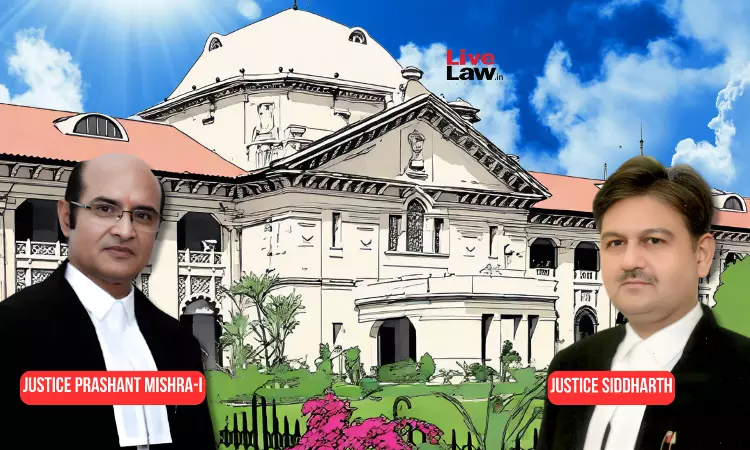
The Allahabad High Court recently observed that there is an increasing tendency among the youth to live together without the solemnization of marriage under the influence of Western ideas and the concept of live-in. It also noted that when such relations fail, FIRs are lodged. A bench of Justice Siddharth and Justice Prashant Mishra-I added that since the laws are in favour of women, men...
This is a premium content
Available exclusively to
Our subscribers
Subscribe Premium 
INR 1099+GST
Your support helps us to bring you more content at
an affordable subscription scheme !!!
All payment options available
The Allahabad High Court recently observed that there is an increasing tendency among the youth to live together without the solemnization of marriage under the influence of Western ideas and the concept of live-in. It also noted that when such relations fail, FIRs are lodged.
A bench of Justice Siddharth and Justice Prashant Mishra-I added that since the laws are in favour of women, men get convicted relying upon the laws which were made when the concept of live-in was nowhere in existence.
The bench made these observations while setting aside the judgment and order of conviction and sentence, including life imprisonment, awarded to appellant Chandresh in March 2024 by a Special Judge, Exclusive Court (POCSO Act), Maharajganj.
For context, the appellant had been convicted under Sections 363 (kidnapping), 366 (abduction for marriage), and 323 (voluntarily causing hurt) IPC, Section 6 POCSO Act (aggravated penetrative sexual assault) and Section 3(2)(V) of the SC/ST Act.
The prosecution's case was that the appellant enticed away the informant's minor daughter on the pretext of marriage and took her to Bangalore and later, he established a physical relationship with her.
The High Court, however, found that the victim was a major. It noted that the trial court had not properly considered the Ossification Test Report which proved her age to be about 20 years.
The bench also observed that the school records produced by the prosecution did not have any documentary basis as per the Juvenile Justice Rules. It further pointed out discrepancies regarding her age, as stated by the informant mother (PW-1).
It may be noted that in the FIR, the mother had stated her age as 18-1/2 years, but it appeared to the court that later, "on legal advice", she stated her age as 17 years in her court statement.
The Court also took into account the victim's (PW-2) conduct as it noted that she admitted in her testimony that she left her house willingly and travelled with the appellant by public transport to Gorakhpur and then to Bangalore.
The Bench pointed out that, despite travelling on public transport, including a government bus and a train, she did not raise any alarm at any point. She lived with the appellant in a locality full of other houses in Bangalore for six months and had a consenting physical relationship with him. She only contacted her family after the appellant dropped her back at Shikarpur Crossing on August 6, 2021.
Against this backdrop, the HC held that the conviction under Sections 363 and 366 IPC was absolutely unwarranted as per the Law as the victim was a major and had eloped of her own free will.
Regarding the charges of rape and the POCSO Act, the Bench observed thus:
"In case the victim was major the conviction of the appellant under Section-6 of the POCSO Act is also unjustified. The conviction under section-376 of I.P.C., is also not proper because the victim was major and had consenting relationship with appellant for six years."
The Court further set aside the conviction under Section 3(2)(V) of the SC/ST Act, noting it is not an independent provision and applies only where the accused is punished with imprisonment of 10 years or more under the IPC.
Additionally, the bench opined that the conviction under Section 323 IPC was unwarranted as the role of pushing the victim was assigned to the appellant's family members, not him.
Thus, concluding that the trial court had not properly considered the evidence on record, the High Court set aside the conviction and allowed convict's appeal.
Counsel for Appellant(s) : Dinesh Kumar Pandey, Manu Sharma, Randhir Jain, Sandeep Kumar Keshari
Counsel for Respondent(s) : Ashish Pandey, G.A.
Case title - Chandresh vs. State Of U.P. And 3 Others 2026 LiveLaw (AB) 41
Case citation: 2026 LiveLaw (AB) 41
Tags

Sparsh Upadhyay
Sparsh Upadhyay is an Associate Editor with LiveLaw.

