



- Home
- /
- High Courts
- /
- Allahabad High Court
- /
- Allahabad High Court Upholds 1999...
Allahabad High Court Upholds 1999 Quadruple Murder Conviction Based On Minor Sons' Testimony Against Mother, Her 'Lover'
Sparsh Upadhyay
8 April 2026 7:08 PM IST
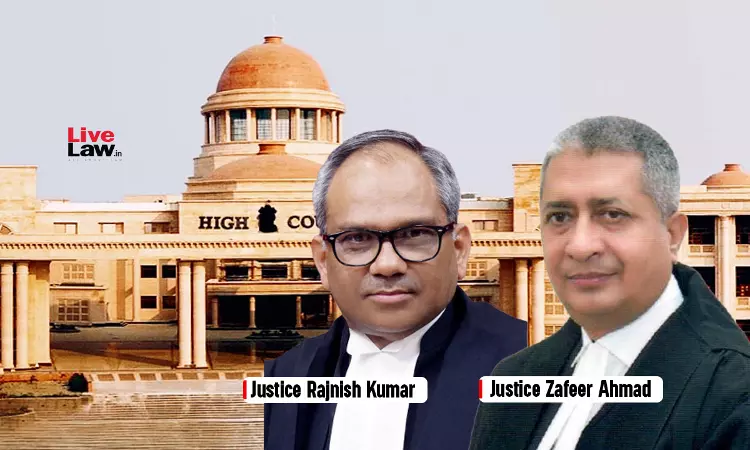
The Allahabad High Court on Tuesday upheld the conviction and life imprisonment sentence awarded to a man who had committed a brutal quadruple murder in 1999 along with her alleged lover (co-accused, now deceased). A bench of Justice Rajnish Kumar and Justice Zafeer Ahmad relied heavily on the 'natural' and 'consistent' testimony of 2 minor children who witnessed the crime and...
This is a premium content
Available exclusively to
Our subscribers
Subscribe Premium 
INR 1099+GST
Your support helps us to bring you more content at
an affordable subscription scheme !!!
All payment options available
The Allahabad High Court on Tuesday upheld the conviction and life imprisonment sentence awarded to a man who had committed a brutal quadruple murder in 1999 along with her alleged lover (co-accused, now deceased).
A bench of Justice Rajnish Kumar and Justice Zafeer Ahmad relied heavily on the 'natural' and 'consistent' testimony of 2 minor children who witnessed the crime and testified against their mother (co-accused, now deceased) and her alleged lover (appellant).
As per the prosecution's case, on the intervening night of May 18 & 19, 1999, the accused-wife (Gurdeep Kaur) lodged an FIR alleging that armed miscreants entered their house and killed her husband, his first wife, his mother and a guest.
During the investigation, the names of Kaur and her alleged lover/Tarsem Singh (appellant) came into the light and it was found that they had committed the murders upon learning that her husband had discovered the affair and planned to kill them.
The accused wife (Kaur) died during the trial and proceedings against her were abated. Appellant-Tarsem Singh was convicted by the trial court in 2008 and sentenced to undergo life imprisonment.
The trial court convicted the accused primarily relying upon the ocular version of the deceased's two minor sons, who were 15 and 12 years old at the time of their depositions. The children woke up to the sound of gunshots in the middle of the night.
In the Court, they had testified that they saw Tarsem Singh (appellant) armed with a single-barreled gun and their mother (Kaur) wielding a large knife.
The court noted that the minors provided a vivid and graphic account of the incident, narrating the sequence of events with minute, specific details.
Before the HC, the appellant's counsel argued that the children were tutored and their testimony was unreliable, being susceptible to tutoring and suffering from material inconsistencies.
It was also argued that there are material inconsistencies between the ocular and medical evidence, rendering the prosecution's version doubtful.
High Court's observations
The High Court noted that the description given by the minors regarding the incident, including the manner of entry, the weapons carried, and the sequence of assault, clearly reflected that they had actually witnessed the occurrence.
The Bench opined that their deposition was spontaneous and bore intrinsic truth. It added that the details they narrated could not have been fabricated without actual knowledge of the incident.
"The Trial Court has rightly observed that a child would not ordinarily falsely implicate his own mother in a serious offence such as murder, knowing fully well that such implication may lead to her punishment. This observation carries considerable weight", the bench remarked.
The High Court also found that the ocular testimony was in complete harmony with the medical evidence. The post-mortem reports confirmed that the victims suffered a combination of firearm wounds and deep incised stab wounds.
The Court also noted that the forensic analysis indicated the presence of lead and nitrite residues in the barrel of the recovered firearm, which clearly established that the weapon had been used.
The court noted that the recovery of incriminating articles and a weapon at the accused's instance, coupled with forensic evidence establishing the use of a firearm, provided further assurance to the prosecution's case.
The High Court ultimately dismissed the appeal and affirmed the trial court's judgment. The bench concluded that the evidence consistently pointed towards the guilt of the accused and that there was no reasonable ground for a conclusion consistent with his innocence.
Case title - Tarsem Singh vs State of UP 2026 LiveLaw (AB) 189
Case Citation: 2026 LiveLaw (AB) 189
Tags

Sparsh Upadhyay
Sparsh Upadhyay is an Associate Editor with LiveLaw.

