



- Home
- /
- High Courts
- /
- Allahabad High Court
- /
- Allahabad High Court Imposes ₹6.7...
Allahabad High Court Imposes ₹6.7 Lakh Costs On Man For Misusing RTI Act, Disturbing Court Proceedings
Sparsh Upadhyay
7 Aug 2026 8:53 AM IST
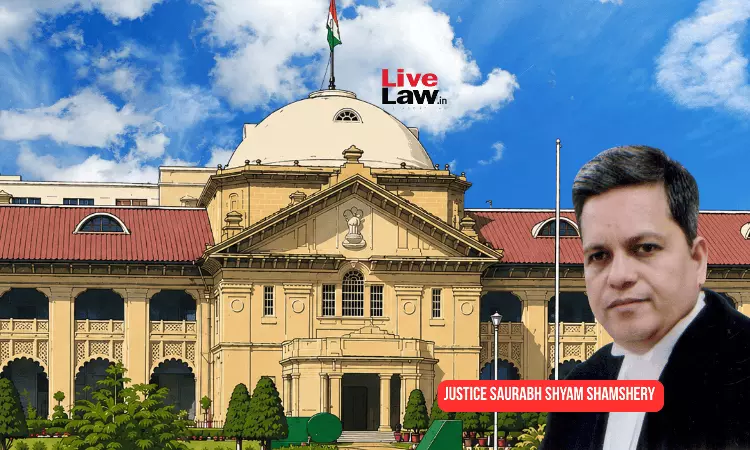
The Allahabad High Court recently imposed costs of ₹6.70 lakh on a party-in-person after finding that he had misused the Right to Information Act, 2005, by repeatedly filing vague RTI applications concerning the Court's internal functioning and also disturbed the judicial proceedings. A bench of Justice Saurabh Shyam Shamshery dismissed the writ petition challenging an order of the...
This is a premium content
Available exclusively to
Our subscribers
Subscribe Premium 
INR 1099+GST
Your support helps us to bring you more content at
an affordable subscription scheme !!!
All payment options available
The Allahabad High Court recently imposed costs of ₹6.70 lakh on a party-in-person after finding that he had misused the Right to Information Act, 2005, by repeatedly filing vague RTI applications concerning the Court's internal functioning and also disturbed the judicial proceedings.
A bench of Justice Saurabh Shyam Shamshery dismissed the writ petition challenging an order of the State Information Commission (SIC) and directed the petitioner to deposit the entire amount with the High Court Legal Service Committee within 4 weeks.
In its order, the bench also took note of recent incidents in the Supreme Court as well as in various High Courts where the petitioner-in-person had not followed the decorum of the Court and acted in a hasty and unruly manner.
Briefly put, the petitioner had challenged an order passed by the UP SIC, passed on July 28, 2023, contending that complete information sought by him under the RTI Act had not been supplied.
However, after examining the record, the High Court found that the requisite information had already been furnished through registered post and that the petitioner had neither denied receiving it nor placed the supplied information on record.
The Court held that there was no ground to interfere with the Commission's order.
While hearing the matter, the Court noted that the Registry had reported that the petitioner had filed numerous RTI applications seeking information relating to the Court proceedings in the pending writ petition itself.
Last month, the Court had restrained him from filing further RTI applications concerning the case, observing that such requests would cause hindrance in the administration of justice and directing that any pending RTI proceedings be kept in abeyance until disposal of the writ petition.
The Court recorded that despite this warning, the petitioner continued with his conduct.
Referring to a report submitted by the Deputy Registrar (RTI), the Court noted that the petitioner had filed 24 RTI applications between June 4 and July 17, 2026, seeking a wide range of internal administrative records, including office note sheets, routing sheets, action taken reports, file movement registers, backend server logs, Cisco Webex session logs, courtroom attendance registers, Bench Secretary log entries, roster-related records, reasons for supplementary cause lists and matters being marked "passed over", among other information having no concern with him.
The Court stated that such applications not only waste the time of employees of the Court but also cause hindrance in the administration of justice.
Concluding that the petitioner had misused the provisions of the RTI Act, the Court directed that all such RTI applications be consigned to record and imposed ₹5,000 costs for each of the 24 applications, amounting to ₹1.20 lakh.
The Bench further found that the petitioner had violated its earlier direction requiring him to appear physically before the Court by instead joining through video conferencing.
Justice Shamshery clarified that appearance through video conferencing is merely a mode of convenience and cannot be claimed as a fundamental right. The Court added that the permission to appear virtually lies within the Court's discretion and directions requiring personal appearance must be complied with absent any reasonable justification.
The Court also observed that the petitioner had filed an application seeking punishment of certain respondents for allegedly not filing a counter affidavit despite the record showing that the contesting respondent had already filed the affidavit and served a copy on the petitioner's counsel.
Describing that application as misconceived, based on incorrect statements and contrary to the record, the Court dismissed it with ₹50,000 costs.
The Court further noted that the petitioner had sent an email titled "Formal Written Declaration of Protest", which it found to be vague and contemptuous. Rejecting the petitioner's claim that a virtual hearing was his fundamental right, the Court clarified that video conferencing is only a convenience subject to judicial discretion.
The Court observed that although it had even offered to appoint an advocate to argue the matter if the petitioner appeared personally, he remained adamant and refused to do so despite having previously travelled to Allahabad on several occasions.
Finding that the petitioner had already received the information sought under the RTI Act and that no interference with the SIC's order was required, the High Court dismissed the writ petition.
It then imposed a further ₹5 lakh to discourage litigants from disturbing court proceedings and the administration of justice. Together with the earlier ₹50,000 and ₹1.20 lakh costs, the total costs came to ₹6.70 lakh, which the petitioner has to deposit with the High Court Legal Service Committee within 4 weeks.
Case Title - Vemula Venkata Vinay Babu Alias Vinay Vemula vs. State of U.P. and 3 others 2026 LiveLaw (AB) 542
Case Citation: 2026 LiveLaw (AB) 542
Tags

Sparsh Upadhyay
Sparsh Upadhyay is an Associate Editor with LiveLaw.

