



- Home
- /
- High Courts
- /
- Allahabad High Court
- /
- 'Tried To Play Tricks': Allahabad...
'Tried To Play Tricks': Allahabad High Court Criticises UP Govt Officials For Concealing Tender Cancellation From Contractor
Upasna Agrawal
16 Nov 2026 5:30 PM IST
The Allahabad High Court has criticised officials of the U.P. Minor Irrigation Department for cancelling a contractor's tender in a clandestine manner and keeping the order of cancellation from him until it surfaced in a counter affidavit filed in his own writ petition.Holding the cancellation arbitrary and violative of Article 14 of the Constitution of India, the Court directed refund of...
This is a premium content
Available exclusively to
Our subscribers
Subscribe Premium 
INR 1099+GST
Your support helps us to bring you more content at
an affordable subscription scheme !!!
All payment options available
The Allahabad High Court has criticised officials of the U.P. Minor Irrigation Department for cancelling a contractor's tender in a clandestine manner and keeping the order of cancellation from him until it surfaced in a counter affidavit filed in his own writ petition.
Holding the cancellation arbitrary and violative of Article 14 of the Constitution of India, the Court directed refund of his entire deposit of Rs. 5,54,000/- with interest at 8.5% per annum, imposed costs of Rs. 25,000/- on the State, and directed an inquiry against the erring officials to fix their liability for what the State must pay.
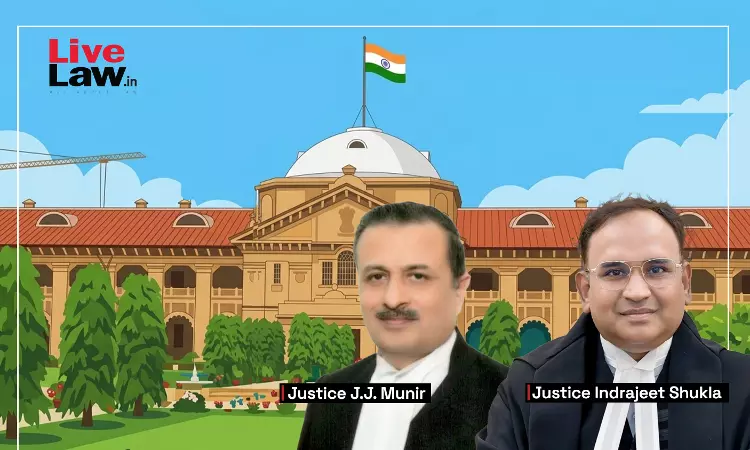
The bench of Justice J.J. Munir and Justice Indrajeet Shukla held
“In a clandestine manner, the decision to cancel the tender was taken and even before this Court the respondents have tried to play tricks, firstly by passing of the letter, which was communication amongst themselves, as sufficient information to the petitioner for making the shortfall of additional performance security good, without making over a copy thereof to the petitioner and even disclosing the fact as to whom the tender was allotted and work got done.”
Pursuant to an e-tender notice dated 14.08.2024 issued by the Executive Engineer, Laghudal Nahar Khand, Banda, the petitioner bid for Lot No. 5 and was declared L-1 by letter dated 22.10.2024, the work being valued at Rs. 28,83,996/-. Clause 7.0 of that letter required a security deposit of Rs. 2,88,400/-, being 10% of the contract value, and an additional performance security of Rs. 3,59,461/-, the letter putting the total at Rs. 5,47,861/-. He deposited Rs. 5,54,000/- on 23.10.2024 and asked the third respondent to execute a formal agreement.
No agreement followed. He wrote on 10.05.2025 and again on 23.07.2025 asking for a copy of the contract, then approached the second respondent on 04.09.2025, to no effect. A first writ petition was disposed of on 22.05.2026 with liberty to file a fresh representation for decision within a month.
Deciding that representation on 02.07.2026, the third respondent told him he had been required to deposit Rs. 6,47,861/- but had deposited only Rs. 5,54,000/-, and that his tender had been rejected on 10.12.2024 for the shortfall of Rs. 93,861/-. The petitioner pleaded that the letter of 22.10.2024 mentioned no such figure, that he had deposited more than was asked of him, that the shortfall was never put to him, and that the order of 10.12.2024 was passed ex parte, never served, and came to his knowledge only when the counter affidavit was filed.
The State relied on a Government Order dated 08.06.2012 requiring an additional performance guarantee on a graded scale where a contractor's rate fell below departmental rates, and said the petitioner's guarantee fell substantially short. It admitted that no written communication of the deficiency was issued, the petitioner being a regular contractor expected to make it good himself. A letter dated 05.12.2024 from a stenographer in the third respondent's own office, addressed to the third respondent, was produced to show he had been told orally.
The Court observed that the letter nowhere stated the date on which the petitioner was informed, was addressed neither to him nor copied to him, and carried no letter number.
“The attending circumstances clearly demonstrate that this letter was engineered after the filing of this writ petition, when we issued an interim mandamus to clarify whether the shortfall/deficiency in performance security/guarantee was ever communicated to the petitioner.”
“Any attempt to create or bring on record a document with an anterior date, if established, would amount to obstruction in the administration of justice, as no party can be permitted to manufacture or antedate evidence to support its case.”
Refraining for the present from a roving inquiry into how the letter came to be prepared, the Court noted that a supplementary counter affidavit filed on 19.09.2026 categorically admitted that no written communication of the shortfall had ever been made. It found that the respondents, State functionaries of whom fairness and non-arbitrariness is legitimately expected, had exhibited complete bias, and condemned their conduct in cancelling the tender and then re-inviting it and having the work completed without disclosing any material particulars to the Court.
The Court further found that the Government Order dated 08.06.2012, the sole basis for demanding the additional performance security, had been superseded by a Government Order dated 09.08.2024, in force when the tender notice issued on 14.08.2024, which specifically provided that no additional performance security at the rate of 10% was to be taken. There was therefore no occasion to cancel the tender at all, and the arbitrariness, the Court held, was writ large.
The Court relied on its own decision in Udai Pal Singh v. State of UP, where cancelling a contract or auction without hearing the highest bidder who has deposited the required amount was held arbitrary, perverse and violative of natural justice, and on State of U.P. v. Sudhir Kumar Singh, where the Supreme Court reiterated that a sustainable plea of breach of natural justice against the State sounds in constitutional law as arbitrary State action.
Holding that forfeiture of the earnest money had no sanction of law, the Court observed,
“If State respondents are allowed to retain the amount deposited as earnest money, as well as the additional performance security or any other amount without any sanction of law, as the Government order dated 8.06.2012 under reference, itself has been superseded, it would entail nothing less than unjust enrichment of the State at the cost of citizens.”
Since the respondents' own stand was that the work had been re-tendered and completed, the prayer for execution of the contract was rendered otiose and a writ of certiorari would issue in futility. Referring to Nur Islam v. The State of Assam, the Court held that it could always mould relief under Article 226 of the Constitution of India to advance substantial justice, and directed restitution of the amount unlawfully withheld. Interest was awarded under Section 4(2)(a) of the Interest Act, 1978, at the maximum rate the Court took a scheduled bank to be paying on fixed deposits.
Accordingly, the writ petition was allowed with costs of Rs. 25,000/-. A writ of mandamus was issued commanding the third respondent to refund the entire amount deposited with interest at 8.5% per annum, payable with the costs within three weeks, and a copy of the order was directed to be placed before the Principal Secretary, Minor Irrigation Department.
Tags


