



- Home
- /
- High Courts
- /
- Allahabad High Court
- /
- RTI Applicant Can't Directly Seek...
RTI Applicant Can't Directly Seek CCTV Footage Covered By Section 8(1)(g), May Approach Court/Commission: Allahabad High Court
Upasna Agrawal
8 Sept 2026 11:00 AM IST
The Allahabad High Court has held that CCTV footage sought under the Right to Information Act, 2005 cannot be supplied directly to the applicant when it is covered by the exception contained in Section 8(1)(g) of the Act. It held that a Court or Commission has the power to call for such footage and to direct its preservation, and may do so once the applicant files a complaint before...
This is a premium content
Available exclusively to
Our subscribers
Subscribe Premium 
INR 1099+GST
Your support helps us to bring you more content at
an affordable subscription scheme !!!
All payment options available
The Allahabad High Court has held that CCTV footage sought under the Right to Information Act, 2005 cannot be supplied directly to the applicant when it is covered by the exception contained in Section 8(1)(g) of the Act.
It held that a Court or Commission has the power to call for such footage and to direct its preservation, and may do so once the applicant files a complaint before the appropriate forum.
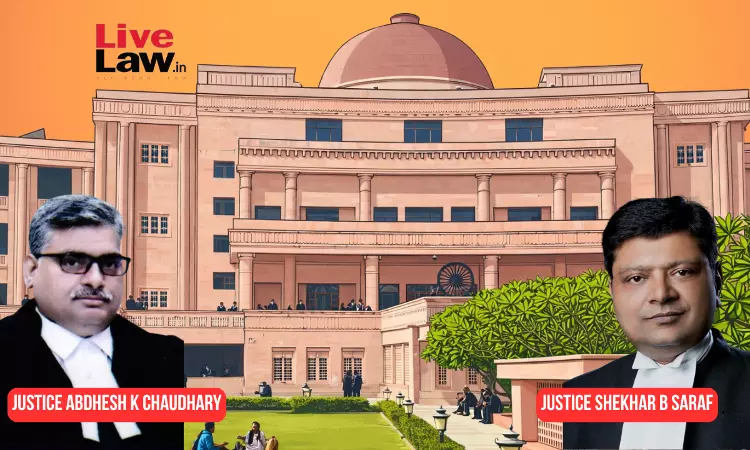
The bench of Justice Shekhar B. Saraf and Justice Abdhesh Kumar Chaudhary held,
“In our view, the petitioner has, till date, not filed any complaint before any Court or Commission and has simpliciter sought the CCTV footage. In our view, the said footage cannot be provided to the petitioner directly, as the same is covered by the exception contained in Section 8(1)(g) of the Act, 2005.”
Petitioner approached the High Court under Article 226 of the Constitution of India seeking quashing of an order dated 14th May 2026 passed by the State Information Commissioner, Uttar Pradesh State Information Commission, Lucknow. He sought a mandamus directing that complete information be furnished to him on his RTI application, that the maximum penalty of Rs. 25,000 be imposed on the fourth respondent under Section 20 of the Right to Information Act, 2005, and that he be compensated under Section 19(8)(b) of the Act for the harassment he had suffered.
Counsel appearing for the State Information Commission submitted that the CCTV footage contained sensitive information and fell within the exceptions contemplated under Section 8(1)(g) of the Act. It was submitted that the footage could be produced before the Court or the Commission if so directed, but could not be handed to the applicant directly.
Counsel for the petitioner relied on the decision of the Supreme Court in Paramvir Singh Saini v. Baljit Singh and others to argue that preservation of CCTV footage was a right of the petitioner. The paragraphs relied upon dealt with complaints of force being used at police stations, the summoning of camera footage by a Commission or Court for safe keeping, and directions that such footage be preserved for a minimum period of six months.
On a perusal of those paragraphs, the Court observed that a Court or Commission had the power to call for CCTV footage and to direct that it be preserved.
“In the event that the petitioner files a complaint before the appropriate Forum/Court, the said Forum/Court may very well direct preservation of the CCTV footage, as well as call for the actual footage for the purpose of verifying the complaint made by the petitioner.”
With the above directions, the writ petition was disposed of.
Case Title: Shobhit Kashayap vs. State Of U.P. Thru. Addl. Prin. Secy. Administrative Reform Deptt. Lko. And 6 Others 2026 LiveLaw (AB) 671
Case Citation: 2026 LiveLaw (AB) 671
Tags


