



Delay In Deciding Govt Servant's Plea Against Deemed Suspension After Release From Custody Indicates 'Malice In Law': Allahabad High Court
Upasna Agrawal
5 Oct 2026 12:35 PM IST
The Allahabad High Court has held that Rule 4(3)(b) of the U.P. Government Servant (Discipline and Appeal) Rules, 1999 casts a mandatory obligation on the competent authority to take an express and conscious decision on the representation made by a Government servant against his deemed suspension after his release from custody.
It held that deemed suspension does not lapse on its own upon release, but its continuance beyond that date must rest on an express order.
Rule 4(3)(a) of the Rules, 1999 provides that a Government servant detained in custody, whether on a criminal charge or otherwise, for more than forty-eight hours shall be deemed to have been placed under suspension from the date of his detention.
Rule 4(3)(b) requires him, after release, to inform the competent authority in writing of the detention and permits him to represent against the deemed suspension, and obliges the authority to consider the representation and pass an appropriate order continuing the deemed suspension from the date of release, or revoking or modifying it.


Rule 4(8) provides that a suspension so ordered or deemed to have been ordered remains in force until modified or revoked by the competent authority.
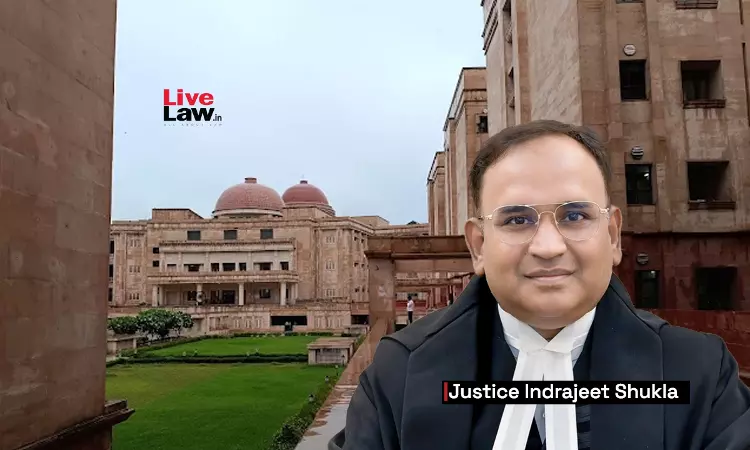
Justice Indrajeet Shukla held,
“The legislative intent underlying Rule 4(3)(b) is thus clear: the requirement of an express decision for continuance of deemed suspension is mandatory. Any other interpretation would render the latter part of the provision otiose and meaningless, which is a construction that ought to be avoided.”
Petitioner, an allopathic doctor, was appointed in 2007 and joined as Medical Officer at the Primary Health Centre, Mauranipur, District Jhansi. Two criminal cases were registered against him, Case Crime No. 118 of 2021 under Sections 354, 504 and 376 IPC and Case Crime No. 69 of 2022 under Sections 306 and 506 IPC, both at Police Station Gursarai, District Jhansi. He remained in custody from 29.06.2022 to 20.10.2022 and was placed under deemed suspension by order dated 10.10.2022, with retrospective effect from 29.06.2022, under Rule 4(3)(a) of the Rules, 1999.
A day after his release, on 21.10.2022, petitioner applied to the Chief Medical Officer, Jhansi, seeking revocation of the deemed suspension and permission to resume duties. The application was referred to the Director, Medical Health, for guidance and no decision was taken on it. Petitioner was eventually driven to file Writ-A No. 3840 of 2024, which was disposed of on 17th May, 2024 with a direction to the competent authority to consider the application in accordance with law and the Rules, 1999.
By order dated 12th July, 2024, the Under Secretary, Medical, Health and Family Welfare, U.P. revoked the deemed suspension and permitted petitioner to resume duties, but stipulated that the question of treating the period of suspension as period spent in service, and of salary for that period, would be taken up after the criminal cases were decided. That order was challenged before the High Court.
The Court observed,
“Suspension is forbidding an employee from working, which is a creature of rules. Service jurisprudence does not contemplate indefinite suspension of a Government servant, even where the Rules, 1999 prescribe no specific outer limit for its continuance.”
Noting that no disciplinary proceedings had been initiated and that the presumption of innocence continues to operate unless a person is held guilty, the Court held that the deemed suspension had run for almost two years on account of the indifference of the State authorities.
“The initial inaction, with the flux of time, transforms into illegal action which can hardly be countenanced in law.”
The Court distinguished the Division Bench decision in Amrit Lal Verma v. Chairman-Cum-Managing Director, Allahabad Bank and another, where a conscious decision of the competent authority to keep an employee under suspension till the decision in criminal proceedings was upheld. Such a course, it held, is well within the realm of the disciplinary authority under the Rules, 1999, but was not the course adopted here; the authority instead opted for revocation, and did so belatedly.
The Court also held that the decision of the Supreme Court in Union of India v. Rajiv Kumar, which held that deemed suspension may continue even after release on bail without any separate or express order. The CCA Rules, 1965 considered there contain no provision corresponding to Rule 4(3)(b), which alone confers the right of representation and casts the obligation to decide it.
Finding that neither the impugned order nor the counter affidavit offered any justification for the delay from 21.10.2022 to 12.07.2024, the Court held that the inaction attracted the doctrine of malice in law, which, unlike malice in fact, needs no proof of personal ill-will and may be inferred where a public authority acts without lawful justification or in disregard of the statutory scheme.
“The authorities could wake up from slumber only when the order by this Court was passed. Thus, the authority competent, in terms of Rule 4(3)(b) of the Rules, 1999, defied his duties in not considering the representation so submitted on 21.10.2022 by either continuing the deemed suspension or revoking/modifying it till 12th July, 2024.”
On whether the requirement of an express decision is mandatory or directory, the Court relied on Lifestyle Equities C.V. and another v. Amazon Technologies Inc, S.P. Chandrakar v. State of Chhattisgarh & Ors and the Constitution Bench decision in Raza Buland Sugar Co. Ltd. v. Municipal Board, Rampur for the principle that the answer turns on the intention of the legislature, gathered from the nature and design of the statute and the consequences of either construction.
It held that Rule 4(3)(b) was introduced to ensure that deemed suspension does not continue indefinitely after release without a conscious decision, and that treating the requirement as directory would render the latter part of the Rule nugatory.
“the deemed suspension remains in force until it is modified or revoked by the competent authority. However, its continuance beyond the date of release from custody must be founded upon an express order. Though it does not automatically ceases.”
“If competent authority is allowed to sit tight upon representation made under Rule 4(3)(b) of 1999 Rules by delinquent employee, same would be attaching premium to inaction of competent authority/appointing authority.”
Holding the impugned order to be bereft of reasons and not in satisfaction of the mandate of Rule 4(3)(b), the Court set it aside and directed the Under Secretary, Medical, Health and Family Welfare, U.P., Civil Secretariat, Lucknow to reconsider afresh the payment of salary for the period of deemed suspension, excluding the period of detention, and to pass a reasoned and speaking order within two months from the date of production of a certified copy of the order.
Petitioner's entitlement to salary for the period between his release and the revocation of suspension, the Court held, would be determined on that fresh decision. It was for the competent authority, and not the High Court in the first instance, to examine whether continuance of the deemed suspension for the intervening period, merely on the ground of pendency of criminal proceedings, was justified.


