



- Home
- /
- High Courts
- /
- Allahabad High Court
- /
- Custodial Death | Prisoner Suicide...
Custodial Death | Prisoner Suicide Attracts Absolute State Liability: Allahabad High Court Awards ₹10 Lakh Compensation
Sparsh Upadhyay
20 Feb 2026 6:34 PM IST
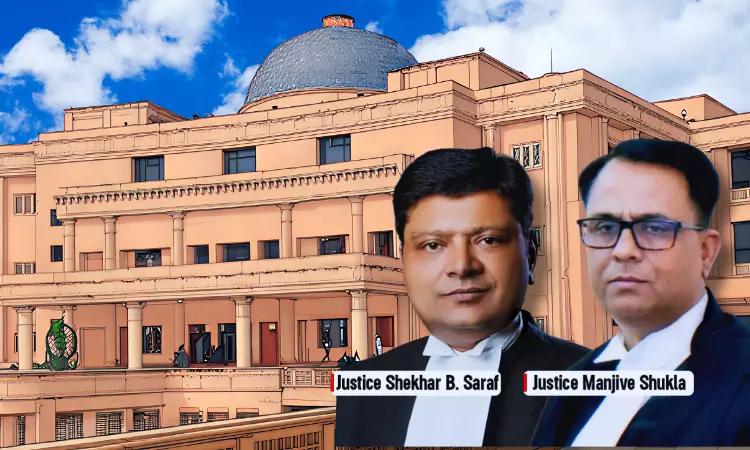
The Allahabad High Court (Lucknow Bench) recently held that the State is absolutely liable for the unnatural death of a prisoner in its custody, even if the death is a patently unnatural suicide. A Bench of Justice Shekhar B Saraf and Justice Manjive Shukla ruled that the right to life and human dignity guaranteed under Article 21 of the Constitution of India is an intrinsic,...
This is a premium content
Available exclusively to
Our subscribers
Subscribe Premium 
INR 1099+GST
Your support helps us to bring you more content at
an affordable subscription scheme !!!
All payment options available
The Allahabad High Court (Lucknow Bench) recently held that the State is absolutely liable for the unnatural death of a prisoner in its custody, even if the death is a patently unnatural suicide.
A Bench of Justice Shekhar B Saraf and Justice Manjive Shukla ruled that the right to life and human dignity guaranteed under Article 21 of the Constitution of India is an intrinsic, inviolable and omnipresent right extended even to an individual who is illegally arrested and detained by the State.
The bench thus allowed a writ petition filed by one Prema Devi, seeking compensation for the unnatural death of her minor son in District Prison Pilibhit.
While directing the respondents to pay compensation of Rupees Ten Lacs to the legal heirs of the deceased within a period of three weeks, the bench also asked the UP Government to frame guidelines fixing compensation.
It added that the government must adopt relevant and cogent parameters for awarding compensation in custodial death cases, akin to the multiplier method based on age, income, and dependents, as available under the Motor Vehicles Act, 1988.
Briefly put, the petitioner's son, an undertrial in a POCSO case, had died by suicide on February 20, 2024. He was found hanging from the ventilator of a prison toilet.
The National Human Rights Commission (NHRC) earlier recommended a compensation of ₹3,00,000/-. However, due to the inaction of the authorities, the same was not paid and hence, the petitioner approached the High Court.
It was categorically claimed that the deceased was subjected to torture by the police personnel due to non-fulfilment of illegal money demands for relief from such torture, which ultimately resulted in his unnatural death.
On the other hand, the state argued that the deceased died by hanging himself. It was contended that the incident was an act of suicide and there was no material on record to suggest any negligence, misconduct or involvement on the part of the respondent authorities.
It was further submitted that once the identification process is complete and the requisite budgetary allocation is received from the Government, the approved compensation shall be released in accordance with the law.
The bench, however, rejected the State's endeavour to evade responsibility as it observed that custodial death depicts one of the most serious challenges to the protection of fundamental rights within the Indian Justice System.
Justice Saraf, writing for the bench, stated that it is 'flabbergasting' to note that there is no express mandate in our Indian Constitution for the grant of compensation for unlawful detention or custodial death.
The court added that if the death in custody occurs naturally, then the State cannot be faulted with it, but if the death is caused unnaturally, then the State is absolutely liable for its act/omission which resulted in the death of an individual.
The Allahabad HC also relied on the Supreme Court's landmark judgment in Rudul Sah v. State of Bihar, wherein it was observed that refusing to pass an order of compensation for the deprivation of fundamental rights would be doing mere lip-service to the right to liberty.
The Court also took into account the Supreme Court's rulings in Nilabati Behera v. State of Orissa and D.K. Basu v. State of West Bengal, wherein it was noted that monetary amends are an appropriate and effective remedy based on the principle of strict liability, to which the defence of sovereign immunity is unavailable.
Notably, while deciding the quantum of compensation, the Court examined a Meghalaya High Court judgment (Suo Motu Custodial Violence) which categorised compensation based on the victim's age.
However, the Division Bench refused to follow it as an authoritative precedent, observing that the said judgment had been stayed by the Supreme Court in The State of Meghalaya Vs. Killing Jana.
Against this backdrop, the Court noted from the undisputed records that the deceased was in the custody of the State and had committed suicide.
The bench said that while there may have been circumstances surrounding him which drove him to take such an extreme step, the State was, however, absolutely liable for the unnatural death of the deceased.
"…an amplified duty is cast upon the State for the death of a prisoner in custody of police without any exception. No State can shirk its duties and responsibilities for providing better facilities to prisoners. Accordingly the case of custodial death is made out in the present case", the bench remarked.
In view of this, the Court concluded that it was a clear infringement of constitutional protections, warranting intervention under Article 226 of the Constitution
Consequently, the Court allowed the writ petition and directed the State to pay ₹10,00,000 as compensation to the legal heirs within three weeks.
Going a step further to institute systemic reform, the Court mandated four preliminary steps to be strictly followed in all future cases of custodial death:
A. The family members of the deceased must be informed immediately by the jail authoritiees about the death of the deceased. A panchnama with independent panchas shall be prepared immediately on the spot in accordance with Section 174 CrPC (corresponding Section 194 BNSS) without any delay.
B. A post mortem examination must be conducted promptly mentioning the cause of death without any delay. The video recording of the post mortem examination in case of custodial death of the deceased must be mandatorily carried out.
C. An inquest report by the judicial magistrate concerned must be submitted in accordance with Section 176 CrPC (corresponding Section 196 BNSS) immediately after considering all the witnesses, post mortem report and panchnama.
D. The monetary compensation in order to provide solace to the next of kin of the deceased in custody must be paid as fixed by National Human Rights Commission after considering the peculiar facts and circumstances of the individual custodial death case
Case title - Prema Devi vs. State of U.P. Thru. its Prin. Secy. Home Deptt. Lko. and 5 others 2026 LiveLaw (AB) 91
Case citation : 2026 LiveLaw (AB) 91
Tags

Sparsh Upadhyay
Sparsh Upadhyay is an Associate Editor with LiveLaw.

