



- Home
- /
- High Courts
- /
- Allahabad High Court
- /
- Eligibility Certificate Can't Be...
Eligibility Certificate Can't Be Filed After Cut-Off Date Where Recruitment Notice Carries Negative Covenant: Allahabad High Court
Upasna Agrawal
8 Sept 2026 3:15 PM IST
The Allahabad High Court has held that where a recruitment advertisement, or a notice forming part of it, contains a negative covenant fixing a cut-off date for uploading documents and stipulating that a defaulting candidate loses the right to be shortlisted, an eligibility certificate cannot be filed after that date. It held that the distinction between existence of eligibility and proof...
This is a premium content
Available exclusively to
Our subscribers
Subscribe Premium 
INR 1099+GST
Your support helps us to bring you more content at
an affordable subscription scheme !!!
All payment options available
The Allahabad High Court has held that where a recruitment advertisement, or a notice forming part of it, contains a negative covenant fixing a cut-off date for uploading documents and stipulating that a defaulting candidate loses the right to be shortlisted, an eligibility certificate cannot be filed after that date.
It held that the distinction between existence of eligibility and proof of eligibility does not assist the candidate in such a case, and no extension or relaxation of time is permissible.
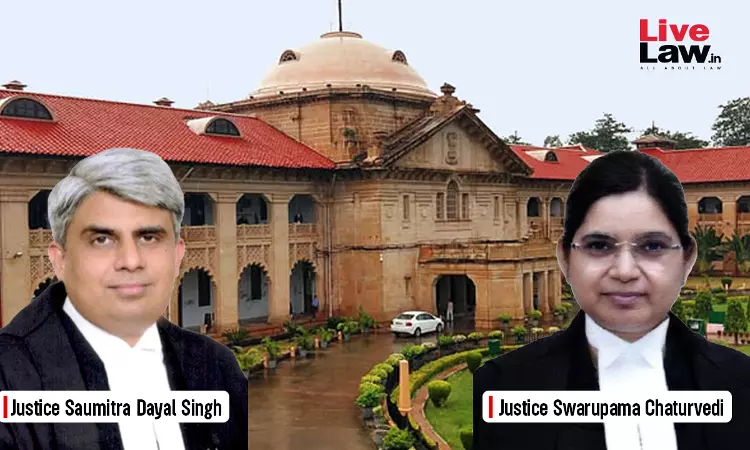
The bench of Justice Saumitra Dayal Singh and Justice Swarupama Chaturvedi held,
“… between cases where a negative covenant exists, with pre-stipulated consequences- making it mandatory to submit eligibility document/s, before the cut-off date, and other cases where, in absence of such negative covenant, it may remain open to candidates to submit eligibility documents subsequently, i.e., after the date of submission of the application form but certainly before completion of the selection.”
It held, “Since where a negative covenant exists, time extension or relaxation of time is impermissible.”
The appellant applied for the post of Instructor in the Trade of Cosmetology under Advertisement No. 2-Examination/2022 dated 06.01.2022, issued by the UP Subordinate Services Selection Commission. Eligibility required three years of experience in Basic Cosmetology, earned only after completing the course.
The examination was delayed. On 03.02.2023, the Commission issued a notice under the same advertisement requiring all documents to be uploaded by midnight of 28.02.2023, with multiple experience certificates merged into one PDF. A candidate who did not comply would not be eligible for shortlisting, and no further opportunity would be given.
The appellant, who earned her qualification on 08.01.2015, uploaded a single certificate dated 19.09.2017 covering 01.09.2014 to 31.08.2017, which established two years and seven months of countable experience. She cleared the written examination, passed document verification without objection and was provisionally selected. When the five-month shortfall surfaced she produced a second certificate dated 10.01.2022 from the same institution, which the Commission refused as it had not been uploaded with the first. The writ petition against that refusal was dismissed on 26.11.2025.
In the intra-court appeal, her counsel argued that the Commission had never doubted that she held the experience. It was urged that the omission was inadvertent and that the second certificate predated the last date for applications.
The Commission relied on Divya v. Union of India to submit that where a negative covenant exists, no deficiency can be cured later.
The Court observed that although the original advertisement carried no negative covenant, the notice of 03.02.2023 did, and the appellant had not challenged it. The notice therefore had to be read as part of the advertisement, held the Court.
On the precedents pressed by the appellant, the Court noted that in Divya a negative covenant existed, and the Supreme Court held there was no room in law to allow later filing, such a clause being mandatory and not directory.
“In the present set of facts- we clearly recognize the first point of distinction arises in law. It has to be applied by us. Since where a negative covenant exists, time extension or relaxation of time is impermissible.”
The Court held that filing the certificate by 28.02.2023 was mandatory, and by not filing the second certificate the appellant lost her right to be shortlisted and selected. Rejecting the argument that the objection had come belatedly, the Court held that the selection was only provisional and that once eligibility does not exist, no equitable jurisdiction survives.
Leaving open whether discretionary relief may still be available where the deficiency is occasioned by a mistake of the third party issuing the certificate, the Court found no error in the Single Judge's conclusion and dismissed the appeal.
Case Title: Neha Rao v. State Of Uttar Pradesh And 2 Others 2026 LiveLaw (AB) 674
Case Citation: 2026 LiveLaw (AB) 674
Counsel for Appellant :- Siddharth Khare
Counsel for Respondent :- Siddharth Singhal, Tej Bhanu Pandey
Tags


