



- Home
- /
- High Courts
- /
- Allahabad High Court
- /
- From Feudal Flexing To Social Media...
From Feudal Flexing To Social Media Display: Allahabad High Court Takes Aim At UP's Gun Culture, Summons Arms Licence Database
Sparsh Upadhyay
3 April 2026 12:59 PM IST
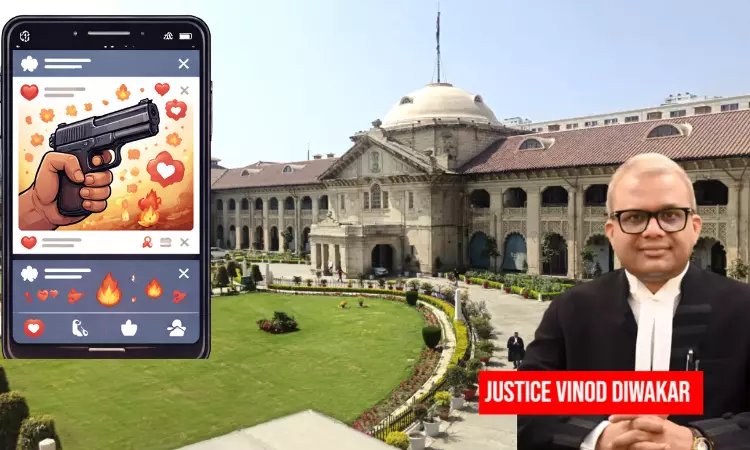
In a significant crackdown on the systemic misuse of firearms to project 'power' and 'influence' in the society, the Allahabad High Court recently sought comprehensive data on arms licences issued in Uttar Pradesh as it took a strict note of a growing "gun culture". Noting that unregulated access to firearms poses a serious threat to society, a bench of Justice Vinod Diwakar observed...
This is a premium content
Available exclusively to
Our subscribers
Subscribe Premium 
INR 1099+GST
Your support helps us to bring you more content at
an affordable subscription scheme !!!
All payment options available
In a significant crackdown on the systemic misuse of firearms to project 'power' and 'influence' in the society, the Allahabad High Court recently sought comprehensive data on arms licences issued in Uttar Pradesh as it took a strict note of a growing "gun culture".
Noting that unregulated access to firearms poses a serious threat to society, a bench of Justice Vinod Diwakar observed that individuals with political ambitions or questionable backgrounds are using licensed weapons to "project authority, cultivate a dominant image, and indirectly intimidate others, thereby fostering an atmosphere of fear".
The bench specifically took exception to the display of firearms on social media platforms, including Instagram reels. The Court observed that this behaviour is used to seek attention, gain social validation, and reinforce identity through the amplification of gun culture.
"Such misuse contributes to a culture of fear rather than adherence to the rule of law. It undermines public confidence in legal institutions and normalizes violence within society," the bench remarked.
"It reflects the persistence of feudal power structures, the inadequate enforcement of norms governing the public display of firearms, and the influence of a media-driven peer-validation culture. The interplay of power, perception, and social media further exacerbates the issue", the Court added..
Against this backdrop, the Court has directed the Additional Chief Secretary (Home) to explain whether an Arms Licence Database has been prepared by the UP Government.
The state has also been asked to clarify if any formal "arms policy" has been formulated to guide the District Magistrates in making reasoned decisions regarding the grant, refusal or renewal of licences.
Furthermore, the Court sought details on whether Rule 16 of the Arms Rules, 2016, which mandates updating approved transactions on the NDAL system, is being complied with.
The bench also took a stern view of the fact that multiple members of a single family, such as a husband, wife, son, daughter, and daughter-in-law, hold individual arms licences and sometimes possess multiple weapons and stressed that this practice requires serious judicial scrutiny.
Accordingly, all the DMs in the state have been directed to provide district-wise and police station-wise details of firearms possessed by individuals. The authorities must explicitly indicate cases where family members hold separate licences.
Furthermore, the Court ordered the preparation of a separate category of arms licence holders who have a criminal history of two or more cases.
All Superintendents of Police, Senior Superintendents of Police and Commissioners of Police across all 75 districts must furnish these details by way of a personal affidavit.
The Court has also sought data on applications pending consideration before District Magistrates and appeals pending before Appellate Authorities.
Importantly, in a word of caution, the bench also reminded the District Magistrates and Appellate Authorities to exercise discretionary powers under the Arms Act, 1959, strictly within the confines of the procedure established by law.
"It is pertinent to note that unregulated discretion creates scope for corruption and misuse of authority. In a parliamentary democracy, unchecked discretionary power within institutions poses a threat to the rule of law and to the procedure established by law", the bench stressed.
These significant observations and directions were made by the HC while dealing with a writ petition filed by Jai Shankar Alias Bairistar, a jeweller, whose application for an arms licence was rejected by the District Magistrate of Bhadohi after an unexplained delay of almost 4 years.
Despite a favourable police report submitted in September 2018, his application was dismissed in November 2022. A subsequent appeal preferred by him was also rejected on November 20, 2025, by the Additional Commissioner, Vindhyachal Division, Mirzapur, without assigning reasoned findings.
The Court specifically noted that while the DM took four years to decide his application, the appellate order was conspicuously silent on the issue of limitation and did not reflect due consideration of the statutory mandate requiring reasons to be recorded.
Hence, the bench has sought a counter-affidavit from the DM, specifically addressing the reasons for the inordinate delay and the legal or administrative impediments to compliance with Rule 13 of the Arms Rule, 2016.
The Commissioner/Appellate Authority has also been directed to file a personal affidavit justifying the circumstances under which the appeal, filed after considerable delay, was entertained without recording any finding on limitation or condonation of delay and why it was not decided in a time-bound manner.
The matter will be heard next on April 28.

Sparsh Upadhyay
Sparsh Upadhyay is an Associate Editor with LiveLaw.

