



- Home
- /
- High Courts
- /
- Allahabad High Court
- /
- FSL Reports Must Disclose...
FSL Reports Must Disclose Scientific Data, Reasons : Allahabad High Court Recommends Forensic Reforms, Acquits Murder Accused
Sparsh Upadhyay
20 July 2026 3:38 PM IST
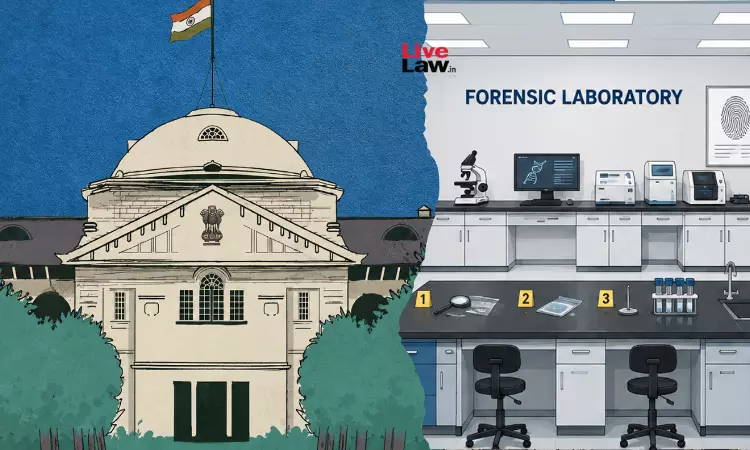
The Allahabad High Court has held that Forensic Science Laboratory (FSL) reports must disclose specific reasons and scientific data. It added that a report merely recording a conclusion without detailing the tests conducted or the criteria used is inadmissible in evidence. A bench of Justice Ajay Bhanot and Justice Divesh Chandra Samant made these significant observations while recommending...
This is a premium content
Available exclusively to
Our subscribers
Subscribe Premium 
INR 1099+GST
Your support helps us to bring you more content at
an affordable subscription scheme !!!
All payment options available
The Allahabad High Court has held that Forensic Science Laboratory (FSL) reports must disclose specific reasons and scientific data. It added that a report merely recording a conclusion without detailing the tests conducted or the criteria used is inadmissible in evidence.
A bench of Justice Ajay Bhanot and Justice Divesh Chandra Samant made these significant observations while recommending a slew of forensic reforms to strengthen the criminal justice system.
The directives were issued while 'honourably' acquitting two individuals, a woman and her co-accused, who were sentenced to life imprisonment by a trial court for allegedly murdering her husband with poison in 2013.
Case in brief
Briefly put, it was the prosecution's case that Accused no. 1 (Gyanmati @ Sangathiya), wife of deceased (Jagdish @ Jagdhar) had developed illicit relations with co-caccused (Ashok Kumar) and on July 20, 2013, they administered poison (Aluminium Phosphide) to the deceased by mixing it in his meal..
Challenging their convictions and life terms, the counsels for the accused argued that the alleged administration of poison by the appellants to the deceased had not been proved.
It was also contended that there was a delay in testing the viscera sample, and the prosecution failed to establish that the viscera were preserved under safe conditions and were fit for testing when evaluated.
Lastly, it was argued that the FSL report, which depicts poison in the Viscera sample, is not supported by reasons and hence could not be read in evidence against the appellant.
The prosecution, on the other hand, heavily relied on the FSL report which concluded that Aluminium Phosphide was present in the deceased's viscera sample.
High Court's observations
Examining the FSL report, the bench noted that it simply recorded its conclusion (ipse dixit) without disclosing the tests conducted or the materials that guided the expert.
The bench stated that FSL/Expert reports are made admissible under Section 45 of the Evidence Act and once it is upheld by a Court, the same becomes the report and the opinion of the Court.
The bench further stated that the tests of admissibility of an expert report are the credibility and the standing of the expert in the field, the reasons on which the expert bases his conclusions.
"The opinion of the expert which is bereft of reasons or does not disclose the basic scientific criteria which has guided the expert to reach the conclusion is of no avail," the Court held.
In this regard, the bench also referred to the Supreme Court's judgments in the cases of Madan Gopal Kakkar Vs. Naval Dubey 1992 and Ramesh Chandra Agrawal Vs. Regency Hospital Ltd and Others 2009 holding that the expert witness is expected to put before the Court all materials, including the data, that induced him to reach the conclusion.
Against this backdrop, in the absence of such relevant data, the expert report was found to be inadmissible in evidence, and the opinion rendered was discarded.
The Court further highlighted investigative failures regarding the viscera sample. The sample was preserved on July 21, 2013, received by the FSL in August 2013, but was not examined until over a year later in September 2014.
The High Court said that the burden is on the prosecution to prove that storage conditions were safe and appropriate for preservation of the viscera sample for future testing. The Court held that the prosecution had failed to discharge the said burden
Because the FSL report failed to certify the state of the sample upon receipt or the lab conditions under which it was kept, the Court held that the real possibility of sample degradation during this long gap could not be ruled out.
Another important aspect of the case dealt with by the Court was the prosecution's stance that the accused mixed the poison in the deceased's dal and served it to him. To understand the nature of Aluminium Phosphide, the Court summoned an expert toxicologist and also considered the medical literature.
The Court noted that Aluminium Phosphide possesses a highly pungent smell, and there were no physical injuries on the deceased's body to suggest the poison was administered forcibly.
Finding that consumption of Aluminium Phosphide by accident is also a remote possibility in view of its pungent nature, the bench found the prosecution's theory of homicidal poisoning highly improbable.
Against this backdrop, the High Court, terming the trial court's judgment "perverse and contrary to the evidence", set aside the conviction and ordered the immediate release of the appellants.
To prevent similar investigative lapses and miscarriages of justice, the High Court made the following suggestions:
- Conclusions in the FSL expert report must be supported by specific reasons. The reasons include the scientific criteria adopted, laboratory tests, and other material and scientific protocols followed in testing the sample, which form the basis of the conclusions in the FSL/Expert Report.
- The credentials/qualifications and experience of the expert who has authored the FSL Report/ expert report will be disclosed in the FSL/expert report.
- The details of safe preservation of the samples (like the viscera report) and the fitness of the sample for testing shall also be recorded in the expert report.
- Strict SOPs for receipt and transfer of samples to be attested by the laboratories/ experts shall be laid down and revealed in the prosecution evidence. The aforesaid procedures shall contain appropriate safeguards against tampering or degradation of the samples.
- The doctors who conducted the post-mortems shall also be confronted with the FSL's findings.
- The competent authorities including Director General of Police, Directors of Forensic Science Laboratory shall ensure proper training of officials and experts for implementation of the above said safeguards in order to uphold the law and prevent the miscarriage of justice
Case Title - Gyanmati @ Sangathiya Versus State of U.P. (along with connected appeal) 2026 LiveLaw (AB) 440
Case Citation: 2026 LiveLaw (AB) 440
Tags

Sparsh Upadhyay
Sparsh Upadhyay is an Associate Editor with LiveLaw.

