



- Home
- /
- High Courts
- /
- Allahabad High Court
- /
- Lucknow Fire Tragedy | Loss Of...
Lucknow Fire Tragedy | Loss Of Lives Was Preventable: High Court Flags Inaction Of Authorities, Regulatory Failures; Seeks Safety SOP
Sparsh Upadhyay
5 July 2026 3:38 PM IST
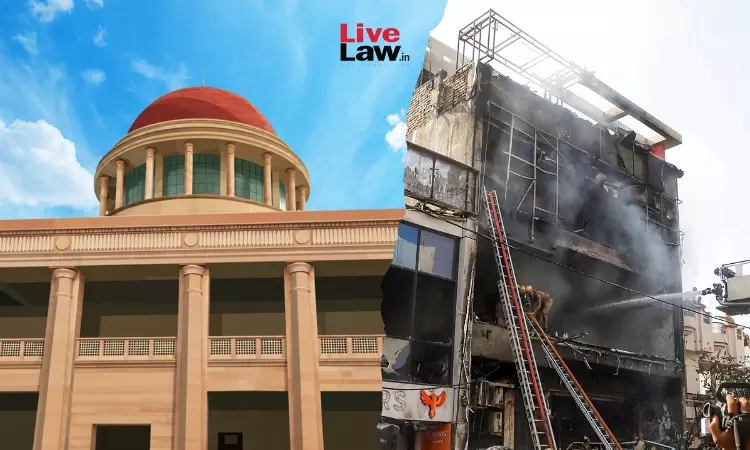
Authorities spring into action after tragedies, but their 'promptness soon dies', and fresh incidents happen, said the Allahabad High Court
The Allahabad High Court last week expressed deep anguish over the loss of at least 15 lives in a devastating fire incident at a three-storey building housing an Animation Centre in Lucknow last month.The Court has directed the Uttar Pradesh government to come up with a Standard Operating Procedure (SOP) to prevent such tragedies and hold defaulting officers...
This is a premium content
Available exclusively to
Our subscribers
Subscribe Premium 
INR 1099+GST
Your support helps us to bring you more content at
an affordable subscription scheme !!!
All payment options available
The Allahabad High Court last week expressed deep anguish over the loss of at least 15 lives in a devastating fire incident at a three-storey building housing an Animation Centre in Lucknow last month.
The Court has directed the Uttar Pradesh government to come up with a Standard Operating Procedure (SOP) to prevent such tragedies and hold defaulting officers accountable.
Flagging the inaction of the authorities in the present case, a Bench of Justice Rajan Roy and Justice Manjive Shukla observed that officials "spring into action" immediately after such casualties, but their promptness soon dies down.
"The matters are also brought to the notice of the Court...and the Courts also take cognizance of the same, but, after sometime, the promptness which was reflected immediately after the incident, dies, and again, fresh incidents of fire, take place, resulting in further injury and casualty," the Court observed.
The bench made these observations while dealing with a Public Interest Litigation (PIL) plea filed by practising Advocate Shivendu Pandey regarding such incidents.
Delving into the statutory loopholes, the State's Standing Counsel informed the Bench that under Section 26 of the UP Fire and Emergency Services Act, 2022, multi-storey buildings having a height of less than 15 meters are completely exempted from obtaining a fire safety certificate from the Fire and Emergency Services.
Terming the provision as "prima facie" unreasonable, the bench remarked that the Aliganj incident, which took place in a building less than 15 meters tall, proves that this statutory exemption needs to be revisited
"If it is so, then from the incident which has taken place in a building which was less than 15 meters, the provision contained in the aforesaid act exempting such buildings from obtaining fire safety certificates, needs to be revisited, as this incident itself proves the provision to be unreasonable, prima facie. All the relevant provisions in this regard need to be revisited by the State Government," the Bench observed.
During the hearing, the bench questioned the Additional Advocate General whether the building complied with fire safety norms.
In response, it was revealed that the building's map was sanctioned strictly for residential purposes, yet a commercial building was constructed and commercial activities were being conducted inside.
The Court further noted that an order for the demolition of the basement construction was passed on May 10, 2016, as it violated the sanctioned map, but the said order was shockingly cancelled/withdrawn on July 5, 2016.
The bench also noted that even after the recall, the subsequent construction did not conform to the sanctioned plan.
Questioning the authorities on why the illegal construction was allowed to proceed unchecked, the Bench noted:
"On being further asked as to why construction was not stopped while it was underway illegally and why suitable action under the U.P. Urban Planning and Development Act, 1973 not taken at the appropriate time, as, had it been taken, loss of lives would have been prevented, learned counsel submitted that the fact is that no action was taken".
The Court also considered the roles of the UP-Power Corporation Ltd. (UPPCL) and Madhyanchal Vidyut Vitran Nigam Ltd. (MVVNL) in the present case.
The counsel for the Power Corporation informed the Court that while a residential electricity connection of 2 KV was originally granted in 2016, a commercial connection was later issued and enhanced to 20 KV.
This was done on the strength of a No Objection Certificate (NOC) granted by the Director of Electrical Safety.
The High Court questioned how a premises supposed to be residential was granted a commercial electricity connection and an enhanced load.
"if at that very stage, proper scrutiny had been made by the concerned officials, then this unfortunate incident which took place subsequently, would not have occurred.," the Bench observed, adding that it is for the State to answer how these illegalities were regularized.
Furthermore, the Court was informed that a total amount of ₹12 Lakhs has been paid to each of the deceased as compensation from different departments.
However, the Bench pointed out that there was no uniformity in the State's compensation policy for such tragedies. It noted that in some instances, the State awards ₹50 Lakhs or ₹25 Lakhs, whereas in this case, it was "barely a few lakhs".
"We would also like to know as to whether there is any policy in the State Government, whether in the form of a stature or otherwise, determining the parameters on the basis of which quantum of compensation payable is determined…After all, what is the criteria or the basis for the State Government in deciding the quantum of compensation in such matters".
The Court directed the petitioner to implead several top officials as opposite parties before the next date, including the Principal Secretary of the Housing and Urban Planning Department, the Housing Commissioner of the U.P. Avas Evam Vikas Parishad, and the Principal Secretary of Energy.
The State Government has been directed to file separate counter-affidavits addressing all observations raised by the Bench.
It has also been directed to formulate a comprehensive Standard Operating Procedure (SOP) to ensure strict compliance with building bylaws and fire safety norms, and to fix strict penal liability on defaulting officers.
The Court has also appointed Shri Rakesh Kumar, Advocate and member of the Oudh Bar Association, as Amicus Curiae to assist in the matter.
The case is listed to be heard next on August 4, 2026.
Case Title: Shivendu Pandey v. State of U.P. Thru. Addl. Chief Secy./Prin. Secy. Home Deptt. Lko. And 11 Others

Sparsh Upadhyay
Sparsh Upadhyay is an Associate Editor with LiveLaw.

