



- Home
- /
- High Courts
- /
- Allahabad High Court
- /
- Magistrate Bound To Consider...
Magistrate Bound To Consider Subsequent 'Closure Report' Even After Taking Cognizance On Initial Chargesheet: Allahabad High Court
Sparsh Upadhyay
16 Feb 2026 7:36 PM IST
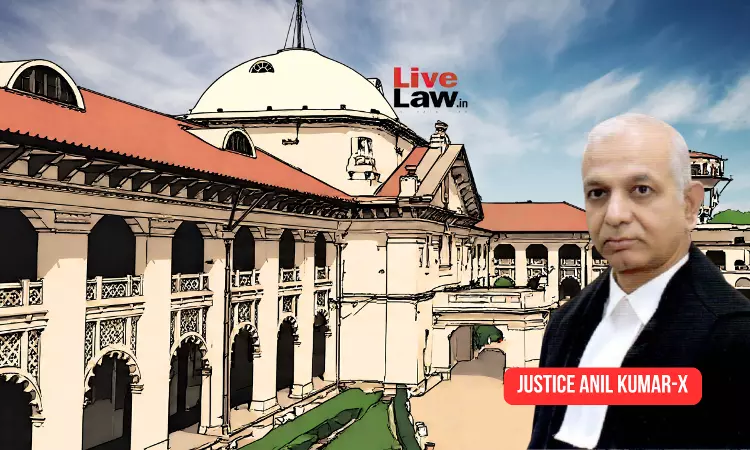
The Allahabad High Court recently observed that a Magistrate is legally bound to consider and pass an order on the Final Report (closure report) filed by the police, even in those cases where he has already taken cognizance of the offence based on an earlier charge sheet. A bench of Justice Anil Kumar-X added that if the Magistrate proceeds further in the case without considering the...
This is a premium content
Available exclusively to
Our subscribers
Subscribe Premium 
INR 1099+GST
Your support helps us to bring you more content at
an affordable subscription scheme !!!
All payment options available
The Allahabad High Court recently observed that a Magistrate is legally bound to consider and pass an order on the Final Report (closure report) filed by the police, even in those cases where he has already taken cognizance of the offence based on an earlier charge sheet.
A bench of Justice Anil Kumar-X added that if the Magistrate proceeds further in the case without considering the Final Report at all, such inaction amounts to a "procedural illegality".
The Court further ruled that in fact, the Magistrate is required to apply his mind independently on every supplementary report, without being influenced by his earlier order of taking cognizance upon primary report (initial report/charge sheet).
In an important clarification, the Court said that if a Magistrate, after applying his judicial mind to the supplementary report, arrives at a conclusion contrary to his earlier decision of taking cognizance on the charge sheet (primary report), the recording of such a contrary opinion will not amount to a review or recall of his earlier order.
The bench held thus last week, allowing a criminal appeal in which the appellants challenged the proceedings in a case lodged under the SC-ST Act and the Indian Penal Code.
BRIEFLY PUT, the police initially investigated the matter and filed a charge sheet on September 15, 2023, against the appellants under Sections 147, 452, 323, 504, 506 of the IPC and the SC/ST Act. The Magistrate took cognizance of the offences on December 21, 2023.
Subsequently, the IO conducted a further investigation and submitted a supplementary report (Final Report) on March 31, 2024, concluding that the allegations against the appellants were found to be false.
Despite the subsequent report that effectively exonerated the accused, the trial court proceeded to frame charges on August 7, 2025, without considering the police's Final Report.
The appellants challenged this in the High Court by contending that it was incumbent upon the court to consider the Final Report before framing charges, a position conceded by the State counsel.
The AGA, on the other hand, did not dispute the facts disclosed by counsel for the appellants.
High Court's observations
At the outset, the High Court observed that Magistrates often face a dilemma in such situations, perceiving that once they have taken cognizance on the primary/initial report, they are now functus officio and cannot pass a contrary order due to the bar on review under Section 362 CrPC.
However, the bench dismissed this logic as being "against the canon of law", as it clarified that the prohibition on review applies only when a court has "disposed of a case" by signing a judgment or final order.
The Court held that taking cognizance on a primary report does not dispose of the case. Rather, the Magistrate's judicial duty is 'continual', and they must apply their judicial mind to each report submitted by the police.
The Court observed that if a Magistrate arrives at a conclusion contrary to their earlier decision based on a supplementary report, "the recording of such a contrary opinion will not amount to a review or recall of his earlier order" but is merely a response to emergent facts.
"Just as the Investigation Officer must continue their investigation until a final logical conclusion is reached, the Magistrate's obligation persists until the police submits their final conclusive report. Consequently, the Magistrate is duty-bound to exercise judicial mind and consider all police reports submitted during the investigation of a single case," the Court held.
Furthermore, relying on the Supreme Court's judgment in Vinay Tyagi vs Irshad Ali @ Deepak & Ors (2013), the High Court reiterated that a supplementary report is not distinct from the primary report but must be treated as an "integral part" of it.
It added that before reaching any conclusion, the court must evaluate the cumulative effect of all reports submitted under this section, reading them conjointly and applying its mind to the reports to determine if there are sufficient grounds to presume that the accused has committed the offence.
Importantly, relying upon Ram Lal Narang Etc. Etc vs State Of Delhi (Admn.) 1979, Dharmatma Singh vs Harminder Singh & Ors 2011 and Mariam Fasihuddin & Anr. versus State by Adugodi Police Station & Anr. 2024 LiveLaw (SC) 53, the bench held that the Magistrate is bound to pass orders on every subsequent report under Section 173(8) unless the supplementary charge sheet lacks fresh materials
Against this backdrop, the appeal was allowed and the court set aside the orders of issuing processes against the appellants in pursuance of taking cognizance of the charge sheet and all other consequential orders including the order of framing charge.
The bench directed the trial court first to consider the final report and pass an order after considering both the initial report (charge sheet) and the final report.
It further provided that if, thereafter, it comes to the conclusion that a conjoint reading of both reports prima facie makes out a case against the appellants, only then shall it proceed to frame charges against the appellants.
Case title - Sonu And 5 Others vs. State of U.P. and Another 2026 LiveLaw (AB) 81
Case citation: 2026 LiveLaw (AB) 81
Tags

Sparsh Upadhyay
Sparsh Upadhyay is an Associate Editor with LiveLaw.

