



- Home
- /
- High Courts
- /
- Allahabad High Court
- /
- Motor Accident Claims Tribunal...
Motor Accident Claims Tribunal Can't Decide Framed Issues In Negative Merely Because Counsel Says 'Not Pressed': Allahabad High Court
Upasna Agrawal
2 Nov 2026 10:20 AM IST
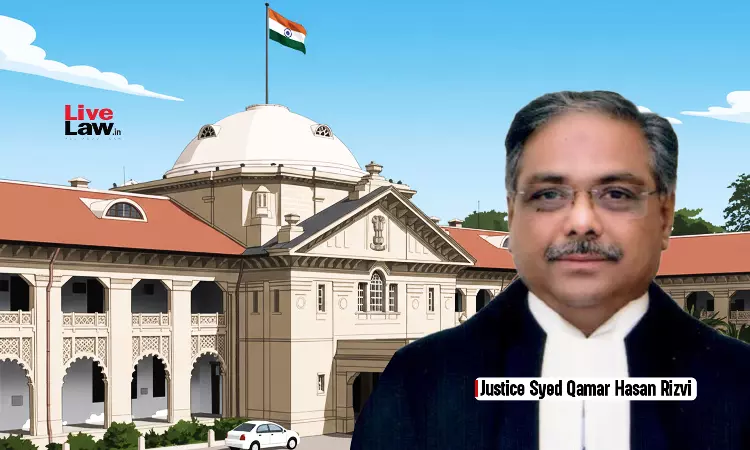
Mere recital that an issue was “not pressed” can't substitute a reasoned determination of the issue, Court said.
The Allahabad High Court has held that a Motor Accident Claims Tribunal cannot answer issues framed on the pleadings in the negative merely because counsel for a party states that he is not pressing them. It held that the obligation to give notice to the insurer under Section 168(1) of the Motor Vehicles Act, 1988 is a statutory mandate in public interest and cannot be defeated by the waiver of...
This is a premium content
Available exclusively to
Our subscribers
Subscribe Premium 
INR 1099+GST
Your support helps us to bring you more content at
an affordable subscription scheme !!!
All payment options available
The Allahabad High Court has held that a Motor Accident Claims Tribunal cannot answer issues framed on the pleadings in the negative merely because counsel for a party states that he is not pressing them.
It held that the obligation to give notice to the insurer under Section 168(1) of the Motor Vehicles Act, 1988 is a statutory mandate in public interest and cannot be defeated by the waiver of a party.
Justice Syed Qamar Hasan Rizvi held,
“The framing of issues constitutes an imperative stage in civil proceedings, as it delineates the scope of the trial by separating wheat from the chaff, thereby identifying the real dispute and narrowing the area of controversy. There cannot be any lis without issues. In that background, failure to determine the issues not only amounts failure to exercise judicial duty enjoined upon by the trial Court, but also a travesty of justice to be expended to the parties in its letter and spirit.”
On 30.06.2001, Jamuna Devi was returning home on foot when she was hit from behind by a bus on the Barabanki-Gonda road. She died during treatment at the District Hospital, Barabanki, on the intervening night of 03/04.07.2001. Her husband and three sons claimed Rs. 5,00,000 before the Motor Accident Claims Tribunal, Barabanki, under Sections 166 and 163-A of the Motor Vehicles Act, 1988.
The U.P. State Road Transport Corporation denied knowledge of the accident but admitted that the bus stood contracted with it. The registered owner never appeared and was proceeded against ex-parte. The Tribunal framed five issues. Three of them, on the non-impleadment of the insurer, on whether the insurer's liability stood extinguished once the bus was contracted to the Corporation, and on whether the insurance was valid and effective, were answered in the negative solely because counsel for the Corporation stated on 14.02.2007 that he was not pressing them.
Taking the deceased's income at Rs. 15,000 per annum with a multiplier of 16, the Tribunal awarded Rs. 1,69,500 with simple interest at 5% per annum.
The Corporation appealed, contending that it was neither the owner of the bus nor the employer of its driver, and that under its agreement with the owner any liability rested on the owner and the insurer.
The claimants cross-objected for enhancement, arguing that the notional income of the deceased, a housewife, should have been taken at not less than Rs. 3,000 per month.
The Court observed that the Tribunal had consciously framed the issues but answered three of them on the mere statement of counsel, without any independent discussion. Reading Section 168(1) of the Act with Rule 207 of the Uttar Pradesh Motor Vehicle Rules, 1998, it held that the Tribunal was bound to issue notice to the insurer, the word “shall” being mandatory.
“Such statutory obligation of issuing notice to Insurance Company under Section 168(1) is not founded merely upon the private rights of the parties to the proceedings and, therefore, cannot be defeated by waiver of the parties.”
Describing the Motor Vehicles Act as a beneficial and social welfare legislation meant to protect innocent third-party victims, the Court held that non-pressing of an issue by counsel is not waiver by the party. It held that waiver is a question of fact which must be pleaded, and that no bald plea of waiver can defeat a statutory provision made in the larger public interest.
It found no pleading of waiver on record, and held that the issues were not confined to the private interest of the Corporation alone.
“Mere recital that an issue was “not pressed”, without examining its legal and factual consequence, cannot substitute a reasoned determination of the issue.”
Accordingly, the appeal was partly allowed. The findings on Issue Nos. 2, 3, 4 and 5 were set aside and the matter was remitted for fresh adjudication, with the parties directed to appear before the Tribunal on 10.12.2026 and the Tribunal directed to treat the insurance company as continuing to be a party. Sums already released were made subject to the fresh award.
Tags


