



Non-Payment Of Admitted Contractual Dues Is Arbitrary, Writ Lies For Their Recovery: Allahabad High Court
Upasna Agrawal
18 Oct 2026 2:25 PM IST
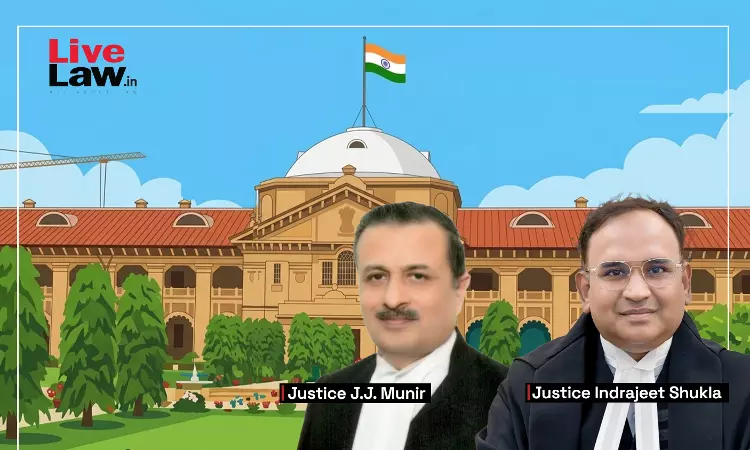
The Allahabad High Court has held that withholding contractual dues which the State authority itself admits is arbitrary, and a writ petition under Article 226 of the Constitution of India is maintainable for their recovery. It held that the rule against deciding money claims in writ jurisdiction is not absolute, and does not apply where the amount is admitted by the authority.
The bench of Justice J.J. Munir and Justice Indrajeet Shukla held
“Non-payment of even the admitted dues/contractual dues for an uncertain period amount to arbitrary in action and cannot be countenanced in law.”
Petitioner, a civil contractor, carried out construction work for the Nagar Panchayat, Chandauli. It claimed that Rs. 28,43,443/- of its bills remained unpaid despite an application and reminders.
On being directed by the High Court to state on personal affidavit whether the claim was admitted, the Executive Officer, Nagar Panchayat, Chandauli admitted that Rs. 7,92,580/- remained unpaid against the first work order and stated that the respondents were ready to consider its payment.


Regarding the second work order, it was submitted that the balance of Rs. 6,31,890/- could not be released as the petitioner had filed only an incomplete Form No. 26 instead of a bill in the prescribed format, and certification by the engineers was pending. Completion of the work was not disputed.
The Court relied on the decision of the Supreme Court in M/s Utkal Highways Engineer and Contractors v. Chief General Manager, wherein it was held that there is no absolute bar on deciding money claims in writ jurisdiction where non-payment of admitted dues is arbitrary. It noted that under State of U.P. v. Bridge & Roof Co. (India) Ltd., seriously disputed contractual claims are to be decided in a civil suit, but admitted claims withheld on the pretext of lack of funds can be enforced under Article 226.
Noting that the respondents had expressed willingness to pay the balance under both work orders, the Court held that the amount of Rs. 7,92,580/- was an absolute admission and had to be paid, while Rs. 6,31,890/- would be paid once the petitioner completed the formalities indicated in the affidavit.
“The contractual dues in the instant case are fair and categorical regarding which there is an admission in the personal affidavit of respondent no. 4. There is no dispute with regard to work having been done and the respondent being under an obligation to liquidate the outstanding dues. Thus, non-interference would lead to undue enrichment of the respondents at the cost of petitioner's legitimate claim.”
Relying on Dr. Poornima Advani and another v. Government of NCT of Delhi, the Court held that a person deprived of money legitimately due to him is entitled to be compensated by interest. Accordingly, the petitioner was directed to raise a fresh bill for the second work order within a fortnight, and the respondents were directed to pay the entire admitted dues within four weeks with simple interest at 6% per annum from the date they fell due till payment.
The writ petition was allowed.


