



- Home
- /
- High Courts
- /
- Allahabad High Court
- /
- RTI Act | Penalty For Delay In...
RTI Act | Penalty For Delay In Furnishing Information Can't Be Imposed Without Hearing Public Information Officer: Allahabad High Court
Upasna Agrawal
13 July 2026 11:00 AM IST
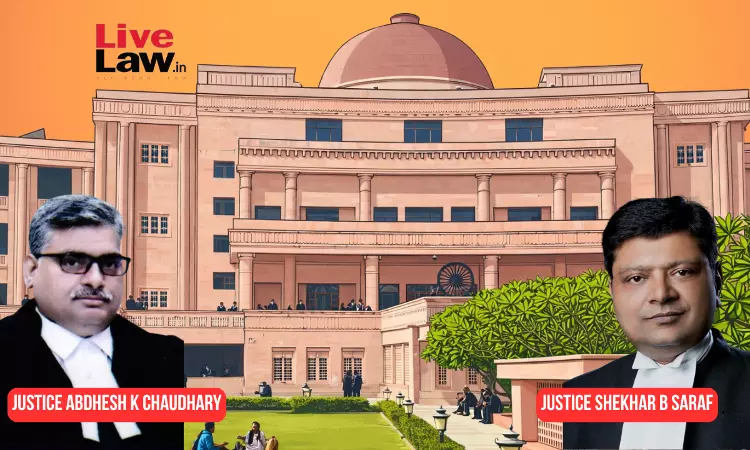
The Allahabad High Court has held that penalty under Section 20 of the Right to Information Act, 2005 cannot be imposed without forming opinion on material and affording opportunity of hearing to the Public Information Officer.For context, Section 20 penalises deliberate obstruction or delay in supplying information sought under the RTI Act.The bench of Justice Shekhar B. Saraf and...
This is a premium content
Available exclusively to
Our subscribers
Subscribe Premium 
INR 1099+GST
Your support helps us to bring you more content at
an affordable subscription scheme !!!
All payment options available
The Allahabad High Court has held that penalty under Section 20 of the Right to Information Act, 2005 cannot be imposed without forming opinion on material and affording opportunity of hearing to the Public Information Officer.
For context, Section 20 penalises deliberate obstruction or delay in supplying information sought under the RTI Act.
The bench of Justice Shekhar B. Saraf and Justice Abdhesh Kumar Chaudhary held,
“… the imposition of penalty by the authority concerned (SIC or the CIC as the case may be) has to be based on an opinion formed by the said Authority in accordance with law. Meaning thereby, that the said opinion is not to be understood in the traditional meaning of being an expression of belief or idea or emotions based on a personal opinion or without any basis, but in contradiction ought to be based on some material available from the records of the said case.”
Petitioner is a Block Education Officer and also a “Public Information Officer”, who failed to provide information on time due to various reasons. The information was eventually provided. It was pleaded that an ex-parte punishment order was passed against him imposing a penalty of Rs. 25,000 under Section 20(1) of the Act. The review application against the punishment order was also rejected.
Accordingly, the petitioner approached the High Court challenging both orders.
The Court observed that a penalty carrying civil consequences could not be imposed without following the principles of natural justice and giving the affected person an opportunity to be heard. It noted that the order impugned did no reflect any opportunity of hearing being granted to the petitioner.
Perusing Section 20 of the RTI Act, the Court held,
“We find that the formation of opinion is the triggering point for imposition of penalty under the provisions of Section 20(1) of the RTI Act, 2005 and obviously, the said opinion has to be formed on the basis of proof provided (or not provided, if opportunity given) by the erring Public Information Officer and after the same is examined for its responsibility and diligence as envisaged under the RTI Act, 2005.”
The Court held that the burden of proof does not end on the material collected but extends to opportunity of hearing on the said material. It held that under Section 20(1), erring Public Information Officer must be provided opportunity of hearing.
“Admittedly, we do not find any opinion having been formed by the SIC in arriving at a decision to impose a penalty of Rs. 25,000/- on the petitioner as neither any notice and/or show-cause was issued to the petitioner prior to the imposition of such a penalty nor any opportunity was provided to file a reply and/or explain or prove that he was reasonable and diligence. Apparently, there was no material on record to form any such opinion on the part of the concerned Authority, for imposition of penalty. To add insult to injury, even no opportunity of hearing was provided to the petitioner as mandated by the first proviso to Section 20(1) of the RTI Act, 2005.”
The Court added that every citizen has an inalienable fundamental right to be heard before being condemned under Article 21, and that the imposition of penalty gave rise to an adverse civil consequence.
In Manohar v. State of Maharashtra, the Supreme Court held that before imposing a penalty under Section 20 the competent authority must give the officer a reasonable opportunity of hearing and examine whether there was any reasonable cause for the delay or non-supply of information.
Accordingly, the impugned orders were quashed.
Case Title: Amarnath v. State Information Commission U.P. Lko. Thru. Chief Information Commissioner And Another 2026 LiveLaw (AB) 393
Case Citation : 2026 LiveLaw (AB) 393
Tags


