



- Home
- /
- High Courts
- /
- Allahabad High Court
- /
- Allahabad High Court Rejects PIL...
Allahabad High Court Rejects PIL Challenging Appointments Of Yogi Adityanath, KP Maurya As UP CM & Dy CM In 2017
Sparsh Upadhyay
16 Dec 2025 8:08 PM IST
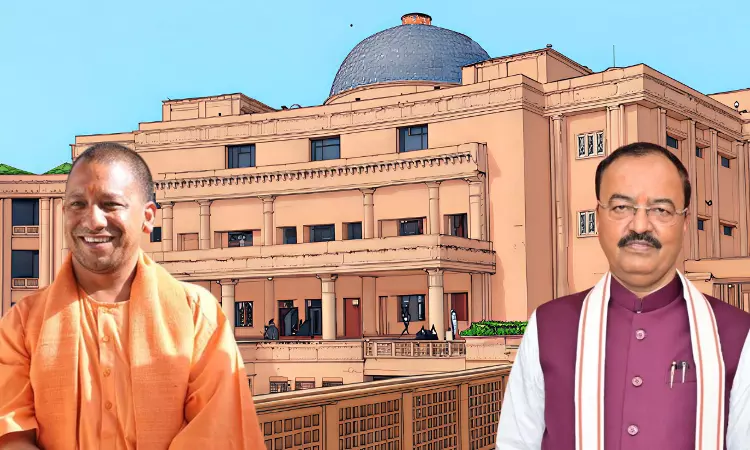
The Allahabad High Court today dismissed a Public Interest Litigation (PIL) plea filed before it in 2017, which challenged the legality of the appointment of Yogi Adityanath as Chief Minister and Keshav Prasad Maurya as Deputy Chief Minister of Uttar Pradesh in 2017. A bench of Justice Rajan Roy and Justice Rajeev Bharti observed that there is nothing in the Constitution which prohibits...
This is a premium content
Available exclusively to
Our subscribers
Subscribe Premium 
INR 1099+GST
Your support helps us to bring you more content at
an affordable subscription scheme !!!
All payment options available
The Allahabad High Court today dismissed a Public Interest Litigation (PIL) plea filed before it in 2017, which challenged the legality of the appointment of Yogi Adityanath as Chief Minister and Keshav Prasad Maurya as Deputy Chief Minister of Uttar Pradesh in 2017.
A bench of Justice Rajan Roy and Justice Rajeev Bharti observed that there is nothing in the Constitution which prohibits the appointment of a person who is already a Member of Parliament as Chief Minister or Deputy Chief Minister of a State.
The HC held that the office of a Member of Parliament is neither a Constitutional Post (such as the President or Vice-President) nor a post held under the government.
Thus, it opined that holding the position of CM or Deputy CM simultaneously, subject to the conditions of Article 164(4), does not violate the doctrine of separation of powers.
The HC was dealing with a PIL filed by Sanjay Sharma in 2017, seeking a declaration that the appointments of Respondent Nos. 5 and 6 (Yogi Adityanath and Keshav Prasad Maurya) be declared null and void with effect from March 19, 2017.
The primary contention was that both the respondents were sitting Members of Parliament when they were sworn in as the CM and Dy CM of the state and they resigned from the Lok Sabha only in September 2017.
High Court's observations
At the outset, the HC noted that the relief seeking to declare their seats vacant or to question their authority (quo warranto) had become 'infructuous' because they had completed their tenure and had been re-elected in 2022. However, the Court proceeded to adjudicate the legal validity of the initial 2017 appointment to settle the question of law.
The HC rejected the petitioner's argument that an MP holds an "office of profit" under the government, which would disqualify them under Article 191(1)(a). The Bench clarified that disqualification under Article 191 applies only if a person holds an office under the Government of India or the State.
The Court held that a Member of Parliament has an "office of election" to raise the voice of the people and does not hold an office under the Government. Therefore, the disqualification provisions of Article 191 were not attracted in the first place.
Referring to the Supreme Court's judgment in Ashwini Kumar Upadhyay v. Union of India (2019), the bench reiterated that legislators cannot be styled as full-time salaried employees. Their status is sui generis (unique).
It added that the mere fact that MPs receive salaries or allowances does not create an employer-employee relationship with the government.
"They occupy a special position so long as the House is not dissolved," the court noted as it emphasized that an MP does not function at the pleasure of the President or Governor.
The petitioner, represented by Advocate Chandra Bhushan Pandey, argued that permitting an MP, who is a member of the Union Legislature, to hold the executive office of Chief Minister violates the "implied restrictions" of the Constitution and the doctrine of separation of powers.
The Court, however, termed this contention 'preposterous' and "constitutionally fallacious". The bench pointed out that under the Indian constitutional scheme, every Minister must ultimately become a member of the Legislature.
"If this contention is accepted that no Member of Legislature should be appointed as a Minister because as member of the Legislature he is part of the Legislative wing and as Chief Minister/ Deputy Chief Minister he becomes part of the executive, then no minister could be appointed," the Court reasoned.
The Bench further noted a sharp distinction between a "Constitutional Body" (such as Parliament) and a "Constitutional Office". It clarified that Constitutional Offices are specific high offices, such as the President, Vice President, Speaker or Chief Election Commissioner.
It added that a seat in the Parliament does not equate to holding a constitutional post and therefore, the petitioner's analogy regarding the Vice-President ceasing to be Chairman of the Council of States upon becoming President was deemed 'misplaced' and without constitutional basis.
Importantly, the petitioner had also challenged the vires of Section 3(a) of the Parliament (Prevention of Disqualification) Act, 1959, which declares that the office of a Minister shall not disqualify the holder from being a Member of Parliament.
The petitioner argued that this provision contravened the spirit of Article 102(1)(a).
However, the bench rejected this contention, as it noted that the Explanation to Article 102 of the Constitution (amended in 1985) explicitly clarifies that a person shall not be deemed to hold an office of profit by reason only that he is a Minister.
"The Constitution itself having excluded the office of Minister of a State which includes Chief Minister and Deputy Chief Minister from the purview of operation and application of Article 102...we fail to understand as to how such a challenge to Section 3(a) of the Act, 1959 can be raised and sustained," the Bench remarked.
The Court also noted that Adityanath and Maurya had taken their oath on March 19, 2017; they were elected to the Legislative Council on September 8, 2017 and they resigned from Parliament on September 21, 2017.
The Bench observed that the Prohibition of Simultaneous Membership Rules, 1950, were not applicable because the respondents resigned voluntarily under Article 101(3)(b) rather than holding onto both seats indefinitely.
"They envisage a contingency where a person has been simultaneously holding a seat in the Parliament and in a house of legislature of a State specified in the 1st Schedule to the Constitution of India and if he does not vacate his seat in the State Legislature, then, his seat in the Parliament will fall vacant, whereas, in the case at hand the opposite party nos. 5 and 6 resigned from their membership of parliament itself in terms of Article 101(3)(b) of the Constitution on 21.09.2017, therefore, Rules 2 and 3 of the Rules, 1950 made by the President under Article 101(2) and Article 190(2) of the Constitution have no application to the case at hand", the Court observed.
Thus, the HC concluded that the Governor's discretion was exercised within constitutional bounds and it dismissed the petition, finding "no merit" in the claims.
Tags

Sparsh Upadhyay
Sparsh Upadhyay is an Associate Editor with LiveLaw.

