



- Home
- /
- High Courts
- /
- Allahabad High Court
- /
- Landlord Need Not Personally Occupy...
Landlord Need Not Personally Occupy Premises For Son's Business To Support Eviction: Allahabad High Court
Upasna Agrawal
3 Oct 2026 4:00 PM IST
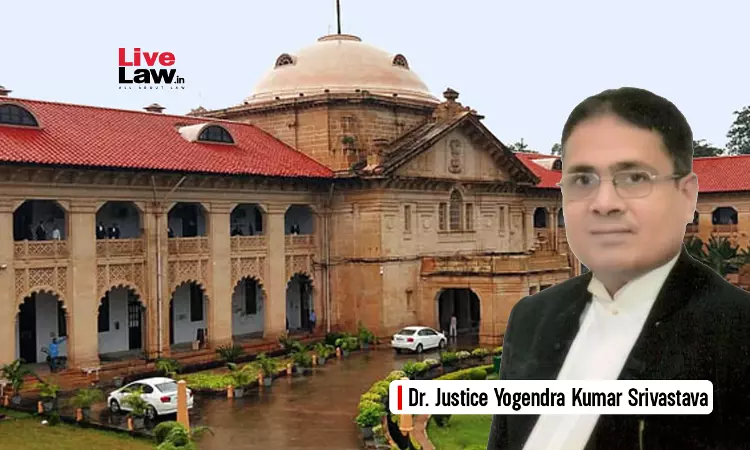
The Allahabad High Court has held that the expression “required by landlord” in the first limb of Section 21(2)(m) of the Uttar Pradesh Regulation of Urban Premises Tenancy Act, 2021 does not require the landlord to be in physical occupation of the premises himself. It held that where premises in their existing form are sought for setting up or carrying on the business of the landlord's...
This is a premium content
Available exclusively to
Our subscribers
Subscribe Premium 
INR 1099+GST
Your support helps us to bring you more content at
an affordable subscription scheme !!!
All payment options available
The Allahabad High Court has held that the expression “required by landlord” in the first limb of Section 21(2)(m) of the Uttar Pradesh Regulation of Urban Premises Tenancy Act, 2021 does not require the landlord to be in physical occupation of the premises himself.
It held that where premises in their existing form are sought for setting up or carrying on the business of the landlord's son, the claim cannot be rejected at the threshold merely because the son, and not the landlord, is to be the actual user.
The Court also held that the relationship by itself decides nothing. A requirement pleaded for a son becomes the landlord's requirement only where a genuine and legitimate connection is shown with the landlord's own interest and circumstances, held the Court.
Section 21(2)(m) makes it a ground of eviction “that the premises are required by landlord either in its existing form, or after demolition and new construction thereof for the purpose of its occupation by landlord.”
Justice Dr. Yogendra Kumar Srivastava held that the clause sets out two separately structured situations and that the closing words relating to occupation by the landlord belong to the second of them.
“The use of the expression “or” is of particular relevance. The first contingency is that the premises are required by the landlord “in its existing form”; the second is that the premises are required “after demolition and new construction thereof for the purpose of its occupation by landlord”. The words expressly referring to occupation by the landlord occur in the latter part of the provision. Read according to its ordinary grammatical arrangement, those words are more naturally referable to the second contingency. To make them necessarily govern the first limb as well would require the Court to extend those words beyond the manner in which they have been structurally placed by the Legislature.”
Two petitions under Article 227, both arising from eviction proceedings under Section 21(2) and turning on the reach of clause (m), were heard together.
In the first, Sandeep Kumar, a tenant of a shop on Wakil Road, New Mandi, Muzaffarnagar at an alleged rent of ₹12,000 a month, faced an eviction application by his landlord Vinod Kumar Chhabra founded on default in rent from 31.10.2023, material alteration, termination of the tenancy by notice under Section 106 of the Transfer of Property Act, 1882, and requirement of the premises for the business of the landlord's son.
The Rent Authority rejected the application; the District Judge/Rent Tribunal partly allowed the landlord's appeal and directed the tenant to vacate.
In the second, Keshav Bhalla occupied a shop at Mohalla Badhpur, Farrukhabad, let out to his father some 45 to 48 years earlier. After his father's death on 07.07.2022 he continued the tempo repairing business carried on there. The landlord Akhilesh Chandra Gangwar sought eviction alleging default and requirement of the premises for his unemployed son, who wished to set up a business. The Rent Authority directed eviction and the Rent Tribunal dismissed the tenant's appeal.
The Additional Advocate General pointed to a change in the text between the Ordinance and the Act. The English translations in the Ordinances of 09.01.2021 and 09.04.2021 carried no comma after “either in its existing form”, whereas the enacted provision places one there, followed by the disjunctive “or”. The Legislature had thereby separated the two contingencies, so that occupation by the landlord is a condition only of the demolition and fresh construction case.
The Court treated the punctuation as an aid only.
“The question, however, is not whether punctuation, by itself, can create a statutory meaning which the words otherwise cannot bear. Punctuation is only a subordinate aid to construction.”
It set out the “Rule of the Last Antecedent”, the working assumption that a qualifying phrase refers to the words immediately before it unless the context shows a wider reach was intended. It also noticed Aswini Kumar Ghose v. Arabinda Bose, where punctuation was described as a minor element which cannot control the plain meaning of a text.
The Court held that the authorities relied on by the landlords were decided on differently worded provisions and do not license it to disregard the words used in Section 21(2)(m). Reading the first limb, which speaks only of premises “required by landlord”, against the second, where the Legislature expressly added the purpose of occupation by the landlord, it held that the difference in language could not be effaced, and declined both constructions pressed before it.
“The Court, therefore, does not accept either of the two extreme constructions advanced before it. The first, that the words “required by landlord” necessarily mean that the landlord himself must physically occupy the premises, would add a qualification not found in the first limb of the provision. The second, that the requirement of a son or any other family member automatically constitutes the requirement of the landlord, would deprive the expression “by landlord” of its limiting content. The proper construction lies between these two extremes and gives effect both to the statutory language and to the controlled principle of nexus recognised in the authorities.”
“There is thus a material distinction between the identity of the proposed user and the legal character of the requirement. The fact that the premises are intended to be used by the landlord's son does not, by itself, take the requirement outside the expression “required by landlord”. Conversely, the mere fact that the proposed user is the landlord's son does not, by itself, establish that the requirement is legally the requirement of the landlord. What is necessary is a sufficient and legitimate nexus between the requirement asserted and the landlord's own interest and circumstances, assessed in the factual setting of the case.”
On alternative accommodation and comparative hardship, the Court observed that Section 21(2)(m) does not use the expression “bona fide” and does not reproduce the comparative hardship formulation of the Uttar Pradesh Urban Buildings (Regulation of Letting, Rent and Eviction) Act, 1972. Relying on Shyam Pal v. B.S. Enterprises, it held that conditions belonging to the repealed regime cannot be read into the new enactment.
Applying that construction, the Court held that in both matters the requirement had been pleaded before the Rent Authority and examined again in appeal, and that nothing had been shown to establish that the findings rested on no evidence or ignored any material circumstance. The challenge invited a re-appreciation of evidence, which does not ordinarily fall within the supervisory jurisdiction under Article 227, held the Court.
Accordingly, both petitions were dismissed. On the tenants' request and with the landlords' consent, six months' time was granted to vacate, subject to their filing undertakings before the Rent Authority within two weeks to hand over possession on or before 23rd March, 2027, depositing the arrears of rent within two weeks, and depositing ₹4,000 a month towards use and occupation charges from October, 2026. On default the protection stood vacated automatically.
Counsel for Petitioners:- Nipun Singh, Senior Advocate, assisted by Aishwarya Pratap Singh, Sumit Suri, Chandrachud Pandey, Rajesh Kumar, Vineeta Pandey
Counsel for Respondents: - Kartikey Saran, Additional Advocate General, assisted by Harish Chandra Kesari, Additional Chief Standing Counsel, Ashok Nath Tripathi, Mukesh Kumar, Shivangi Singh, Keshav Hari Dixit
Tags


