



- Home
- /
- High Courts
- /
- Allahabad High Court
- /
- Routine Retail Sale Of Codeine...
Routine Retail Sale Of Codeine Cough Syrup Without Prescription Violates Drugs & Cosmetics Act, Not NDPS Act: Allahabad High Court
Upasna Agrawal
7 Sept 2026 11:50 AM IST
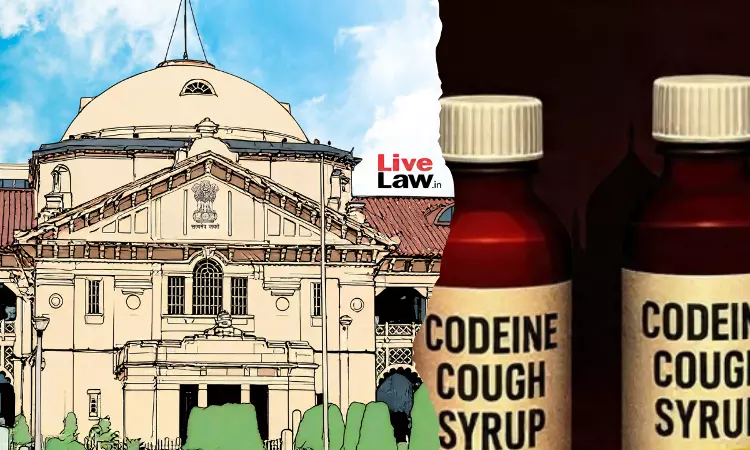
The Allahabad High Court has held that where a medical store sells codeine-based cough syrup containing a permitted quantity of codeine in the course of routine sale without a medical prescription, the lapse is a violation of the Drugs and Cosmetics Act and not an offence under the Narcotic Drugs and Psychotropic Substances Act, 1985. It held that the position changes only where a large...
This is a premium content
Available exclusively to
Our subscribers
Subscribe Premium 
INR 1099+GST
Your support helps us to bring you more content at
an affordable subscription scheme !!!
All payment options available
The Allahabad High Court has held that where a medical store sells codeine-based cough syrup containing a permitted quantity of codeine in the course of routine sale without a medical prescription, the lapse is a violation of the Drugs and Cosmetics Act and not an offence under the Narcotic Drugs and Psychotropic Substances Act, 1985.
It held that the position changes only where a large quantity is sold within a very short period, which would show that the retailer knew the syrup was going to a use other than medicinal or scientific.
The clarification came while the Court was deciding a batch of bail applications arising from the stock, sale and transport of codeine-based cough syrups, in which it held that syrup within the limit fixed by Entry 35 of the notification dated 14.11.1985 becomes a narcotic drug only when it is dealt with for intoxication rather than medicine.
Justice Arun Kumar Singh Deshwal held,
“if any drug retailer/medical store sells codeine based cough syrup (having permitted quantity of codeine) during routine sale without medical prescription, then it would be treated as a violation of Drugs and Cosmetics Act, not the NDPS Act, unless huge quantity of such cough syrup is sold within very short span of time, which clearly indicates the knowledge of drug retailer regarding its use other than medicinal or scientific purpose.”
A Drug Inspector had inspected M/s Life Medical Store and the FIR alleged that its proprietor had bought 800 bottles of Codiva cough syrup over two years and sold 920. The Inspector then revised that figure twice, first to 13 bottles and then to 45. During investigation the police found that sales of 238 bottles were accounted for, while records for the remaining 558 bottles and for 488 Puroxowin Spas capsules were not produced.
The applicant argued that keeping prescription records during rush hours was not always possible, and this could at most be a breach of the conditions of the licence. It was urged that prosecution under the NDPS Act was malicious.
The State submitted that the missing invoices showed a clear violation of the Drugs and Cosmetics Act and that the syrup and capsules could have been used for intoxication.
The Court held that the unexplained stock could amount to a violation of the Drugs and Cosmetics Act. It observed that there was no material to show that the 558 bottles had been sold over two years for the purpose of intoxication. Noting that the applicant had no criminal history and the charge sheet had been filed, it granted bail and observed,
“This is a classic case where the alleged offence completely appears to be covered within the domain of the Drugs and Cosmetics Act, even then the F.I.R. has been lodged under the NDPS Act.”
The Court directed the Commissioner of Food Safety and Drug Administration, Uttar Pradesh, to instruct all Drug Inspectors that,
“whenever they find any fault in a medical shop with regard to the violation of the conditions of licence, then, before proceeding to register an F.I.R. under the NDPS Act, they should obtain legal advice from the concerned D.G.C. Or JD(prosecution).”
Further, the Court recorded its displeasure with the department across the batch.
“This Court has also expressed its anguish towards Drug Department, which instead of proceeding under Drug and Cosmetics Act even for small violation of the conditions of license, has lodged the FIR under NDPS Act by mentioning incomplete, vague and unnecessary facts.”
It further observed,
“It is also clear from the facts of several cases that before lodging the FIR, the Drug Inspectors have not given sufficient time to drug license holders, therefore they submitted the required documents before the investigating officer during investigation, which in many of cases have changed the version of FIRs.”
The Commissioner was directed to look into the issue and apprise Drug Inspectors of the correct method of lodging an FIR, and the office was directed to send a copy of the judgment to him for compliance. The personal appearance of the Drug Inspector concerned was exempted until further orders.
Case Title: Bhola Prasad v. State of U.P.
Case Citation: 2026 LiveLaw (AB) 661
Appearances: Sri G.S. Chaturvedi, Sr. Adv., Sri Nipun Singh, Sr. Adv., and Sri Sushil Shukla, Sr. Adv., on behalf of the applicants and Sri Anoop Trivedi, Additional Advocate General assisted by Sri Paritosh Kumar Malviya, Sri Chandan Agrawal, Nitesh Kumar Srivastava, Ranjit Kumar Sagar, AGAs along with Sri Rakesh Kumar Soni, State Law Officer on behalf of the State.
Tags


