



- Home
- /
- High Courts
- /
- Allahabad High Court
- /
- School TC Not A 'DOB Certificate'...
School TC Not A 'DOB Certificate' U/S 94 JJ Act; Habeas Plea Against 'Mechanical' CWC Order Maintainable: Allahabad High Court
Sparsh Upadhyay
11 Dec 2025 8:51 AM IST
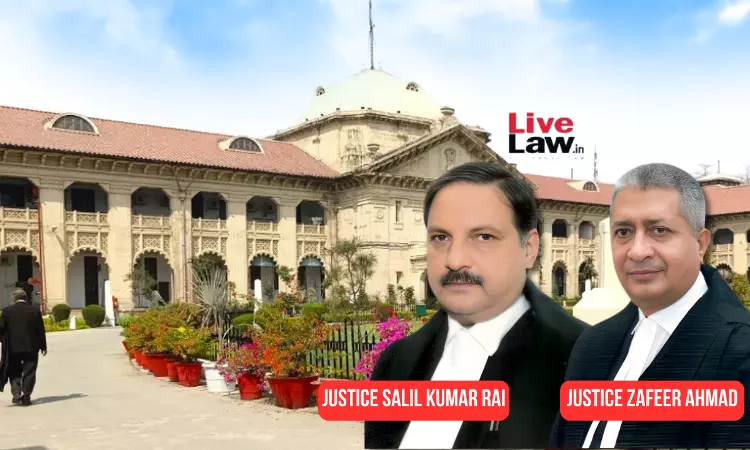
The Allahabad High Court has held that a mere School Transfer Certificate (TC) or an entry in an admission register of the school does not satisfy the requirement of a "date of birth certificate from the school" under Section 94 of the Juvenile Justice (Care and Protection of Children) Act, 2015. A Bench of Justice Salil Kumar Rai and Justice Zafeer Ahmad observed thus while...
This is a premium content
Available exclusively to
Our subscribers
Subscribe Premium 
INR 1099+GST
Your support helps us to bring you more content at
an affordable subscription scheme !!!
All payment options available
The Allahabad High Court has held that a mere School Transfer Certificate (TC) or an entry in an admission register of the school does not satisfy the requirement of a "date of birth certificate from the school" under Section 94 of the Juvenile Justice (Care and Protection of Children) Act, 2015.
A Bench of Justice Salil Kumar Rai and Justice Zafeer Ahmad observed thus while allowing a Habeas Corpus writ petition, effectively ruling that such a plea is maintainable if the Child Welfare Committee (CWC) acts without jurisdiction by ordering the detention of a person in a protection home based solely on unverified school records.
Briefly put, the Court was hearing a petition filed by a girl and her husband. The couple alleged that they married according to Hindu rites in 2023. However, the girl's mother lodged an FIR alleging kidnapping as she claimed that her daughter was born on May 11, 2008, and she is a minor.
The girl consistently stated that she was 19 years old; her claim was supported by her Aadhaar card and a medical examination indicating that her age was 18 years or above. The CWC, Kannauj, however, sent her to the Government Children's Home (Girls) in Kanpur Nagar.
The CWC relied exclusively on a school transfer certificate recording her date of birth as May 11, 2008.
When she and her husband moved for habeas corpus relief for the release of the girl from the Children's Home, the AGA raised a primary objection that the petition was not maintainable.
The State argued that the CWC functions as a 'Court' with powers of a Judicial Magistrate First Class under Section 27(9) of the JJ Act, 2015 and thus, as per the Allahabad HC judgment in Rachna and Anr. vs. State of U.P. (2021), a writ of Habeas Corpus cannot be issued against a valid judicial order of detention.
The division bench, however, rejected this contention as it observed that while the writ is generally not entertained against judicial custody, there is a vital exception as laid down by the Top Court in Madhu Limaye in re (1969) and Manubhai Ratilal Patel Tr. Ushaben vs. State of Gujarat (2012).
The HC noted that in a Habeas Corpus petition, the legality of a detention order can be examined to ascertain whether the order suffers from a lack of jurisdiction, is absolutely illegal, or has been passed in a wholly mechanical manner.
"If the order detaining the person is without jurisdiction or is absolutely illegal or has been passed in a mechanical manner, a writ of Habeas Corpus directing the release of the detenue would be issued", the HC noted.
The Bench also distinguished the Rachna judgment as it noted that it does not bar the writ if the detention order suffers from the vice of lack of jurisdiction or is a nullity due to non-application of mind. Thus, it found the habeas plea to be maintainable in the present case.
Further, on the merits of the case, the Court analyzed Section 94 of the JJ Act, 2015, which mandates seeking a date of birth certificate from the school or matriculation certificate first, to determine whether a person brought before it is a child or not.
The Court pointed out that the CWC had mechanically relied on a Transfer Certificate despite the Supreme Court's decision in P. Yuvaprakash vs. State 2023 LiveLaw (SC) 538, wherein it was held that a school transfer certificate and extracts of the admission register cannot be relied on to determine age of the victim in POCSO cases.
Furthermore, the Court referred to the recent Supreme Court judgment in Suresh vs. State of Uttar Pradesh 2025 LiveLaw (SC) 761, which held that entries in school records are unacceptable if they are based merely on the "oral representation" of parents without supporting documents.
The Bench noted the "mechanical manner" in which the CWC acted:
"In the present case, the Child Welfare Committee has not recorded any finding as to the genuineness of the school records produced before it. There is nothing on record disclosing the source of entries made in the school record and the reliability of such source. The entries in school record were also not proved as required by law. The Child Welfare Committee has also not taken the evidence of the Principal of the institution to verify the school records produced before it."
The Court further noted that the school in question was not a government institution, meaning its principal was not a public servant and the records were not public documents.
Thus, the High Court concluded that since the CWC failed to scrutinise the evidence and passed the detention order without proper age determination, the order was "absolutely illegal", "without jurisdiction" and one passed "mechanically and without any application of mind".
Noting that there was no other document on record except the medical report, which assessed the girl's age as 18 years or above, the HC relied upon it and declared that the petitioner is not a 'child' under Section 2(12) of the Act, 2015.
Thus, finding her detention to be without jurisdiction, the Court directed the Superintendent of the Government Children Home and the Chairman, CWC Kannauj, to release the girl forthwith.
"The corpus, i.e., the petitioner no. 1 is free to go wherever she likes and to stay with whomsoever she wants including the petitioner no. 2 [her husband]," the Court ordered as it allowed the plea.
Case title - Rohini and another vs. State of U.P. and 4 others
Citation :
Tags

Sparsh Upadhyay
Sparsh Upadhyay is an Associate Editor with LiveLaw.

