



- Home
- /
- High Courts
- /
- Allahabad High Court
- /
- S. 311 CrPC | Material Witnesses...
S. 311 CrPC | Material Witnesses Can Be Summoned Even If Their Examination-In-Chief Hasn't Been Conducted: Allahabad High Court
Sparsh Upadhyay
23 July 2026 9:07 PM IST
The Allahabad High Court has held that there is no legal bar to summoning material witnesses under Section 311 CrPC merely because their examination-in-chief has not yet been conducted. The bench observed that if the trial court reaches the conclusion that the examination of a witness is necessary, such a witness can be summoned at any stage, prior to the pronouncement of...
This is a premium content
Available exclusively to
Our subscribers
Subscribe Premium 
INR 1099+GST
Your support helps us to bring you more content at
an affordable subscription scheme !!!
All payment options available
The Allahabad High Court has held that there is no legal bar to summoning material witnesses under Section 311 CrPC merely because their examination-in-chief has not yet been conducted.
The bench observed that if the trial court reaches the conclusion that the examination of a witness is necessary, such a witness can be summoned at any stage, prior to the pronouncement of the judgment.
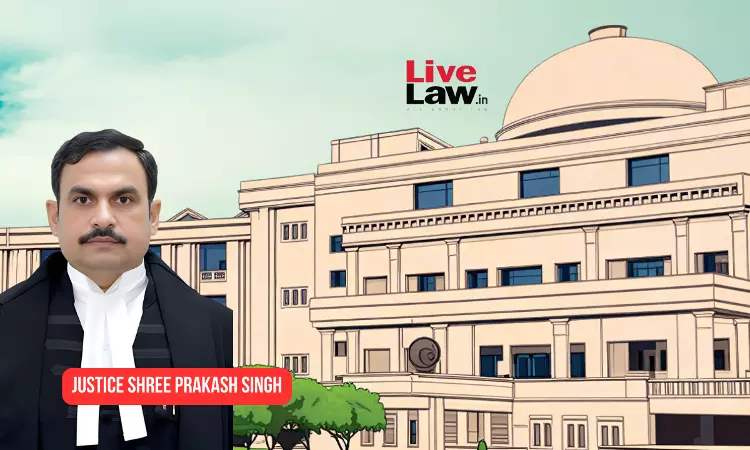
A bench of Justice Shree Prakash Singh made the observation while allowing a petition challenging an order of the Additional Sessions Judge, Unnao, rejecting an application under Section 311 CrPC.
For context, Section 311 CrPC empowers courts to summon any person as a witness, or recall and re-examine an already examined witness, at any stage of the proceedings if such evidence appears essential to the just decision of the case. The provision aims to ensure that all material evidence is before the court before it renders its verdict.
The petitioner had sought summoning of PW-1 (mother of the victim) and the 2 experts who had assisted in recording the statements of a mentally challenged victim, under Sections 161 and 164 CrPC.
The applicant's counsel submitted that the victim had improved upon her earlier version by alleging that rape had been committed upon her, though no such allegation was made in the FIR, which contained allegations only of outraging modesty.
It was, therefore, argued that the summoning and examination of the said experts was necessary for the proper adjudication of the matter.
On the other hand, the AGA argued that a Section 311 CrPC plea was filed at a belated stage, almost 3 years after the statement of P.W.1 (mother of the victim).
It was further submitted that since the examination-in-chief of the proposed witnesses had not yet been conducted, they could not be permitted to be cross-examined at this stage.
Rejecting both the state's submissions as well as the trial court's reasoning, the High Court observed thus:
"Such a finding is erroneous and groundless as, if the trial court reaches to the conclusion that the examination of a witness is necessary, such witness can be summoned at any stage, prior to the pronouncement of the judgment. Therefore, there can be no legal bar of summoning the witnesses only because their examination-in-chief has not yet been conducted."
The Court noted that the prosecution itself had failed to produce the 2 experts, despite the victim's statements having been recorded in their presence and with their assistance.
It further observed that before recording a conviction, all relevant possibilities bearing upon the innocence of the accused are required to be explored.
The bench added that the interest of the accused cannot be left to be jeopardised merely on unfounded presumption of delay.
Explaining the scope of Section 311 CrPC, the Court noted that the trial court may, at any stage of any inquiry, trial or other proceeding, summon any person as a witness.
"This shows that before pronouncing the judgment, if the trial court reaches to the conclusion that for proper and just adjudication of the trial, examination of any witness is required, such witness may be summoned", the bench remarked.
In this regard, the bench also relied upon the Supreme Court's decision in Manju Devi vs. State of Rajasthan and another (2019) and Natasha Singh v. CBI (State) 2013 to reiterate that the age or pendency of a case cannot by itself be decisive when a request is made to examine a material witness, and that the power under Section 311 CrPC exists to enable courts to discover the truth and render a just decision.
Thus, finding that the statements of the 2 experts constituted "relevant evidence", particularly because the allegation of rape surfaced for the first time in the victim's Section 164 CrPC statement recorded with their assistance, the Court set aside the impugned order.
The matter was remitted to the trial court for fresh consideration of the Section 311 application within 8 weeks.
Case title - Gulzar Ali v. State of Uttar Pradesh & Others 2026 LiveLaw (AB) 460
Case Citation: 2026 LiveLaw (AB) 460
Tags

Sparsh Upadhyay
Sparsh Upadhyay is an Associate Editor with LiveLaw.

