



- Home
- /
- High Courts
- /
- Allahabad High Court
- /
- Senior Citizens Act | Tribunal Can...
Senior Citizens Act | Tribunal Can Evict Children To Protect Elderly's Life & Limb: Allahabad High Court
Upasna Agrawal
10 Sept 2026 1:05 PM IST
The Allahabad High Court has held that a Tribunal under the Maintenance and Welfare of Parents and Senior Citizens Act, 2007 can order the eviction of children or relatives from a senior citizen's property where that is expedient to protect his life and limb. It held that the power is not expressly conferred by the Act, but arises as an incident of the right to maintenance and...
This is a premium content
Available exclusively to
Our subscribers
Subscribe Premium 
INR 1099+GST
Your support helps us to bring you more content at
an affordable subscription scheme !!!
All payment options available
The Allahabad High Court has held that a Tribunal under the Maintenance and Welfare of Parents and Senior Citizens Act, 2007 can order the eviction of children or relatives from a senior citizen's property where that is expedient to protect his life and limb. It held that the power is not expressly conferred by the Act, but arises as an incident of the right to maintenance and protection.
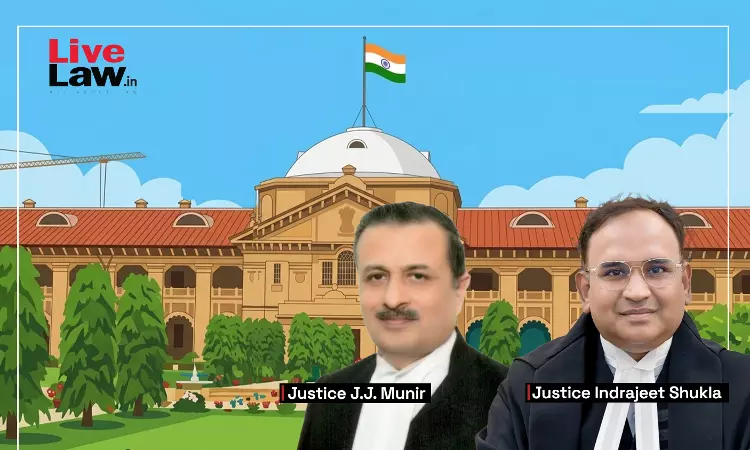
The bench of Justice J.J. Munir and Justice Indrajeet Shukla held,
“The jurisdiction of Tribunal to order eviction is not akin to the plenary jurisdiction of the Civil Court. It can be assumed in extraordinary circumstances, depending upon the facts of a case, where grant of incidental relief of eviction of children or relatives occupying same 'shared household' is expedient to advance protection of life and limb of the elderly person as a last resort/measure and should be exercised sparingly and rarely to give effect to the true spirit of the Act, 2007, which is a beneficial piece of legislation enacted by the Parliament to meet the challenges of modern times on account disintegration of families.”
Petitioner, claiming House No. 34, P Block, Yashodanagar, Kanpur Nagar to be his self-acquired property, applied under Sections 5 and 22 of the Act before the Tribunal presided over by the Sub Divisional Magistrate, Tahsil Sadar, Kanpur Nagar, seeking eviction of his son and daughter-in-law. He alleged atrocities, abuse and misbehaviour, and pleaded that his life and property were in danger.
By order dated 13.01.2026, the Tribunal partly allowed the claim and directed the police to protect his life and property, but refused eviction. That refusal was challenged under Article 226 of the Constitution.
The son and daughter-in-law filed a joint counter affidavit asserting that the proceedings had been resorted to because a demand of dowry was not met. They denied misbehaviour and coercion, relied on a compromise which the petitioner denied, and pleaded that the petitioner was siding with his younger son.
It was urged that the house was a 'shared household' under Section 2(s) of the Protection of Women from Domestic Violence Act, 2005, and the daughter-in-law was protected by Section 17 of that Act.
The State supported the Tribunal's order, relying on two decisions of the High Court holding that the Tribunal cannot order eviction from a senior citizen's property.
For the petitioner, it was argued that eviction is an incident of the enforcement of the right to maintenance and protection.
The Court framed the question as whether the Tribunal has a simpliciter jurisdiction to evict, or whether it must be tied to maintenance and the protection of life.
“It is beyond cavil that Act, 2007 does not contain an express provision, enabling the Tribunal to pass eviction orders. Such power can only be inferred and jurisdiction assumed as an incident to rights of maintenance and protection the Senior citizen or parent. The remedial measures for protecting the life and property of senior citizens may, in the fitness of factual matrix, require an order of eviction, but that too, for ensuring protection of life and limb of an elderly person. Maintenance is defined under the Act, 2007 which includes food, clothing, residence, medical assistance and treatment. The right to residence includes right to residence with dignity.”
Noting that Smt. S. Vanitha v. The Deputy Commissioner, Bengaluru Urban District and others had harmonised the two statutes, the Court observed that the 2007 Act may not be used as an innovative device to oust beneficiaries of the Domestic Violence Act, 2005, the daughter-in-law having an inherent right to live in the shared household.
In Ravi Kant Gupta v. State of U.P. and others, the Supreme Court had not confined eviction to an inquiry under Section 23, holding that a statute conferring jurisdiction impliedly grants the power to do all acts essential to its execution. The Apex Court recognized the power of eviction of the Tribunal to protect the life and limb of senior citizen.
Relying on Article 141 of the Constitution and on Director of Settlements, A.P. v. M.R. Apparao and Suganthi Suresh Kumar v. Jagdeeshan, the Court held that a High Court cannot treat the law declared by the Supreme Court as not binding because the relevant provisions were not brought to its notice, or because all points were not considered.
The Court preferred the judgment of the Supreme Court in Ravi Kant Gupta v. State of U.P. and others over the Full Bench decision of the High Court in Onkar Nath Gaur v. District Magistrate/President Appellate Tribunal, Lko., which had answered a reference by holding that neither the Maintenance Tribunal nor the Appellate Tribunal can order eviction, save where a case falls under Section 23 of the Act.
“The law declared by the Supreme Court is binding upon all Courts within the country. It founds the core and legal basis for doctrine of judicial precedent (stare decisis). Thus, this Court owns and prefers the dictum of the Supreme Court in Ravi Kant Gupta (supra), despite being cognizant of the Full Bench decision.”
On Tribunal's power to order eviction, the Court held,
“The Tribunal's power of eviction is not a blanket and unfettered one. It is rather an indirect one for relief of protection and maintenance as incidental relief to order eviction.”
Holding that the Tribunal had failed to consider whether incidental eviction was justified on the facts, the Court found its declaration that it was bereft of jurisdiction unsustainable, and its refusal without cogent reasons ex facie bad. A writ of certiorari was issued quashing that portion of the order dated 13.01.2026, and the Tribunal's proceedings were restored. The Court clarified that it had not applied its mind to the veracity of the allegations and counter allegations.
Noting that the daughter-in-law's complaint under Section 12 of the 2005 Act was at the stage of arguments, the Court left her free to pursue that remedy and directed the Tribunal to await its outcome before proceeding against her. The Tribunal was left at liberty to proceed against the son in the interregnum, only after recording a conclusion that eviction is expedient to protect the petitioner's life and limb.
Case Title: Shyamji Shukla v. State of U.P. and others 2026 LiveLaw (AB) 688
Citation: 2026 LiveLaw (AB) 688
Tags


