



- Home
- /
- High Courts
- /
- Allahabad High Court
- /
- Simultaneous Issuance Of Recovery &...
Simultaneous Issuance Of Recovery & Arrest Warrants For Maintenance Arrears Is Illegal: Allahabad High Court, Says Practice Must Stop
Sparsh Upadhyay
2 Feb 2026 9:51 AM IST
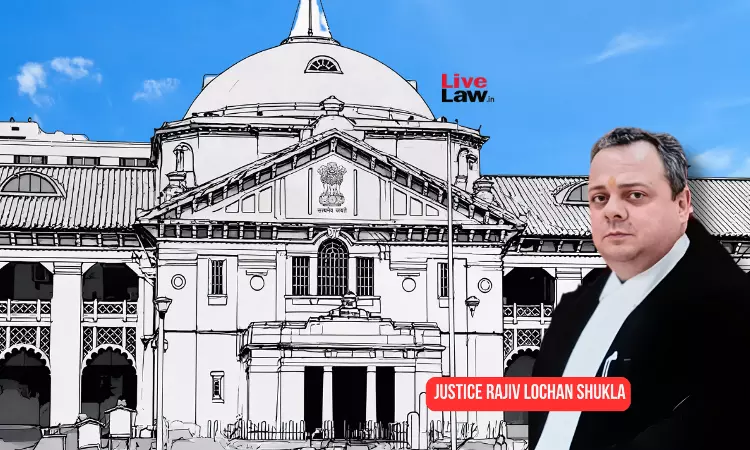
The Allahabad High Court has held that the routine practice prevalent in the Family Courts of issuing warrants for recovery and arrest simultaneously is illegal and inhumane and the same must stop. A bench of Justice Rajiv Lochan Shukla observed that a person liable to pay maintenance is not to be treated as a person who has committed a crime and the dignity and liberty of...
This is a premium content
Available exclusively to
Our subscribers
Subscribe Premium 
INR 1099+GST
Your support helps us to bring you more content at
an affordable subscription scheme !!!
All payment options available
The Allahabad High Court has held that the routine practice prevalent in the Family Courts of issuing warrants for recovery and arrest simultaneously is illegal and inhumane and the same must stop.
A bench of Justice Rajiv Lochan Shukla observed that a person liable to pay maintenance is not to be treated as a person who has committed a crime and the dignity and liberty of such an individual cannot be trampled upon by the Courts to enforce a maintenance order
"His personal dignity and liberty cannot be trampled with by the Courts in their excessive enthusiasm in enforcement of orders of maintenance, even if they come to a finding that there has been a deliberate non-payment of arrears of maintenance pursuant to an order of Court", the Court remarked.
The Single Judge thus set aside an order passed by the Additional Principal Judge, Family Court, Aligarh, wherein a recovery and arrest warrants against the petitioner were issued to recover arrears of maintenance.
The plea was filed by one Mohammad Shahzad under Section 528 BNSS, challenging the Family Court's order.
Before the High Court, his counsel argued that, as per the Supreme Court's decision in the cases of Rajnesh vs. Neha & Another (2021), while maintenance orders must be enforced, the procedure cannot contravene specific statutory provisions.
On the other hand, the AGA appearing for the State also admitted that no arrest warrants can be issued for recovery of arrears of maintenance without first following the procedure prescribed under Sections 125(3) and 128 CrPC.
The AGA, however, submitted that the applicant had previously defaulted on payment instalments directed by the High Court.
High Court's observations
Justice Shukla referred to the provisions contained under Section 125(3) and Section 421 of the CrPC to note that recovery of the arrears of maintenance can be made in the manner provided for levying fines.
The Court explained that under Section 421 CrPC, a warrant for the levy of a fine is executed by attachment and sale of movable property or by authorising the Collector to realise the amount as arrears of land revenue.
The Court noted that the proviso to Section 421 expressly provides that "no such warrant shall be executed by the arrest or detention in prison of the offender."
The bench added that it is only on failure to deposit the amount or arrears remaining after execution of the warrant, that imprisonment can be awarded.
"Section 125(3) Cr.P.C. clearly indicates that efforts are to be made, first, to recover the arrears of maintenance/enforce the order of maintenance in the manner provided for levying fines, and if the warrant is not executed or is partially executed, the Court may sentence the person, directed to pay the maintenance amount, to imprisonment for the whole or any part of each month's allowance for maintenance, interim maintenance, or expenses of proceedings, as the case may be, which remain unpaid after the execution of the recovery warrant. Thus, the simultaneous issuance of warrants for recovery and arrest is not contemplated under the Code of Criminal Procedure. Even the directions given by the Supreme Court do not contemplate any such practice", the Bench remarked.
In view of this observation, the Court took a stern view of the procedure adopted by the Family Court in the present case, as it observed that the issuance of arrest warrants was not merely a misinterpretation of the law but an overreach of its jurisdiction.
The bench also added that it has come across a number of cases in which the Family Court has passed orders to issue warrants of arrest along with recovery warrants, and, in some cases, non-bailable warrants, as if the defaulter is an accused.
"This is clearly against specific statutory provisions and the directions given by the Supreme Court in the case of Rajnesh", the bench noted.
Notably, the Court also addressed another argument that maintenance orders should be executed strictly as money decrees under the CPC, specifically Sections 51, 55, 58, and 60 read with Order 21.
The High Court clarified that while the Family Courts Act, 1984, allows Family Courts to lay down their own procedure, Section 18(2) of the Act clearly provides that an order passed under Chapter IX of the CrPC (which includes Section 125) shall be executed in the manner prescribed for the execution of such order by the CrPC.
Referring to the Uttar Pradesh Family Courts Rules, 2006, the Court noted that Rule 36 allows for attachment of salary as provided in the CPC.
However, the Court interpreted this as a provision in addition to the mode of recovery provided in sub-section (3) of Section 125 CrPC and not a replacement for it.
The Court held that the provisions of the CPC apply only to salaries and that the entire chapter on the execution of decrees cannot be made applicable, as the CrPC is exhaustive in the enforcement of maintenance orders.
Against this backdrop, the High Court directed that the practice of issuing arrest warrants along with recovery warrants must stop. The Court pointed out the correct procedure:
First, a notice be issued to the person who has been ordered to pay maintenance
Second, if sufficient cause is not shown by him, then warrants for recovery have to be issued in the manner provided for levying fines (Section 421 CrPC).
Thereafter, only upon the failure to recover the amount through this mode, imprisonment can be considered.
Consequently, the application was allowed. The High Court set aside the impugned order and the matter was remitted back to the Additional Principal Judge, Family Court, Court No. 2, Aligarh, to decide the application strictly in accordance with statutory provisions.
Case title - Mohammad Shahzad vs. State Of U.P. And 2 Others 2026 LiveLaw (AB) 50
Case citation : 2026 LiveLaw (AB) 50
Tags

Sparsh Upadhyay
Sparsh Upadhyay is an Associate Editor with LiveLaw.

