



- Home
- /
- High Courts
- /
- Allahabad High Court
- /
- Tenant's Right To Seek Re-Entry...
Tenant's Right To Seek Re-Entry Need Not Be Decided Before Building Is Released For Demolition: Allahabad High Court
Upasna Agrawal
24 Nov 2026 9:00 AM IST
The Allahabad High Court has held that the right of re-entry available to an original tenant under Section 24(2) of the Uttar Pradesh Urban Buildings (Regulation of Letting, Rent and Eviction) Act, 1972 cannot be read as an additional requirement to be satisfied before a building is released for demolition and new construction under Section 21(1)(b) of the Act. It held that the absence of...
This is a premium content
Available exclusively to
Our subscribers
Subscribe Premium 
INR 1099+GST
Your support helps us to bring you more content at
an affordable subscription scheme !!!
All payment options available
The Allahabad High Court has held that the right of re-entry available to an original tenant under Section 24(2) of the Uttar Pradesh Urban Buildings (Regulation of Letting, Rent and Eviction) Act, 1972 cannot be read as an additional requirement to be satisfied before a building is released for demolition and new construction under Section 21(1)(b) of the Act.
It held that the absence of a finding on the tenant's eventual claim to allotment in the reconstructed building, or of an undertaking by the landlord in that regard, does not by itself invalidate an otherwise sustainable release order.
Section 21(1)(b) of the Act, 1972 empowers the Prescribed Authority to order eviction of a tenant where the building is in a dilapidated condition and is required for demolition and new construction.
Rule 17 of the Rules, 1972 requires the authority to satisfy itself that the building requires demolition, that a proper estimate of expenditure has been prepared, that a plan has been duly prepared in conformity with local bye-laws, and that the landlord has the financial capacity for the work.
Section 24(2) provides that where the landlord, after obtaining such release, demolishes the building and constructs a new one on its site, the District Magistrate may allot the new building to the original tenant on his application, at rent equivalent to one per cent per month of the cost of construction, excluding the value of the land. Under Rule 20, that application must be made within one month of completion of construction.
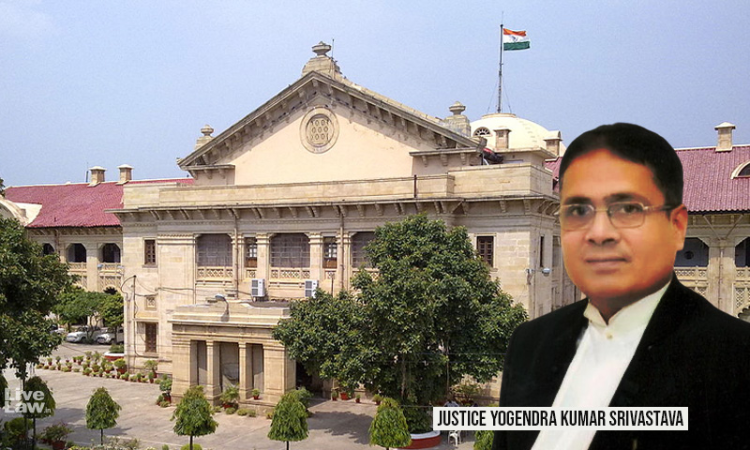
Justice Dr. Yogendra Kumar Srivastava held,
“The right available under Section 24 cannot, therefore, be construed as introducing an additional requirement for release which is not prescribed under Section 21(1)(b) or Rule 17.”
Respondent-landlady instituted release proceedings in 2018, claiming ownership of a property at Colonelganj, Kanpur Nagar under a registered sale deed of 2012. Petitioner occupied a ground floor shop measuring about 18 feet by 5.87 feet at a monthly rent of Rs.100/-. It was pleaded that the building was 90 to 100 years old, had become dilapidated, and that the other tenants had either vacated or settled their claims.
Petitioner, asserting that the shop had been allotted to him in 1993, disputed the dilapidated condition and pleaded that the structure was sound and could be maintained through ordinary repairs.
The Prescribed Authority dismissed the application, holding that the landlady had failed to establish compliance with Rule 17, and finding deficiencies in the material on the condition of the building, the estimate of expenditure, the proposed plan and her financial capacity.
In appeal under Section 22, the landlady sought to bring additional documents on record, including an engineer's estimate for the demolition and reconstruction and her income-tax return for the assessment year 2018-19, asserting that these existed earlier but had not been filed owing to an oversight by the previous counsel. Over petitioner's objection that the documents had always been available, the appellate court allowed the application by order dated 26.11.2025, referring to its power under Section 34 of the Act to receive evidence on affidavit. It thereafter allowed the appeal and directed petitioner to vacate the shop within thirty days.
Petitioner challenged the appellate judgment under Article 227 and the order permitting additional evidence under Article 226, both decided by a common judgment. It was contended that the conditions in Order XLI Rule 27 of the Code of Civil Procedure, 1908 had to be satisfied before additional evidence could be admitted. It was further contended that Sections 21(1)(b) and 24(2) read with Rule 17 had to be construed conjointly, and that the appellate court was required to examine whether the proposed reconstruction left petitioner's right under Section 24(2) capable of being exercised.
Counsel for the landlady submitted that the inquiry under Section 21(1)(b) read with Rule 17 was confined to the statutory requirements governing release, and that the right under Section 24(2) was to be exercised before the District Magistrate after reconstruction. That possession had been taken and the building demolished was not disputed.
On the additional evidence, the Court held that the appellate authority's power to receive it in an appeal under Section 22 flows from Section 22 read with Section 10(2) of the Act, and not from Section 34(1)(b), which deals with receiving evidence on affidavits.
“The two provisions operate in their respective fields and cannot be treated as interchangeable.”
Relying on Govind Prasad (D) and others v. Mukut Bihari and Rajkumar v. Nasir Ahmad and others, the Court held that the power under Section 10(2) is more liberal than Order XLI Rule 27 but not unrestricted, the principles of that provision serving as guiding principles rather than applying of their own force.
It held that the oversight of previous counsel would not by itself establish due diligence, but the appellate court was independently competent to admit the documents on finding them necessary for effective adjudication of the Rule 17 requirements. Petitioner having been given an opportunity to lead rebuttal evidence, the order did not warrant interference.
On Section 24(2), the Court held that the right of re-entry is a direct statutory consequence of a release order under Section 21(1)(b) and not an independent remedy, proceedings under Section 24(2) being a continuation of those under Section 21(1)(b). It noted that in Karamat Ullah v. District Judge, Kanpur and others the proposed plan had been held to require minute examination to ensure the tenant's option of re-entry was not defeated, and that in Riazur Rahman Khan and Rafeeq Ahmad conditions as to the time for reconstruction had been imposed.
“A statutory right cannot be construed in a manner that renders its exercise illusory.”
The Court held that the obligation at the stage of release is to examine the proposed reconstruction in the context of the tenant's statutory right and ensure that the plan does not render its exercise impossible or illusory, without encroaching upon the District Magistrate's jurisdiction over allotment. It held that the tenant can claim neither a particular unit nor accommodation identical to the premises he occupied, but the reconstruction cannot proceed in a manner excluding any meaningful possibility of his seeking allotment.
It held that undertakings or conditions relating to reconstruction may be considered on the facts of an individual case but cannot be elevated into an inflexible statutory requirement which must invariably precede release.
“The absence of a specific finding regarding an undertaking or a condition relating to the future allotment of accommodation under Section 24(2), by itself, does not invalidate an otherwise sustainable order of release.”
Noting that the appellate court had examined the engineering report, the municipal inspection report, the estimate, the financial particulars and the proposed plan, and had recorded findings on each requirement of Rule 17, the Court held that no perversity or error of law warranting supervisory interference had been demonstrated.
Accordingly, both petitions were dismissed, with a clarification that the dismissal would not preclude petitioner from invoking the remedy under Section 24(2) at the appropriate stage, and that the observations made would not be construed as an opinion on his entitlement under that provision.
Counsel for Petitioner :- Jitendra Pratap Singh, Kirti Kumar Nirkhi, Shobhit Saxena
Counsel for Respondent :- Sikandar Raza
Tags


