'Sordid State Of Affairs': Allahabad High Court Says UP Police Are A 'Law Unto Themselves', Declares Man's Detention Unlawful
Sparsh Upadhyay
15 Oct 2026 11:41 AM IST
The Allahabad High Court has once again criticized the Uttar Pradesh Police over the unlawful detention of a man before his formal arrest, observing that the police appeared to be acting as a "law unto themselves".
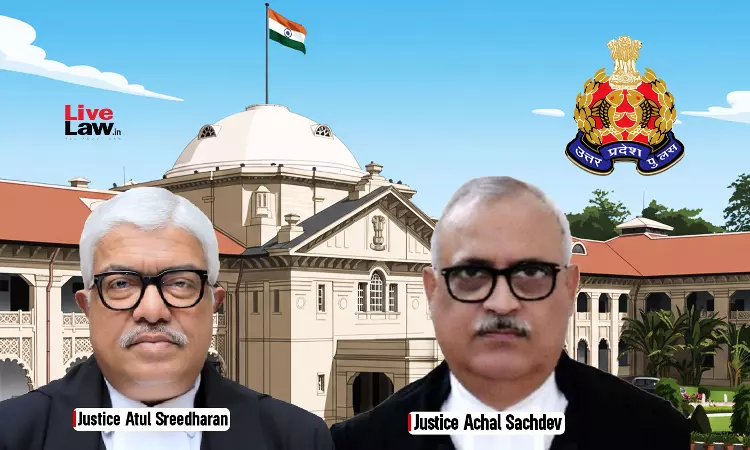
A Bench of Justice Atul Sreedharan and Justice Achal Sachdev allowed a habeas corpus petition filed by a man while holding his detention in police custody to be 'unlawful'. The Court directed his immediate release, if he was not required in any other case.
"This case reflects the sordid state of affairs prevailing in the Uttar Pradesh Police", the Bench observed.
"Repeatedly, cases have come before this Court in which the strict requirements of law, both procedural and substantive, have not been adhered to in letter and spirit. Documents appear to have been prepared and executed as a mere formality, replete with errors that raise serious doubts about the legality of the detention and arrest of the petitioner and others similarly situated. It appears that the police are a law unto themselves", it added.


Regarding the present case, the Court noted that the police had failed to comply with the procedural requirements of preventive detention under Sections 126 and 130 BNSS.
Case in brief
Briefly put, an incident of violence took place between two groups on August 23, 2026. Police records show that Deepak (petitioner) and four others were taken into custody at 7:34 PM on August 23 under Sections 126, 135, and 170 of the Bharatiya Nagarik Suraksha Sanhita (BNSS).
On the same day, an FIR under relevant sections was registered at 9:39 PM, based on a written report. In this FIR, the petitioner was formally arrested on August 24 at 2:57 pm.
However, the undisputed sequence was that the petitioner was already in police custody before the FIR was registered and was subsequently shown as formally arrested in that FIR while he remained in police custody.
High Court's observations
Beyond the pre-FIR custody issue, the Bench also found serious discrepancies in the arrest-related documents. The grounds of arrest referred generally to "material based on FIR and evidence", which the Court considered 'perfunctory'.
It noted that the IO signed the grounds of arrest dated August 23, although the arrest date in the document was August 24. The personal search and seizure document also bore the officer's signature and the date August 23 at two places.
Although the IO explained that the dates were errors, the Court was not persuaded, noting that the discrepancy appeared in 5 places and had not been corrected or authenticated.
The bench noted that the preventive-proceedings papers also left the bond amount blank and did not bear the signature, date or time necessary to indicate whether the Assistant Commissioner of Police had accepted or rejected the bond papers.
The Section 130 notice was purportedly issued on August 24 in the name of ACP-I but signed by ACP-II Kamlesh Kant.
Considering these circumstances, the Bench said there appeared to be a strong prima facie case that the relevant document was filled up at a later stage and that the signature of the petitioner was obtained on a blank paper and countersigned by Mr. Anuj Kumar himself, leaving the portion above blank for the grounds of arrest to be filled in later.
Though the state argued that the situation was tense, with a crowd present, and therefore the police had acted in good faith to prevent escalation, the Court remarked that it did not absolve the police of their obligation.
"…the situation on the ground does not absolve the police of errors committed by them in failing to proceed strictly in accordance with law. It is for the police to understand that all the provisions in the Cr.P.C./BNSS providing protection to a person sought to be detained arise from the constitutional protection guaranteed under Article 22(1)", the Court remarked.
The Bench expressed concern that the police had shown insufficient regard for civil liberties. It observed thus:
"The narrative of the facts herein reflects that the police are acting in a manner that demonstrates their lack of concern for the civil liberties of ordinary citizens and their propensity to make arrests without exploring the option of whether the case can proceed without such arrest or detention."
The Court further observed that the Magistrate had gravely erred by failing to scrutinise the police papers for compliance with the applicable legal requirements.
The Court described ACP Kamlesh Kant and IO Anuj Kumar as "highly ignorant" of BNSS procedures and criticized their cavalier approach to the statutory requirements.
It requested the Director General of Police, Uttar Pradesh, to prepare better police training modules to sensitise officers to civil liberties and the procedures that must be followed before arrest or detention.
Referring to instances of suspects allegedly being kept in police stations for more than 24 hours and subsequently released, the Bench warned:
"Henceforth, such action on the part of the police shall not be tolerated on the ground of lack of knowledge of procedure and shall be deemed to be malicious unless the police provide material enabling the Court to take a contrary view".
The Court also directed that its observations expressing displeasure against ACP Kamlesh Kant andIO Anuj Kumar be recorded in their respective service books.
Allowing the habeas corpus petition, the Bench declared the petitioner's detention unlawful and directed his release forthwith, provided he was not wanted in another case.
Advocates Arpit Malviya and Awadhesh Kumar Malviya appeared for the petitioner.