



Wife Who Cultivates Husband's Land Can Claim Farmers' Accident Relief: Allahabad High Court
Upasna Agrawal
3 Nov 2026 12:05 PM IST
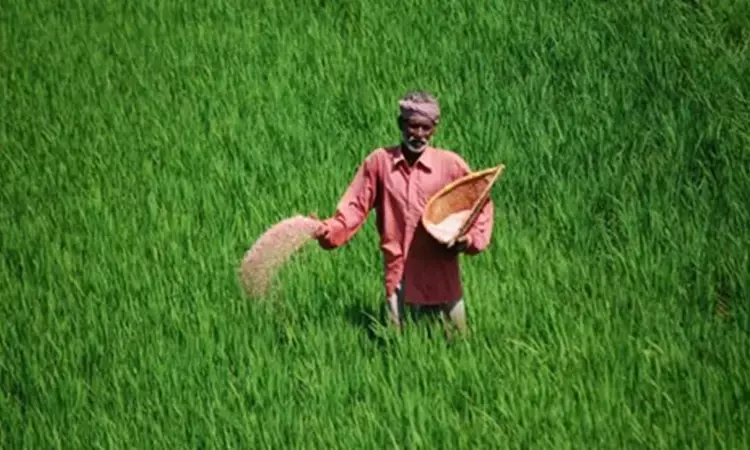
The Allahabad High Court has held that a woman who does agricultural work on a land recorded in her husband's name, and whose principal source of livelihood is the agricultural income from that land, is an 'earning member' of the family under Clause 2(2) of the Mukhyamantri Krishak Durghatna Kalyan Yojana (CM Farmers' Accident Relief Scheme).
It held that her claim cannot be rejected merely because she was neither a recorded tenure-holder nor a bataidar (tenant).
Clause 2 of the Scheme, introduced by Government Order dated 28.02.2020 with effect from 14.09.2019, defines a farmer in three alternative categories: a tenure-holder or co-tenure-holder recorded in the Khatauni; an earning member (breadwinner) of such a holder's family whose principal source of livelihood is agricultural income from the recorded land; and a landless person cultivating land taken on lease or on share-cropping.


The bench of Justice Prakash Padia and Justice Garima Prashad held,
“Agricultural work within a family may be undertaken jointly by the spouses. A wife's contribution to cultivation is not excluded merely because she also attends to the household. Her status as an earning member is determined by the work she performs and the livelihood she derives from it. A separate wage paid by her husband for work on the family holding is not a condition stated in Clause 2(2).”
Petitioner's wife, Smt. Meera, died in a road accident on 20.08.2020. He applied under the Scheme on 31.10.2020, relying on the Khatauni, which records him as a co-tenure-holder along with his brothers, the First Information Report, the death certificate and the family-register extract. The District Magistrate, Kushinagar rejected the claim on 24.05.2022 on the ground that the deceased had no land in her name and was not a bataidar.
Petitioner pleaded that the deceased cultivated the holding recorded in his name, that the family lived on her earnings, and that the authority had overlooked the separate category of earning family members. The State pleaded that she was a household lady, was not recorded as a co-tenure-holder, and that no documentary proof of her co-sharer status had been filed.
The Court observed that the three categories in Clause 2 are alternative bases of eligibility, and that a claimant under Clause 2(2) need not also establish recorded title under Clause 2(1) or bataidar status under Clause 2(3).
“Requiring the land to stand in the deceased's own name would remove the distinction between Clauses 2(1) and 2(2) and deprive the latter provision of its purpose.”
It held that Clause 2(2) does not require the earning member to be the sole breadwinner, and that the husband's own holding or earnings do not exclude a wife who works on the land and depends on its income. On the First Information Report's mention of a tea shop run by the petitioner, the Court held that his shop earnings did not show that the deceased drew her principal livelihood from that activity.
The Court relied on the Division Bench decisions in Smt. Gayatri Devi v. State of U.P. and others, holding that the Scheme does not require the holding to be recorded in the deceased's own name, and Rajesh Kumar v. State of U.P. and others, holding that land recorded in an elder family member's name did not exclude the spouses who cultivated it.
Noting that the State had placed no material showing that the deceased's principal source of livelihood was anything other than agriculture, the Court allowed the writ petition and quashed the order dated 24.05.2022. The District Magistrate, Kushinagar was directed to pass a fresh order on the claim within four weeks.


