



- Home
- /
- High Courts
- /
- Allahabad High Court
- /
- Writ Court Can't Decide A Party's...
Writ Court Can't Decide A Party's Eligibility On Oral Submission Made Across The Bar: Allahabad High Court
Upasna Agrawal
31 Oct 2026 11:30 AM IST
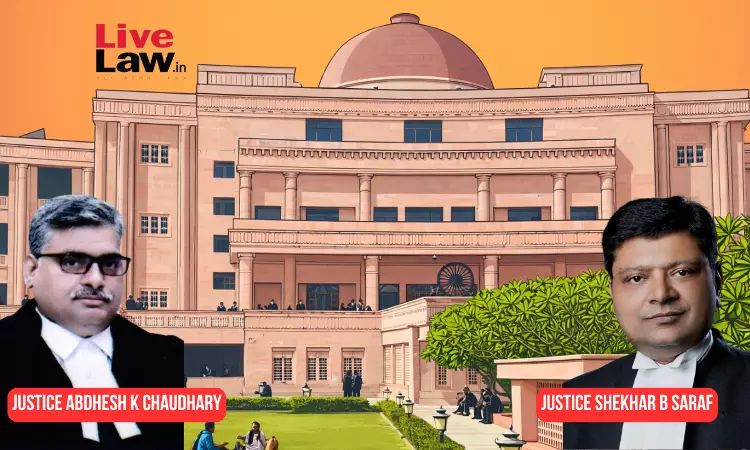
The Allahabad High Court has held that where a writ petition turns on disputed or unverified facts going to the eligibility of a third party, the Court must ordinarily call for a counter-affidavit before recording a finding of fact against a party who has had no opportunity to place his version on record. Setting aside a Single Judge's order to that extent, it held that the eligibility of...
This is a premium content
Available exclusively to
Our subscribers
Subscribe Premium 
INR 1099+GST
Your support helps us to bring you more content at
an affordable subscription scheme !!!
All payment options available
The Allahabad High Court has held that where a writ petition turns on disputed or unverified facts going to the eligibility of a third party, the Court must ordinarily call for a counter-affidavit before recording a finding of fact against a party who has had no opportunity to place his version on record.
Setting aside a Single Judge's order to that extent, it held that the eligibility of the officer granted officiating charge of the post of Chief Town and Country Planner could not be decided on a statement from the Bar, unsupported by any affidavit or certificate.
The bench of Justice Shekhar B. Saraf and Justice Abdhesh Kumar Chaudhary held,
“..where the resolution of the controversy turns upon disputed or unverified facts, particularly facts going to the eligibility of a third party whose interest is directly affected by the decision, the Court ought ordinarily to have the benefit of a counter-affidavit before recording a finding of fact adverse to a party who has had no opportunity to place his version on record..”
Appellant Ashok Kumar, an Executive Engineer in the Department of Town and Country Planning, challenged the order dated 04.11.2025 entrusting officiating charge of the post of Chief Town and Country Planner to respondent no. 4, an Architect Planner. Under the Uttar Pradesh Town and Country Planning Service Rules, 1987, the post is filled by promotion from Senior Planners, for which Appendix 'B' prescribes a degree or post-graduate diploma in Town and Country Planning.
The Single Judge dismissed the challenge on 09.12.2025, holding that Appendix 'B' prescribes no equivalence and that the Court cannot read in a condition omitted by the rule-making authority, and that the clarification of the All India Council for Technical Education equating the Associateship Examination of the Institute of Town Planners, India with a Master's Degree in Planning pertained to Central Government service. It held that there is no estoppel against a statute. The State was, however, directed to constitute a Departmental Promotion Committee for the post of Senior Planner within six months.
In appeal, the appellant argued that the petition had been decided in limine without a counter-affidavit, and that the finding that respondent no. 4 held the prescribed qualification rested solely on an oral submission of the Additional Advocate General. The certificate produced for the first time in appeal showed a Master's Degree in Urban Development Planning from Barkatullah University, which, it was contended, is not what Appendix 'B' prescribes.
The State did not seriously dispute this, and the Court held that the premise on which the impugned judgment rested stood falsified.
“..a finding resting on a foundation now shown to be erroneous cannot be allowed to conclude the rights of the parties, and the least that fairness demands is that the matter be re-examined on verified material..”
No counter-affidavit having been called for, the appellant had no occasion to meet the submission, and respondent no. 4's ineligibility on the very test that disqualified the appellant went unexamined. This, the Court held,
“offends the elementary requirement that no person (nor a party's substantive case) should be condemned or defeated on a factual finding without being heard on the material said to support it”
Relying on Zahoor Ahmad Rather v. Sheikh Imtiyaz Ahmad and Bedanga Talukdar v. Saifudaullah Khan, on strict testing of eligibility against the qualification prescribed, the Court held that the Single Judge, having ruled out equivalence, was bound to examine whether respondent no. 4 held the exact qualification stipulated.
“it would be wholly incongruous for the very rigour applied to the appellant's qualification to be relaxed, in the same judgment, into an unverified oral acceptance where respondent no. 4's qualification was concerned.”
Allowing the Special Appeal in part, the Court set aside the order dated 09.12.2025 insofar as it dismissed prayer nos. 1 and 2 and restored the writ petition to that extent for fresh consideration, directing counter-affidavits within three weeks and a rejoinder within one week thereafter.
The direction to constitute the Departmental Promotion Committee was left undisturbed, and the existing officiating arrangement was allowed to continue subject to the outcome, conferring no equity on respondent no. 4. Noting that the appellant superannuates on 31.12.2026, the Court requested the Single Judge to decide the remanded proceedings preferably within two months.
Tags


