



- Home
- /
- High Courts
- /
- Allahabad High Court
- /
- Writ Petition For Contractual Dues...
Writ Petition For Contractual Dues Against State Not Entertainable Unless Amount Is Admitted: Allahabad High Court
Upasna Agrawal
17 Aug 2026 11:15 AM IST
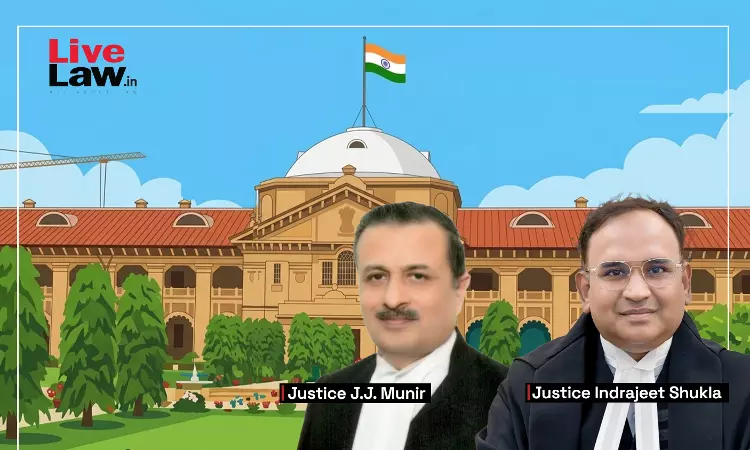
The Allahabad High Court has held that a writ petition seeking payment of contractual dues can be entertained against the State only where the dues are admitted. The bench of Justice J.J. Munir and Justice Indrajeet Shukla held,“We are conscious of the fact, that every writ petition seeking payment of contractual dues cannot be thrown out and can very well be entertained against the State...
This is a premium content
Available exclusively to
Our subscribers
Subscribe Premium 
INR 1099+GST
Your support helps us to bring you more content at
an affordable subscription scheme !!!
All payment options available
The Allahabad High Court has held that a writ petition seeking payment of contractual dues can be entertained against the State only where the dues are admitted.
The bench of Justice J.J. Munir and Justice Indrajeet Shukla held,
“We are conscious of the fact, that every writ petition seeking payment of contractual dues cannot be thrown out and can very well be entertained against the State and its instrumentalities if the amount of money due under contract is admitted and no inquiry is required to ascertain the facts. But, where facts are so disputed that these cannot be decided without leading evidences by rival parties, this Court must lay its hands off while exercising our writ jurisdiction.”
Petitioner, a cooperative society registered under the Cooperative Societies Act, 1965 and licensed to manufacture AYUSH medicines, received a supply order 17 from the office of the Chief Medical Officer, Allahabad and supplied the medicines. It claimed to have paid GST of Rs. 2,00,000 and pleaded that there was no fault or deficiency in the supply.
Its bills remained unpaid. On an earlier writ petition, the Court directed the Chief Medical Officer to decide the pending representation within eight weeks, and by order dated 8th October 2018 he refused to pass the bills. That order was challenged in the present petition, along with a prayer for a mandamus directing payment with 18% interest.
The Court observed that the grounds on which payment had been refused threw up disputed questions of fact: compliance with the procurement policy, the quality of the goods, their utilisation, the return of the medicines, the identity of the firm and limitation, none of which could be settled on affidavits, since facts must be proved by evidence tested in cross-examination.
“The fault/deficiency/quality in supply of medicine are contractual rights and obligations for which the private law remedies are best suited.”
On the certification of the Chief Pharmacist relied on by the petitioner, the Court noted that no such letter had been placed on record, and even assuming certification, the competence of the Chief Pharmacist to certify quantity and quality would itself arise for consideration. The plea that the registration of the empanelled manufacturers had expired while the petitioner's subsisted was held not to create any right in the petitioner's favour.
The Court relied on its decision in M/s Alaska Tech through its Partner Sanjeet Singh and another v. State of U.P. through Principal Secretary Urban Development and others, where it was held that a claim for dues under a non-statutory contract for supply of goods is in substance a prayer for a money decree, and that questions such as whether the goods were of the mandated quality, or whether the claim is within limitation, are not fit for adjudication under Article 226.
It also referred to the Supreme Court's decision in Hindustan Petroleum Corporation Limited and another v. Dolly Das, wherein it was held that absent a constitutional or statutory right, Article 226 cannot be availed of to claim money for breach of contract.
Holding that the petitioner's entitlement could not be determined without oral and documentary evidence, the Court declined to exercise its extraordinary jurisdiction and dismissed the writ petition. It clarified that the order would not preclude the petitioner from approaching the Civil Court or any other statutory forum, including arbitration.
Case Title: Kalyan Health Care Products Pharmaceuticals Co-Operative Society Limited v. State of U P and 4 others
Tags


