



- Home
- /
- High Courts
- /
- Allahabad High Court
- /
- Arya Samaj Marriage Certificate...
Arya Samaj Marriage Certificate Alone Can't Prove Valid Hindu Marriage; Essential Ceremonies Must Be Performed: Allahabad High Court
Sparsh Upadhyay
21 Sept 2026 1:52 PM IST
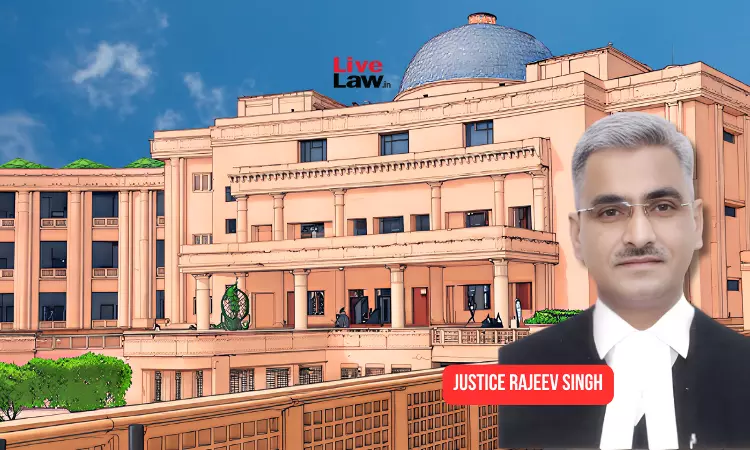
The Allahabad High Court has observed that merely producing a marriage certificate issued by an Arya Samaj Mandir cannot establish that a valid marriage was solemnized under the Hindu Marriage Act. The Court said that the essential ceremonies prescribed for a Hindu marriage must be performed. A bench of Justice Rajeev Singh observed thus while quashing the removal of an officer of the...
This is a premium content
Available exclusively to
Our subscribers
Subscribe Premium 
INR 1099+GST
Your support helps us to bring you more content at
an affordable subscription scheme !!!
All payment options available
The Allahabad High Court has observed that merely producing a marriage certificate issued by an Arya Samaj Mandir cannot establish that a valid marriage was solemnized under the Hindu Marriage Act. The Court said that the essential ceremonies prescribed for a Hindu marriage must be performed.
A bench of Justice Rajeev Singh observed thus while quashing the removal of an officer of the Sashastra Seema Bal (SSB) who had been removed from service on the ground that he had made a false declaration about his marital status.
Case in brief
Briefly put, a complaint was made alleging that the petitioner (Rohit Pandey), had married the complainant (Sucheta Tiwari), at an Arya Samaj Mandir in 2007. The authorities treated the alleged marriage as an existing marriage and relied upon it while passing the removal order against Pandey.
The Court noted that the controversy essentially revolved around the complaint alleging that Pandey had married Tiwari at an Arya Samaj Mandir.
The petitioner had argued that there was no evidence of a valid marriage according to Hindu rituals and that Tiwari herself had admitted during the trial of a criminal case that the marriage had not been solemnized according to Hindu rituals and Saptpadi.
The respondent authorities, on the other hand, relied on the departmental inquiry, in which Tiwari stated that the marriage had been solemnized at an Arya Samaj Mandir in August 2007.
The priest of the Arya Samaj Mandir was also examined and stated that the marriage had been solemnized in his presence. Notary certificates were also produced.
The authorities therefore contended that Pandey had made an incorrect declaration upon entering service by stating that he was unmarried.
High Court's observations
The High Court referred to the Supreme Court's decision in Priya Bala Ghosh v. Suresh Chandra Ghosh 1971.
The Court observed that under the Hindu Marriage Act, a marriage is valid only when it is performed with the essential ceremonies of Hindu rituals and Saptpadi.
Importantly, the Court noted that the complainant herself had stated during the trial that the marriage had not been solemnized according to Hindu rituals.
Referring to Priya Bala Ghosh, the Court observed thus:
"...merely on the basis of placing any certificate of Arya Samaj Mandir, it cannot be said that marriage was solemnized as per Hindu Marriage Act".
The Court consequently held that the finding in the removal order that the petitioner's marriage to Sucheta Tiwari had already been solemnized lacked substance.
The authorities had also relied upon the allegation that Pandey had first married Tiwari on August 16, 2007, and subsequently married another woman, Sadhana Tiwari, on December 13, 2015.
The High Court held that, in view of the law laid down by the Supreme Court in Priya Bala Ghosh, the alleged 2007 marriage "cannot be held to be a marriage in the eyes of law".
Consequently, it could not be treated as a ground for holding Pandey unsuitable for service.
Finding the removal order unsustainable, the High Court quashed and set aside the impugned order dated April 28, 2022.
The writ petition was allowed and the respondents were directed to permit Pandey to resume his duties forthwith.
However, the period from April 28, 2022 until the date of the judgment was directed to be treated as "No work, No pay", though without treating it as a break in service.
Case Title - Rohit Pandey vs. Union of India Thru.Secy. Ministry of Home Affairs and 3 Other 2026 LiveLaw (AB) 731
Case Citation: 2026 LiveLaw (AB) 731
Tags

Sparsh Upadhyay
Sparsh Upadhyay is an Associate Editor with LiveLaw.

