



- Home
- /
- High Courts
- /
- Allahabad High Court
- /
- Invoking Kautilya, Allahabad High...
Invoking Kautilya, Allahabad High Court Flags Senior IAS Officer's Conduct To DoPT For Resisting HC Directives On Police Reforms
Sparsh Upadhyay
4 Jun 2026 5:51 PM IST
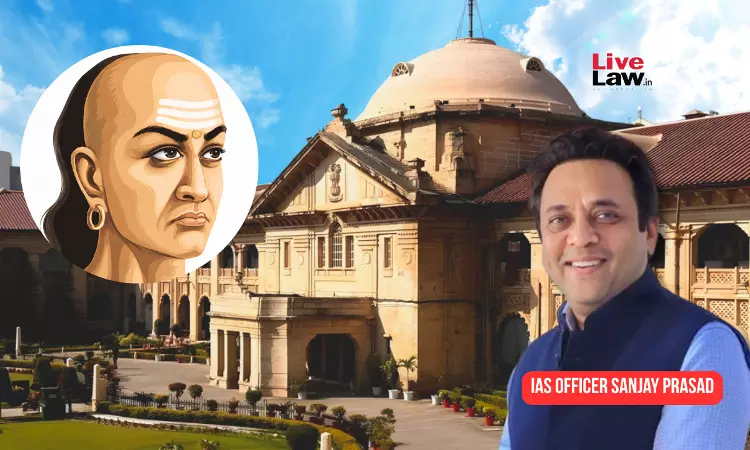
In an unprecedented order, the Allahabad High Court on Wednesday referred the conduct of Senior IAS Officer Sanjay Prasad to the Dept of Personnel and Training (DoPT) for the assessment of his suitability for future assignments by the Appointment Committee of the Cabinet (ACC). The stern order was passed by a bench of Justice Vinod Diwakar, who took exception to the deliberate...
This is a premium content
Available exclusively to
Our subscribers
Subscribe Premium 
INR 1099+GST
Your support helps us to bring you more content at
an affordable subscription scheme !!!
All payment options available
In an unprecedented order, the Allahabad High Court on Wednesday referred the conduct of Senior IAS Officer Sanjay Prasad to the Dept of Personnel and Training (DoPT) for the assessment of his suitability for future assignments by the Appointment Committee of the Cabinet (ACC).
The stern order was passed by a bench of Justice Vinod Diwakar, who took exception to the deliberate and calculated attempt of Prasad, serving as Additional Chief Secretary (Home), Government of UP, to undermine the authority of the Court.
To set the tone for the reprimand, the Court quoted Kautilya's Arthashastra regarding the conduct of government servants. Justice Diwakar noted that Kautilya prescribes that Superintendents of Government Departments must be examined daily while discharging their duties.
"…for men are by nature fickle-minded and, like horses at work, exhibit constant changes in their temperament. Accordingly, the agencies and instruments of which they avail themselves, the place and time of the work in which they are engaged, as well as the precise form of the work, the expenditure incurred, and the results achieved, shall all be daily ascertained", the Court noted, referring to the Arthasastra (Second Book, Chapter IX)
The Court observed that this ancient wisdom remains as relevant to the governance of public administration today as it was when first articulated almost 2300-2400 years ago.
Briefly put, the Court was dealing with a habeas corpus petition by one Megha Raikwar seeking direction to the State authorities to recover her 15-year-old daughter (corpus) from the alleged illegal custody of respondent no.5.
The Court was apprised that an FIR was lodged and subsequently, the police filed a charge-sheet based primarily on the statements of the accused. However, it was submitted that the charge-sheet was filed without arraying the 'real' accused.
The bench found fault with the investigation, observing that it wasn't conducted in an effective, fair, impartial, and comprehensive manner, thereby raising serious concerns.
Importantly, it also noted that the charge-sheet in the case had not been submitted in conformity with the directions issued by the High Court in Subhash Chandra & Others v. State of U.P. & Another, wherein exhaustive directions were issued to ensure that criminal investigations are fair, scientific, and legally sustainable.
To assess statewide compliance, the bench had earlier directed the police to place on record ten charge-sheets, one each from ten different districts.
Upon examination, it was found that in a number of cases, compliance with the Court's directives was not observed, which, the bench said, reflected a "lack of effective implementation of the aforesaid directions at the field level".
It also noted that the Home Department had not taken steps to ensure that the 'checklist' it prepared was uniformly implemented. Hence, the bench sought an explanation from the ACS (Home) regarding this persistent non-compliance.
In response, the Home Department filed an affidavit on February 20, 2026, stating that the State proposed to challenge HC's judgment in Subhash Chandra before the Supreme Court.
Therefore, it was urged to the Court to refrain from passing any further orders concerning the implementation or enforcement of the directions issued in the said judgment until the Supreme Court decides on the “proposed Special Leave Petition (SLP)” of the state government.
Though the Court deferred the matter and awaited information regarding the status of the proposed SLP, no information was provided to the Court till the time of dictation and signing of the order, despite a lapse of more than 3 months since February and more than 1 year since the judgment was passed.
Taking strong exception to the same, the bench observed that the proposed SLP was relied upon by the ACS (Home) merely as a justification for postponing scrutiny of the continued non-compliance of the directions, rather than as a bona fide and diligent effort to obtain an authoritative determination from the Supreme Court at the earliest opportunity.
"The facts on record, therefore, prima-facie indicates a lack of diligence on the part of incumbent ACS (Home)…such conduct has the effect of impeding effective consideration of the issue of compliance and cannot be viewed with approval by this Court…Such an approach, if sustained, has the potential to impede reforms intended to enhance transparency, professionalism, and accountability within the police machinery", the bench remarked.
Taking note of this state of affairs, the Court made a scathing commentary on the bureaucracy, observing that 'unbridled' and 'unchecked' discretion attached to the civil services undermines the rule of law and legal certainty and also frees public officials from accountability.
To combat this, the High Court recommended that the Secretary, Department of Personnel and Training, Government of India, evolve a doctrine of 'superior responsibility' to hold senior officers in a hierarchy criminally accountable for 'failure to prevent and/or punish acts of commission or omission' on the part of their subordinates.
"Superior officers must be held accountable for the conduct and performance of their subordinates, as it is their professional and administrative responsibility to ensure the effective delivery of public services. Such responsibility may be elevated to criminal liability, where the failure to prevent or punish subordinate misconduct leads to criminal acts such as corruption, fraud, wilful suppression, contempt of Government Orders and Gazette Notifications, and the failure to implement 'State Policy' and 'Programs', such as zero tolerance towards organised, institutionalised corruption- whether corruption of the mind, whereby the decision-making process is deliberately perverted to serve private ends under the guise of official authority, or corruption of the purse, whereby public office is converted into an instrument of personal pecuniary gain," the bench remarked.
[Note: This proposal echoes a similar observation made by Justice Diwakar in a separate matter on the same day. Read more about the same here: 'Corruption Of Mind & Purse': Allahabad HC Tells UP CM Time Has Come To Make Top Bureaucrats Criminally Liable; Here's Why
Regarding the deliberate and calculated attempt of the ACS (Home) to 'undermine' the authority of the Court, the bench directed the Registrar (Compliance) to transmit the order to the DoPT.
It further directed that the file be placed before the Appointment Committee of the Cabinet (ACC) to assess his suitability for future assignments.
On the merits of the case, the bench disposed of the petition, noting that the minor girl was safely recovered by the local police and restored to her parents.
Case title - Megha Raikwar vs State of U.P. And 4 Others 2026 LiveLaw (AB) 312
Case citation: 2026 LiveLaw (AB) 312
Tags

Sparsh Upadhyay
Sparsh Upadhyay is an Associate Editor with LiveLaw.

