Krishna Janmabhumi Dispute | Allahabad High Court Rejects Plea Challenging 1968 Land-Sharing Compromise With Idgah Trust
Sparsh Upadhyay
21 Nov 2026 5:30 PM IST
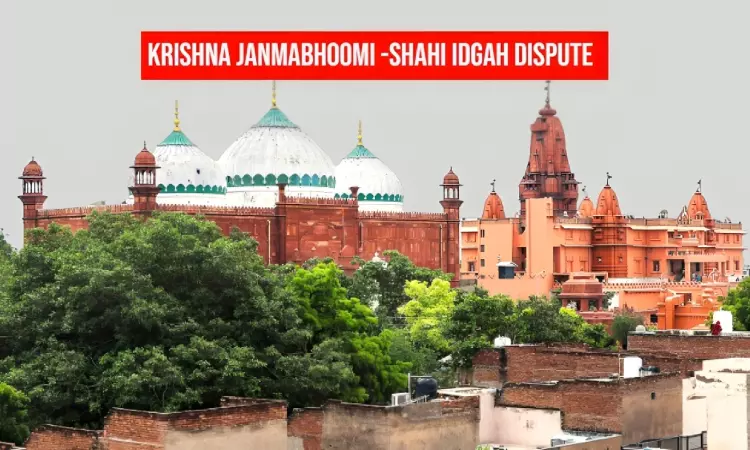
HC dismisses the plea without examining the validity of the 1968 compromise on merits; says the challenge requires a trial.
The Allahabad High Court on Friday dismissed an application seeking to declare a 1968 land-sharing compromise agreement between Shri Krishna Janmasthan Seva Sangh and the Trust Shahi Masjid Idgah as "null and void" and to cancel two decrees passed by a Mathura Court in 1973 and 1974.
A bench of Justice Avnish Saxena observed that the relief sought by way of application under disposal cannot be adjudicated without holding a trial as the same is the main relief in some of the connected suits concerning the disputed property.
The Court clarified that the application was dismissed without deciding the validity of the 1968 compromise.
"The same is devoid of merit and hence, dismissed without effecting the merit of other suits, as the application is not taken up on its merit," the Court said.
For context, the agreement in question (dated October 12, 1968) was entered into between Shri Krishna Janmasthan Seva Sangh and the Trust Shahi Masjid Idgah, dividing the disputed land and asking the 2 groups to stay away from each other's areas (within the 13.37-acre complex).


The compromise was filed in Civil Suit No. 43 of 1967 and the same was decreed in terms of the compromise through judgments dated July 20, 1973 and November 7, 1974.
The compromise sought to settle disputes between the Seva Sangh and the Idgah Trust, as well as certain Muslim Ghosis and other inhabitants who claimed to be tenants or licensees of the Idgah Trust. The agreement also referred to several civil and criminal cases pending between the parties.
As per the terms of the compromise, the northern and southern walls of the Idgah's "Kachchi Kursi" were to be extended eastwards up to the railway line.
The compromise provided that the Idgah Trust was to get the Muslim Ghosis and other inhabitants residing outside these walls vacated and hand over possession of that land to the Seva Sangh.
The agreement stipulated that the Seva Sangh would have no claim over the land within the northern walls, which would be treated as the property of the Idgah Trust.
It also provided that the Idgah Trust would make its "Kachchi Kursi" rectangular, with the specified land at its western-northern corner treated as its property.
The Trust was required to remove rubble of stairs on the southern side, after which the Seva Sangh would take possession of that land.
The agreement further provided that, after the occupants outside the northern and southern walls were evicted, possession would be handed over to the Seva Sangh.
No party was permitted to install doors, windows or grills or open drains or water outlets in walls facing the other side.
The compromise stated that the Seva Sangh would divert the Idgah's western-side water outlets through pipes and construct a masonry drain at its own cost.
It also agreed to hand over to the Idgah Trust, after acquisition, land falling in front of the Idgah within the northern and southern walls from the railway land being acquired by it.
The agreement provided that both parties would file compromise applications in their pending cases after fulfilling its conditions. The compromise also provided that either party could approach a court to enforce the agreement in case of non-compliance.
The agreement recorded that the Idgah Trust had obtained permission from the Waqf Board through a letter (dated September 9, 1968) and that the agreement had been adopted at a meeting held on October 8, 1968.
Now, before the High Court, the plaintiffs argued that the Seva Sangh, which entered into a compromise with the Idgah Trust, and the Shri Krishna Janmabhoomi Trust were separate legal entities.
It was specifically pleaded that the Seva Sangh had no authority to enter into the compromise or relinquish any part of the disputed property allegedly belonging to the Trust and the deity.
According to the plaintiffs, Seth Jugal Kishore Birla created the Shri Krishna Janmabhoomi Trust through a trust deed dated March 9, 1951 and endowed the property at Katra Keshav Dev to it.
They contend that the Seva Sangh, formed separately in 1958, had no ownership rights or authority to represent the Trust and, despite this, it entered into a compromise with the Idgah Trust, effectively giving up rights over the land where the Idgah stands as of today.
The plaintiffs further argued that the Janmabhoomi Trust was not a party to Civil Suit No. 43 of 1967 or the 1968 compromise.
They alleged that the Seva Sangh wrongly represented itself as being the same entity as the Janmabhoomi Trust and consequently entered into an agreement affecting property over which it had no authority.
On these grounds, they sought a declaration that the compromise be declared null and void and the decrees of 1973 and 1974 based on the said compromise be also cancelled.
Furthermore, it was prayed that the delivery of vacant and peaceful physical possession of the premises at Khasra No. 255, Deeg Gate, Mathura, be given to the deity.
Rejecting the application, the Court noted that the present suit was one of 18 suits concerning the same property, some of which had been consolidated.
It noted that since the relief sought through the application was also the main relief in some connected suits, the Court remarked that it could not be decided without a trial.
The application was accordingly dismissed as misconceived.
Apart from this, the High Court also dismissed three other applications in the same suit.
Application no. 114Ka2 was moved by plaintiff no. 1 (Shri Bhagwan Shrikrishna Lala Virajman) seeking impleadment of the direct descendants of Thakur Keshav Dev Ji, members of the Jadaun clan and others as parties to the suit and to recognise Sri Kaushal Kishore Thakur Ji as the next friend representing the deity.
The Court, however, found that there was no gainful purpose in impleading these parties in view of the fact that the deity was already represented by a next friend.
"Kaushal Kishore Thakur Ji, is already appearing in the suit being next friend of plaintiff no.1, what gainful purpose would be served impleading direct descendants of Thakur Keshav Dev Ji, Jadaun Clan and others is not properly disclosed. It is the interest of the plaintiff in the suit, who is a deity, which is the point of concern in respect to the cause of action and the relief sought. There is nothing in the application or in the arguments of learned counsel to show the gainful purpose for which other plaintiffs be included in the suit," the bench said,
Another application (132Ga2) by plaintiffs 2 to 5 sought recall of an earlier order rejecting their plea to remove Kaushal Kishore Thakur Ji as the deity's next friend. The Court dismissed the plea, finding no ground to recall the earlier order.
The fourth application (56Ga2) sought modification of an August 1, 2024 order rejecting applications under Order VII Rule 11 CPC in 15 connected suits.
The Court said that the changes sought were neither clerical nor arithmetical errors, nor errors arising from accidental slips or omissions, and dismissed the application.
All four applications in Original Suit No. 7 of 2023 were thus dismissed.
All 4 applications were argued by Advocates Reena N Singh and Anil Kumar Singh.
Counsel for Plaintiff(s): Ajay Pratap Singh, Akash Balmik, Amit Kumar, Anil Kumar Singh, Anil Kumar Singh Bishen, Damodar Singh, Devendra Vikram Singh, Leena Srivastava, Mahendra Pal Singh Gaur, Manish Kumar, Naman Kishor Sharma, R.u. Rinki Renu, Rana Singh, Sachin Singh, Satya Pal, Suman Srivastava, Sunil Singh, Vivekanand Yadav
Counsel for Defendant(s): Advocates Tasneem Ahmadi, Afjal Ahmad, Azim Ahmad Kazmi, Hare Ram, Nasiruzzaman, Pranav Ojha, Punit Kumar Gupta
Advocate Hari Shankar Jain appeared for plaintiffs in Suit no. 1, 9 and 16
Advocate Saurabh Tiwari appeared for plaintiffs no. 1 to 3 in Suit no. 9