



- Home
- /
- High Courts
- /
- Allahabad High Court
- /
- NDPS Act | IO's Oral Apprehension...
NDPS Act | IO's Oral Apprehension Of Seized Items Being Drug-Sale Proceeds No Ground To Withhold Them: Allahabad High Court
Sparsh Upadhyay
5 Sept 2026 2:10 PM IST
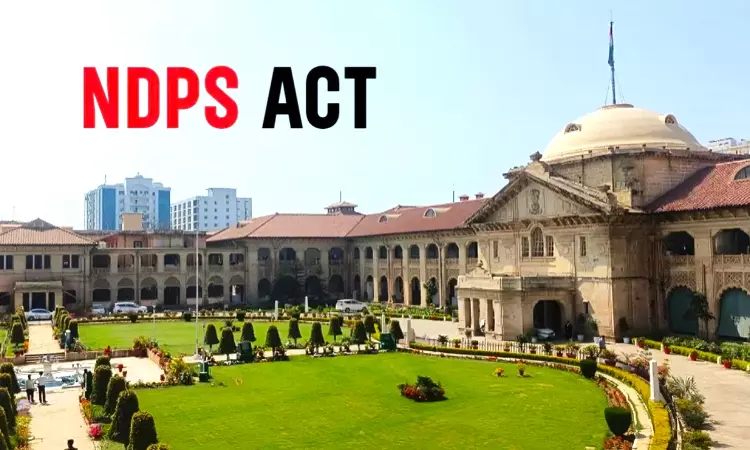
The Allahabad High Court has held that merely on the basis of the investigating agency's oral apprehension that articles recovered from an accused's personal search could be proceeds of illegal narcotics sale, the accused cannot be deprived of their use.A bench of Justice Dr. Gautam Chowdhary observed thus while setting aside an order of the Varanasi trial court refusing to release gold...
This is a premium content
Available exclusively to
Our subscribers
Subscribe Premium 
INR 1099+GST
Your support helps us to bring you more content at
an affordable subscription scheme !!!
All payment options available
The Allahabad High Court has held that merely on the basis of the investigating agency's oral apprehension that articles recovered from an accused's personal search could be proceeds of illegal narcotics sale, the accused cannot be deprived of their use.
A bench of Justice Dr. Gautam Chowdhary observed thus while setting aside an order of the Varanasi trial court refusing to release gold jewellery and ₹850 cash recovered from the accused's personal search in an NDPS Act case.
Case in brief
The proceedings arose from a 2023 case registered under Sections 8/22/25/29/30 of the NDPS Act at NCB (Lucknow Zone), Varanasi.
Following his arrest on August 4, 2023, the applicant was subjected to a personal search, during which 10 articles were allegedly recovered, including 1 gold chain with pendant, 3 gold rings, 1 gold bracelet and ₹850 in cash.
The applicant subsequently moved an application seeking release of the articles, claiming that there was no other claimant and that the recovered articles were not connected with the case property.
The NCB opposed the release of the articles as it contended that the seized jewellary and cash had been purchased from the "illegal gain after sale consideration" arising from the sale of narcotic substances.
During the pendency of the release application, the applicant produced an estimate concerning the gold jewellery, which indicated that the gold articles had been purchased by his wife.
Before the HC, the applicant argued that the trial court had failed to consider the documents relating to his wife's ownership and had also overlooked the fact that, apart from him, no other person had claimed the recovered articles.
High Court's observations
The High Court noted that the gold jewellery and ₹850 cash had been recovered from the applicant's personal search, but observed that there was no direct evidence at the present stage to establish that the specific jewellery was the subject matter of any offence or that retaining the articles in the police station or malkhana would have any favourable impact on the trial.
Referring to the Supreme Court's decision in Sunderbhai Ambalal Desai v. State of Gujarat 2002, the Court reiterated that seized property should not be unnecessarily retained in police stations or malkhanas for years.
The Court observed that such articles should be properly photographed and a panchnama prepared, following which they should be released to the actual owner on an appropriate bond or security.
The High Court found that the trial court had not properly evaluated the relevant legal principles or the documents concerning ownership while passing the impugned order. The Court observed thus:
"मात्र जांच एजेंसी की मौखिक आशंका के आधार पर किसी व्यक्ति को उसकी व्यक्तिगत जमातलाशी से बरामद वस्तुओं के उपभोग से वंचित रखा जाना उचित नहीं प्रतीत होता।" [Merely on the basis of an oral apprehension expressed by the investigating agency, it does not appear justified to deprive a person of the use of articles recovered from his personal search.]
The Court consequently held that the application deserved to be allowed and set aside the July 3, 2025, order to the extent it related to the release of the articles recovered from the applicant's personal search.
The High Court granted the applicant liberty to file a fresh application before the trial court within 1 month, along with relevant documents showing ownership of the gold chain with pendant, three gold rings, gold bracelet and ₹850 cash.
The trial court was directed to dispose of the application within one month from the date of its receipt, in accordance with the law laid down by the Supreme Court in Sunderbhai Ambalal Desai.
The Section 528 BNSS application was accordingly finally disposed of.
Case Title: Sandeep Indrajeet Tiwari vs. Union of India 2026 LiveLaw (AB) 657
Case Citation: 2026 LiveLaw (AB) 657
Tags

Sparsh Upadhyay
Sparsh Upadhyay is an Associate Editor with LiveLaw.

