PITNDPS Act | Detenu Must Be Specifically Informed Of Right To Represent To Detaining Authority: Allahabad High Court
Sparsh Upadhyay
7 Oct 2026 10:37 AM IST
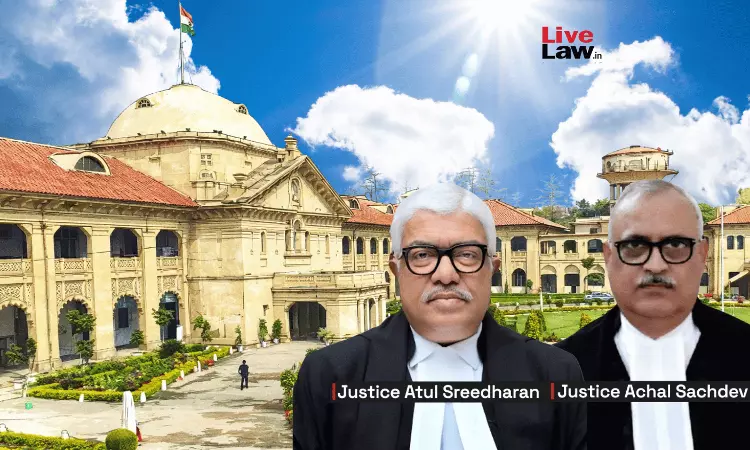
The Allahabad High Court has held that a person detained under the Prevention of Illicit Traffic in Narcotic Drugs and Psychotropic Substances Act (PITNDPS Act) must be specifically informed of his right to make a representation to the detaining authority.
The Court held that merely informing a detenu of his right to make a representation to the State Government is insufficient, even where the same officer passed the detention order while acting in a different capacity.
A Bench of Justice Atul Sreedharan and Justice Achal Sachdev made this observation while setting aside the detention order passed against Lokendra, noting that he was not specifically informed of his right to make a representation to the detaining authority.
The Court directed that he be released forthwith if he was not wanted in any other case.
Case In Brief
The issue before the Bench was whether the detenu was informed of his right to make a representation to the detaining authority, whose power to revoke the detention order was distinct from the power of other authorities to set it aside.


The detention order dated January 29, 2026 stated that representation could be made to the Advisory Board constituted by the State Government, the Secretary, Government of India, Department of Revenue, Ministry of Finance, and the Secretary/Principal Secretary, Home Department, Government of Uttar Pradesh.
The State argued that the detention order complied with the law laid down by the Supreme Court in Alfiya.A v. State of Kerala & Ors. However, the High Court disagreed.
The Bench noted that as per the Alfiya Judgment, Article 22(5) imposes two distinct obligations on the detaining authority in cases of preventive detention. One is to provide the grounds of detention, while the other is to afford the detenu the earliest opportunity of making a representation against the detention order.
The latter obligation, the Supreme Court had held, necessarily carries with it a duty to inform the detenu of the persons or bodies to whom such representation may be addressed.
The Allahabad High Court also noted that in Alfiya.A, the Supreme Court had held that the detenu's actual submission of a representation to the detaining authority did not cure the illegality where he had not been separately informed of his right to do so.
The obligation to communicate that right, the Supreme Court had made clear, could not depend upon whether the detenu independently became aware of it.
High Court's observations
Against this backdrop, the Allahabad High Court explained the important distinction between setting aside a detention order and revocation of a detention order.
Referring to Section 12 of the PITNDPS Act (Revocation of detention orders), the Court explained that the Advisory Board, the Secretary to the Government of India, or the Secretary/Principal Secretary to the State Government may set aside a detention order.
However, it noted that only the "detaining authority" who passed the order of detention has the right to revoke it.
Explaining the difference, the bench clarified that a superior authority may set aside a detention order where it was passed without jurisdiction or suffered from a violation of natural justice, arbitrariness, or procedural infirmity.
On the other hand, revocation is undertaken because the circumstances existing when the detention order was passed have changed, or because continuation of the detention order is no longer necessary.
As per Section 12, a Revocation is undertaken by the "detaining authority".
Importantly, the Court further noted that while setting aside a detention order by a superior authority would preclude the detaining authority from passing a fresh detention order on the same set of facts, revocation would still permit the detaining authority to pass a fresh detention order, potentially on the same set of facts but on different grounds, subject to Section 12 of the PITNDPS Act.
Furthremore, on the merits of the case, the bench noted that the third authority mentioned in the detention order was not the detaining authority in that capacity. Rather, it noted that the authority could set aside the detention order while acting as the State Government.
The Court emphasized that the detenu had to be specifically informed of his right to represent to the "detaining authority", which alone was vested with the power to revoke the detention order.
The Bench explained that, in the present case, the detenu ought to have been informed of his right to make representations to four authorities:
1. The Advisory Board;
2. The Central Government;
3. The State Government; and
4. The Detaining Authority.
It categorically noted that while the detenu had been informed about the first three, he was not informed about making a representation to the detaining authority.
The High Court consequently held that the strict requirements laid down by the Supreme Court in Alfiya.A had not been complied with.
Therefore, the Court allowed the habeas corpus petition, set aside the impugned detention order and directed that the petitioner be set at liberty forthwith, if he was not wanted in any other case.