



- Home
- /
- High Courts
- /
- Allahabad High Court
- /
- S.21 NIA Act | Order Framing...
S.21 NIA Act | Order Framing Charges Is Not Interlocutory, Appeal Lies Before HC: Allahabad High Court Differs With Delhi HC View
Sparsh Upadhyay
18 Aug 2026 9:15 PM IST
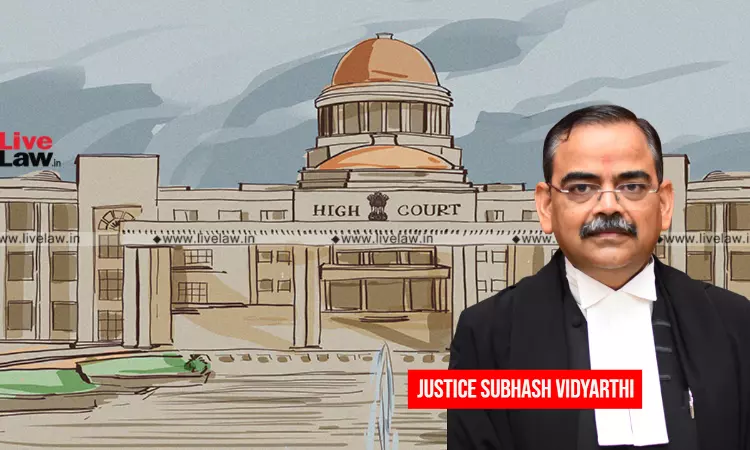
The Allahabad High Court has held that an order framing charges passed by a Special Court under the National Investigation Agency Act, 2008 (NIA Act) is not an interlocutory order and can therefore be challenged by way of an appeal before the High Court under Section 21 of the 2008 Act.A bench of Justice Subhash Vidyarthi thus differed with the view of the Delhi High Court in the case of...
This is a premium content
Available exclusively to
Our subscribers
Subscribe Premium 
INR 1099+GST
Your support helps us to bring you more content at
an affordable subscription scheme !!!
All payment options available
The Allahabad High Court has held that an order framing charges passed by a Special Court under the National Investigation Agency Act, 2008 (NIA Act) is not an interlocutory order and can therefore be challenged by way of an appeal before the High Court under Section 21 of the 2008 Act.
A bench of Justice Subhash Vidyarthi thus differed with the view of the Delhi High Court in the case of Shahid Yousuf v. NIA, wherein it was held that the order framing charges is interlocutory in nature and cannot be challenged in appeal under Section 21 of the 2008 Act.
For context, Section 21 of the 2008 Act provides that an appeal lies against any judgment, sentence or order of a Special Court, "not being an interlocutory order", and that such appeal is to be heard by a Division Bench of the High Court.
It further provides that, except as provided under the section, no appeal or revision would lie against an order, including an interlocutory order, of a Special Court.
Case in brief
The High Court was hearing a petition filed under Article 227 of the Constitution challenging an order passed by the Special Judge, NIA, Lucknow in connection with a case registered under Section 121-A IPC and Sections 3/5/9 of the Official Secrets Act, 1923. The petitioner had specifically challenged the framing of the charge under Section 121-A IPC.
At the outset, the State raised a preliminary objection to the maintainability of the petition.
The State argued that the petitioner had a statutory remedy of appeal under Section 21 of the NIA Act and therefore could not invoke the High Court's jurisdiction under Article 227.
Opposing the State's objection, the petitioner's counsel relied on the Supreme Court's decision in VC Shukla vs. State 1979 to contend that an order framing charges is an interlocutory order and, therefore, no appeal would lie against such an order under Section 21 of the NIA Act.
The petitioner's counsel also relied upon the Delhi High Court's 2025 judgment in Syed Shahid Yousuf, wherein an order framing charges was treated as an interlocutory order, and it was held that an appeal under Section 21 of the NIA Act would not lie against it.
In view of these submissions, it was argued that the instant petition had to be filed under Article 227 of the Constitution of India.
Now the question before the Allahabad High Court was: whether an order passed by an NIA Special Court framing a charge under Section 121-A IPC is an "interlocutory order" within the meaning of Section 21 of the NIA Act.
High Court's observations
The High Court examined the Supreme Court's decision in VC Shukla, in which a four-Judge Bench had held by a 3:1 majority that an order framing charges under the Special Courts Act, 1979, was in fact an interlocutory order.
Justice Vidyarthi stressed that the VC Shukla judgment was decided in the context of a different statute and that it was not concerned with Section 21 of the NIA Act.
The single judge noted that the Special Courts Act, 1979, which the VC Shukla Judgment dealt with, had been enacted to deal with offences allegedly committed by persons holding high public or political offices during the Emergency era.
It provided for Special Courts presided over by sitting High Court Judges, with appeals lying before the Supreme Court. The legislation was subsequently repealed in 1982.
Justice Vidyarthi contrasted this with the NIA Act, under which Special Courts are presided over by Sessions Judges and appeals lie before Division Benches of the High Courts.
Finding substantial differences in the provisions of the now-repealed Special Courts Act, 1979 and the provisions of the NIA Act, the Court observed thus:
"…the interpretation of the term 'interlocutory order' used in Section 11 of the repealed Special Courts Act, 1979 will not apply to interpretation of the same term used in Section 21 of the NIA Act, which is worded differently from Section 11 of the repealed Special Courts Act, 1979".
The High Court then referred to the subsequent 3-Judge Bench judgment of the Supreme Court in Asian Resurfacing of Road Agency (P) Ltd. v. CBI, wherein it was held that "an order framing charge is not purely an interlocutory order nor a final order".
Now, to answer which of the two conflicting judgments was to be relied upon, the Court relied upon the Constitution Bench decision in Iveco Magirus Brandschutztechnik GMBH vs. Nirmal Kishore Bhartiya.
It observed that since Asian Resurfacing had "noticed, considered and explained" the earlier VC Shukla judgment, the later three-Judge Bench decision in Asian Resurfacing would hold the field.
The Court further relied upon Sanjay Kumar Rai v. State of U.P., another 3-Judge Bench decision of the Supreme Court, which followed Asian Resurfacing and reiterated that orders framing charges or refusing discharge are neither interlocutory nor final in nature.
Against the backdrop of the above discussion, the Court concluded thus:
"The legal position is well settled beyond any doubt that an order framing charges is not an interlocutory order".
Reverting to the facts of the case, the Court said that it was not required to examine whether the impugned order was a final order. It remarked thus:
"It is not necessary to examine whether it is a final order or not as Section 21 of the NIA Act merely prohibits filing of appeals against interlocutory orders and it does not provide that appeals would lie only against the final orders".
In view of these findings, the High Court refused to entertain the petition under Article 227, observing that entertaining it before a Single Judge despite the availability of a statutory appeal before a Division Bench would amount to a "breach of judicial discipline".
The petition was accordingly dismissed. However, the bench kept open to the petitioner the option to challenge the order framing charges by filing an appeal under Section 21 of the NIA Act before a Division Bench of the Allahabad High Court.
Case title - Satendra Siwal vs State of U.P. Thru. Prin. Secy. Home Lko. and 2 others 2026 LiveLaw (AB) 597
Case Citation: 2026 LiveLaw (AB) 597
Tags

Sparsh Upadhyay
Sparsh Upadhyay is an Associate Editor with LiveLaw.

