



- Home
- /
- High Courts
- /
- Allahabad High Court
- /
- How Should A Test Identification...
How Should A Test Identification Parade (TIP) Be Conducted? Allahabad High Court Explains Step-By-Step Procedure
Sparsh Upadhyay
3 Aug 2026 4:17 PM IST
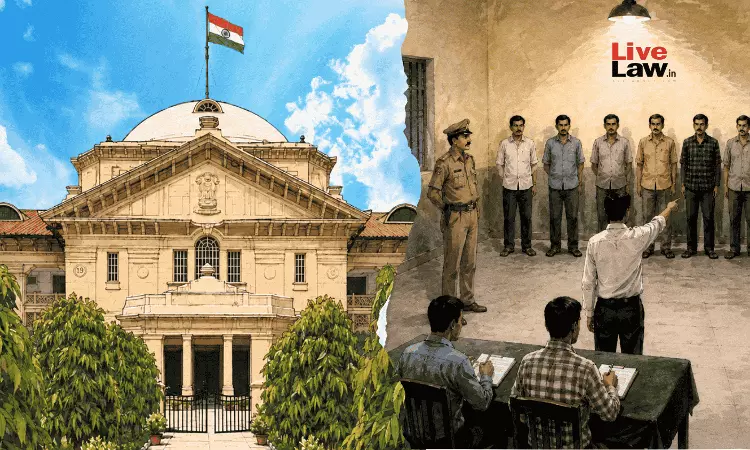
The Allahabad High Court last week elaborately explained the step-by-step procedure governing the conduct of a Test Identification Parade (TIP).The bench clarified that such an identification parade must strictly comply with the safeguards prescribed under the UP Police Regulations and the UP Jail Manual, as any unexplained delay or procedural lapse seriously undermines their...
This is a premium content
Available exclusively to
Our subscribers
Subscribe Premium 
INR 1099+GST
Your support helps us to bring you more content at
an affordable subscription scheme !!!
All payment options available
The Allahabad High Court last week elaborately explained the step-by-step procedure governing the conduct of a Test Identification Parade (TIP).
The bench clarified that such an identification parade must strictly comply with the safeguards prescribed under the UP Police Regulations and the UP Jail Manual, as any unexplained delay or procedural lapse seriously undermines their evidentiary value.
Allowing a criminal appeal filed by two persons convicted under Section 392 IPC, a bench of Justice Santosh Rai observed that the FIR had been lodged against unknown assailants and the entire prosecution case hinged upon the identification of the appellants as the culprits.
However, the Court found that the prosecution had failed to prove their identity beyond reasonable doubt due to an unexplained delay in holding the TIP and non-compliance with the prescribed safeguards.
Case in brief
Briefly put, on February 21, 1985, when the complainant was travelling on a bicycle, he was allegedly surrounded by 4 persons who held a knife to his chest and robbed him of 2 containers of desi ghee weighing four kilograms each, Rs.126.50 in cash and certain grocery articles.
Initially, the FIR was lodged against unknown persons. However, following the investigation, the 4 accused were arrested and subjected to a TIP.
Later, they were charge-sheeted and ultimately convicted by the trial court. Challenging their conviction, they moved the High Court. During the pendency of the appeal, two of the accused died and, therefore, the appeal survived only in respect of Accused-Kanhai and Kallu.
High Court's observations
Examining the primary evidence against them (the TIP), the High Court found that the same was conducted about 42 days after the accused were admitted to jail and more than 2.5 months after the incident, without any satisfactory explanation from the prosecution.
The Court observed:
"It is well settled that where there is unexplained and inordinate delay in holding a test identification parade, and the accused are not previously known to the witness, such delay affords the accused a reasonable opportunity of being shown to the witnesses...and seriously dilutes the evidentiary value of the identification proceedings".
The High Court further found that the TIP itself did not support the prosecution's case because the two independent witnesses involved in the proceedings failed to identify either of the present appellants.
Consequently, their identity rested solely on the complainant's testimony in court, which too was recorded more than 2 years after the incident and was not corroborated by the TIP.
Reiterating the well-settled legal position, the Court observed that a TIP is not substantive evidence but only corroborative evidence intended to lend assurance to the identification of an accused made before the Court. It observed:
"The object of a TIP is not to constitute substantive evidence, but to test the memory and veracity of a witness who claims to have seen an unknown offender. The substantive evidence is the witness's identification of the accused during trial before the Court."
In its 10-page judgment, Justice Rai set out the procedure prescribed under Paragraph 116 of the U.P. Police Regulations and Paragraph 443 of the 2022 U.P. Jail Manual (formerly Paragraph 416) for conducting a Test Identification Parade:
- When the accused is sent to judicial custody, the Investigating Officer moves an application before the Magistrate requesting a Test Identification Parade.
- Normally, the parade should be held inside the jail and not at the police station.
- The Superintendent of Police or an officer not below the rank of Inspector informs the Jail Superintendent in writing that the prisoner is to be put up for identification. Such information should be given at the time of admission or as soon thereafter as possible.
- Upon receiving such intimation, the Jail Superintendent must ensure that the accused does not shave or grow a beard contrary to his appearance at the time of arrest, that his hairstyle and moustache remain unchanged, no disguise is permitted and he wears the same or similar type of clothing as at the time of arrest.
- From the beginning of the investigation, the Investigating Officer must ensure that witnesses do not see the accused before the parade, police avoid showing the accused to witnesses and unnecessary production before witnesses is avoided, as prior exposure substantially weakens the evidentiary value of the TIP.
- The TIP should ordinarily be conducted by a Judicial Magistrate. Police officers should not participate in the actual proceedings. A jail officer remains present only to comply with the Magistrate's directions.
- The accused must be mixed with several persons of similar age, height, complexion, build, dress and general appearance to ensure fairness and eliminate suggestive identification. Prisoners who themselves have to be identified in other cases should not be used as dummies.
- Each witness should be brought individually. Witnesses must be kept separate, should not be permitted to communicate with each other and must identify independently.
- Ordinarily, after each witness, the accused should be permitted to change his position in the line-up and the Magistrate must record whether such change was requested or made.
- The Magistrate must record the names of persons mixed with the accused, objections raised by the accused, whether the position was changed, the exact words and conduct of each witness, and whether the identification was immediate, hesitant or mistaken. The proceedings are to be signed by the Magistrate.
- Before the proceedings commence, the prosecuting inspector and defence counsel, if present, may satisfy themselves that the prescribed safeguards have been observed. However, they do not participate in the actual identification process, which remains under the exclusive control of the Magistrate.
The Court found that these prescribed safeguards had not been followed in the present case. It observed thus:
"In this case at hand, the test identification parade has not been conducted properly as per existing rule and procedure, thus the accused persons are liable to provide the benefit of the material omissions and procedural lapses committed by the prosecution in this regard."
The Bench also relied on the Supreme Court's decisions in Budhsen vs. State of Up 1970, Malkhansingh vs. State of MP 2003, and State of H.P. vs Lekh Raj 1999, to observe reiterate that a TIP is only corroborative evidence under Section 9 of the Evidence Act.
It noted that while failure to hold a TIP is not invariably fatal, when the accused is previously unknown and identified for the first time in court, such dock identification is generally considered weak unless supported by other evidence.
Against this backdrop, noting the absence of any recovery of the stolen property or weapon, the failure of the independent witnesses to identify the appellants during the TIP, the absence of any independent eyewitness to the occurrence, and the lack of any corroborative material, the Court concluded that the prosecution had failed to establish the identity of the appellants beyond a reasonable doubt.
Accordingly, the Court allowed the appeal and acquitted the surviving appellants.
Case title - Kanahi and others vs State of UP 2026 LiveLaw (AB) 518
Case Citation: 2026 LiveLaw (AB) 518
Tags

Sparsh Upadhyay
Sparsh Upadhyay is an Associate Editor with LiveLaw.

