



- Home
- /
- High Courts
- /
- Andhra Pradesh High Court
- /
- Sriharikota Rocket Station Evacuees...
Sriharikota Rocket Station Evacuees Are Assignees Of Govt Land Under GO, Can't Claim Absolute Ownership Based On Later Memo: AP High Court
Ritika Verma
2 Jun 2026 12:00 PM IST
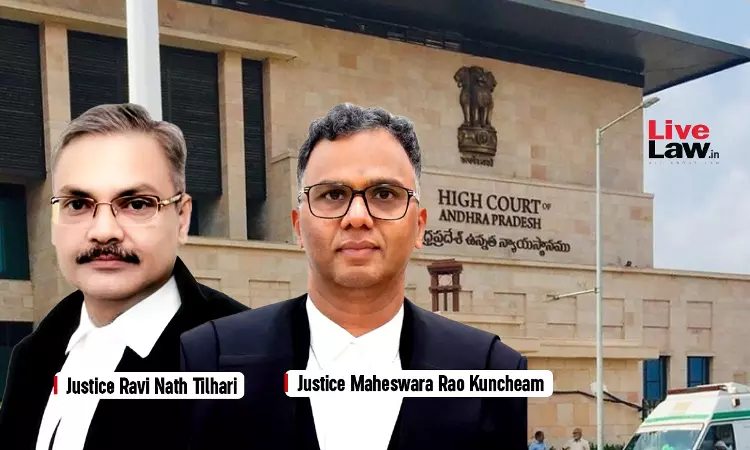
Clarifying the legal status of lands assigned to Sriharikota Rocket Station evacuees under a 1970 rehabilitation scheme, the Andhra Pradesh High Court held that such persons were assignees of Government land with restricted rights and could not claim absolute ownership based on a subsequent memo or revenue entries.A Division Bench comprising Justice Ravi Nath Tilhari and Justice Maheswara...
This is a premium content
Available exclusively to
Our subscribers
Subscribe Premium 
INR 1099+GST
Your support helps us to bring you more content at
an affordable subscription scheme !!!
All payment options available
Clarifying the legal status of lands assigned to Sriharikota Rocket Station evacuees under a 1970 rehabilitation scheme, the Andhra Pradesh High Court held that such persons were assignees of Government land with restricted rights and could not claim absolute ownership based on a subsequent memo or revenue entries.
A Division Bench comprising Justice Ravi Nath Tilhari and Justice Maheswara Rao Kuncheam examined the legality of resumption proceedings initiated by the State for establishment of an Industrial Park and Special Economic Zone. The court observed:
“We are also of the view that the memo cannot override the Government Order and consequently based on the subsequent memo without making any amendment in the Government Order conferring right as owners, the status of the respondents shall remain of DKT pattaholders and they would be entitled only for the compensation in terms of the 95 G.O.Ms.No.1307, dated 23.12.1993 and as directed in the previous W.P.No.561 of 2007 by this Court vide judgment dated 17.07.2008 and W.P.No.26439 of 2008, but they would not become the owners of the land so as to contend that the acquisition proceedings should be initiated under the provisions of the Land Acquisition Act.
We are of the view that applying the principle of law as laid down in Yadaiah (supra) to the facts of the present case, that there being difference between resumption of land and the acquisition of land and in the present case it being a case of resumption of land, which Order of resumption has not been set aside in any of the previous petitions and the same was also not under challenge in W.P.No.23208 of 2010, in which the impugned judgment dated 04.11.2013 has been passed, the 108 resumption order of the Government still holds the field as on today and has attained finality.”
The litigation traces its origin to the acquisition of lands around Sriharikota for the Rocket Launching Station, followed by rehabilitation of displaced families under G.O.Ms. No.1024 dated 02.11.1970 by allotting alternative agricultural lands in Tondur village. In subsequent proceedings, the State resumed these assigned lands for an Industrial Park/Special Economic Zone and granted compensation under G.O.Ms.No.1307, which was upheld treating the petitioners as assignees entitled to compensation on par with landowners.
The principal issue before the Court was whether the writ petitioners were absolute landowners entitled to compulsory acquisition under the Land Acquisition Act, 1894, or merely assignees whose lands were liable to be resumed by the Government under the terms of assignment.
The Division Bench held that the lands assigned under G.O.Ms.No.1024 read with G.O.Ms.No.1142 dated 18.06.1954 were “heritable but not alienable,” thereby conferring only limited assignment rights and not absolute ownership.
Rejecting the contention that a subsequent Government Memo dated 16.09.2000 conferred unrestricted alienation rights, the Court held that an administrative memo issued by a Principal Secretary could not override a statutory Government Order issued in the name of the Governor.
The Court observed that the Government Memo dated 16.09.2000, which stated that the evacuees were entitled to alienation rights and regular pattas, could not enlarge the nature of rights originally granted under the assignment scheme. The Bench relied upon settled precedent in K.V.Ramana Rao v. Government of Andhra Pradesh, 2001 (4) ALD 852 holding that executive instructions, circulars or memos cannot override statutory Government Orders.
The Court further held that entries in pattadar passbooks or revenue records do not by themselves confer title, particularly in the absence of valid title deeds.
While analysing the distinction between “resumption” and “acquisition,” the Division Bench relied upon the judgment of the Hon'ble Supreme Court in Yadaiah v. State of Telangana, (2023) 10 SCC 755, reiterating that acquisition involves deprivation of pre-existing ownership rights under statute, whereas resumption concerns taking back lands granted subject to conditions of assignment.
The Bench held that the lands in question were liable to resumption for public purpose in accordance with the terms of assignment and that the learned Single Judge erred in directing compulsory acquisition proceedings under the Land Acquisition Act.
At the same time, the Court clarified that the petitioners were nevertheless entitled to compensation on par with landowners in terms of earlier judgments which had attained finality.
The Division Bench emphasized the principles of judicial discipline and finality of judgments, observing that the earlier decisions had already attained finality by treating the petitioners as assignees entitled to compensation under G.O.Ms.No.1307 and on par with landowners for compensation purposes.
Consequently, it held that the subsequent judgment of the learned Single Judge setting aside the resumption proceedings and directing acquisition under the Land Acquisition Act could not be sustained in law, and accordingly allowed the writ appeals.
The Court, however, clarified that compensation already determined or payable pursuant to earlier orders would continue to remain payable to the writ petitioners.
Case Title: M/s. Sri City Pvt. Ltd. & Ors. v. N. Sakkubayamma & Ors.
Case Numbers: W.A. Nos. 205, 259 of 2014, 848 of 2022 and W.P. No. 26568 of 2014
Counsel for Appellants: Sri K.S. Murthy, Sri G. Rama Chandra Rao, Government Pleader for Land Acquisition & Sri G.R. Sudhakar
Counsel for Respondents: Sri V. Sudhakar Reddy
Tags


