



- Home
- /
- High Courts
- /
- Andhra Pradesh High Court
- /
- Right To Health Is Fundamental...
Right To Health Is Fundamental Right Even Post-Retirement: AP High Court Grants Medical Reimbursement To Ex-Revenue Officer
Saahas Arora
16 Dec 2025 3:40 PM IST
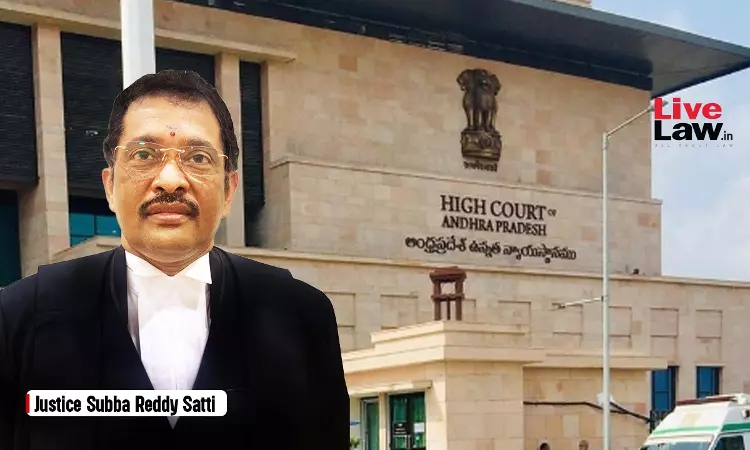
The Andhra Pradesh High Court, while reiterating that right to health is integral to the right to life under Article 21, has granted relief to a retired Revenue Officer whose proposal for reimbursement of medical expenses incurred towards the treatment of his deceased wife was returned by the Secretary to Government of Andhra Pradesh (Respondent 1).Respondent 1 had returned the proposal...
This is a premium content
Available exclusively to
Our subscribers
Subscribe Premium 
INR 1099+GST
Your support helps us to bring you more content at
an affordable subscription scheme !!!
All payment options available
The Andhra Pradesh High Court, while reiterating that right to health is integral to the right to life under Article 21, has granted relief to a retired Revenue Officer whose proposal for reimbursement of medical expenses incurred towards the treatment of his deceased wife was returned by the Secretary to Government of Andhra Pradesh (Respondent 1).
Respondent 1 had returned the proposal for sanction of Rs. 96,424 by relying on a Government Order of 2011 whereby instructions were issued to promote fiscal discipline and clause (iv) of the GO put an embargo on granting permissions for the relaxation of rules that involved putting additional burden on the State Exchequer— like payment of medical bills.
Emphasising that the Government has a constitutional obligation to provide health facilities under Article 39(e) of the Constitution, Justice Subba Reddy Satti observed that the right to health and medical care to protect the health of a citizen while in service or post-retirement is a fundamental right under Article 21, read with Article 39(e) of the Constitution of India.
For reference- Article 39(e) casts obligation upon the State to direct its policy towards ensuring that the health and strength of workers, men and women, and the tender age of children are not abused and that citizens are not forced by economic necessity to enter avocations unsuited to their age or strength.
Reiterating that no administrative order, executive action, or Government Order can override, curtail, or suspend the provisions of the Constitution, the Single Judge observed:
“The G.O.Ms.No.230 Finance (DCM-I) Department dated 15.10.2011 would not take away the petitioner's constitutional right under Article 21 read with Article 39(e) of the Constitution of India and the State's Obligation under Part-IV of the Constitution of India. In other words, the government order, referred to supra, will not overturn the right guaranteed to the petitioner under Article 21 of the Constitution of India. Unfortunately, the petitioner, a retired employee, has been made to wait for a claim of Rs.96,424/- for more than a decade.”
Background
The petitioner's wife underwent treatment for breast cancer in 2007, however, later lost her breath. While the petitioner had initially claimed relaxation of an amount of Rs. 1,28,446 in 2009, the bill was scrutinised by the Director of Medical Education— who approved an amount of Rs.96,424. When the proposal was eventually forwarded to Respondent 1 with a request to issue a necessary relaxation order, the same was returned citing the mandate of GO of 2011. Aggrieved, the petitioner filed a writ petition challenging that aforesaid action as illegal and arbitrary.
The Court referred to Rule 3, Appendix III of the Andhra Pradesh Integrated Medical Attendance Rules, 1972, which prescribed that any claim that has been preferred six months after the last date of the period of treatment shall ordinarily be rejected. However, in note (1), it is mentioned that belated claims of officers shall be referred to the Government in the General Administration and Health Departments, respectively, for special sanction. In note (2), it is further prescribed that 15% cut will be imposed upon the belated claims.
On the question whether the GO of 2011 would trump or overturn the fundamental right of the petitioner under Article 21 of the Constitution of India, the Court observed that the GO operates only prospectively. As the petitioner made the claim initially in 2009, the Court held:
“The respondents have sought to justify the rejection of the petitioner's medical claim in the guise of G.O.Ms.No.230, which was issued to promote fiscal discipline and financial prudence, and that clause (iv) of this G.O. restricts relaxation of rules that involve additional burden on the Exchequer. However, the operation of the said G.O. is prospective in nature, and it would not apply to the claim of the petitioner since the claim was approved as per the Rules.”
Noting that the GO of 2011 cannot take away the fundamental right of the petitioner, nor excuse the State of fulfilling its constitutional obligation under Article 39(e), the Court allowed the petition and directed Respondent 1 to sanction relaxation regarding the proposal towards medical reimbursement for sanction of Rs.96,424/- to the petitioner.
Case Details:
Case Number: WRIT PETITION NO: 11212 of 2012
Case Title: NG PAPA RAO v THE SECRETARY TO GOVERNMENT
Citation: 2025 LiveLaw (AP) 181
Tags


