



- Home
- /
- High Courts
- /
- Andhra Pradesh High Court
- /
- Forgery Of Sale Agreements,...
Forgery Of Sale Agreements, Mortgage Deeds And Other Valuable Documents Can Attract Life Imprisonment: AP High Court
Ritika Verma
13 Nov 2026 9:15 AM IST
The Andhra Pradesh High Court has observed that forging sale agreements, sale deeds, gift deeds, mortgage deeds and other documents relating to valuable security can attract life imprisonment under Section 467 of the Indian Penal Code (IPC), corresponding to Section 338 of the Bharatiya Nyaya Sanhita (BNS).The Court also noted that electronic evidence, including call detail records,...
This is a premium content
Available exclusively to
Our subscribers
Subscribe Premium 
INR 1099+GST
Your support helps us to bring you more content at
an affordable subscription scheme !!!
All payment options available
The Andhra Pradesh High Court has observed that forging sale agreements, sale deeds, gift deeds, mortgage deeds and other documents relating to valuable security can attract life imprisonment under Section 467 of the Indian Penal Code (IPC), corresponding to Section 338 of the Bharatiya Nyaya Sanhita (BNS).
The Court also noted that electronic evidence, including call detail records, internet protocol detail records, chats, voice recordings, videos and CCTV footage, may be examined to establish forgery and identify persons involved in such offences. Persons who abet the commission of these offences may also be prosecuted, depending on the evidence.
In this regard, Section 467 IPC prescribes life imprisonment or imprisonment up to 10 years, along with fine, for forgery of valuable security, a will or other specified documents. The Court also referred to Section 193 IPC, corresponding to Section 229 BNS, which prescribes punishment for giving or fabricating false evidence.
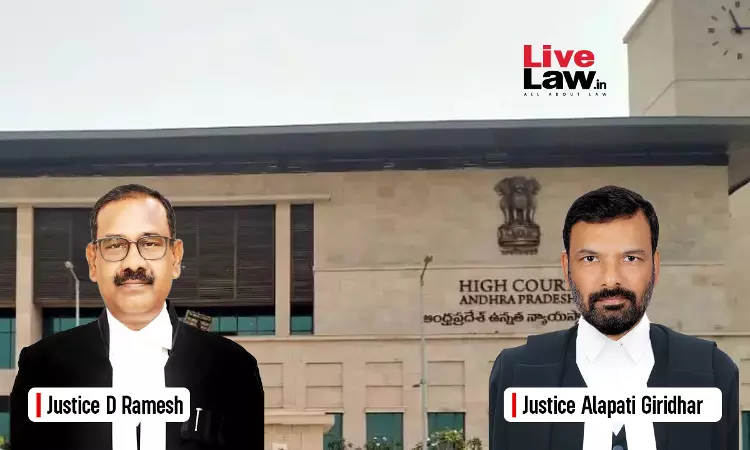
A Division Bench of Justice D. Ramesh and Justice Alapati Giridhar made these observations while dismissing an appeal challenging the rejection of a suit for specific performance of an alleged sale agreement. The Bench observed:
“Thus, in view of the law as stated supra, for fabrication of document/s, the concerned personsand the concerned abettors may be prosecuted based on evidence, including electronic evidence such as CDR/IPDR, chats, voice recordings, videos, and/or CCTV footage, to show filing of civil and/or criminal cases, at the instance of a person/s. Also false evidence in civil and/or criminal proceedings at the instance of a person/s out of money lending or real estate frauds etc. The Law is comprehensive enough to cover every dimension of fraud.
Section 467 of IPC, takes care of fabrication of documents concerning valuable security, Will etc., which provides imprisonment for life or a term which may extend upto 10 years and fine, for forging valuable security (agreement, sale or gift or mortgage deed or negotiable instrument, their endorsement etc). Section 193 of IPC, takes care of giving or fabricating false evidence, including a Party or witness, who files a forged or fabricated document and makes a false statement or declaration, which provides imprisonment, which may extend to seven years, and shall also beliable to fine) r/w 191 or 192 of IPC as per law, depending on the facts of the case.”
Turning to the facts of the case, the plaintiffs claimed that the defendant had agreed to sell them 2.74 acres of his ancestral property for ₹20 lakh per acre. They alleged that he executed an agreement of sale after receiving an advance of ₹20 lakh. They further claimed that, when the defendant later sought money to develop his hotel business, they paid him another ₹15 lakh, for which he issued a receipt.
The plaintiffs alleged that they repeatedly asked the defendant to measure the land and complete the sale. However, he avoided doing so and eventually demanded an additional ₹20 lakh. When they visited the property, they learnt that it had been mortgaged. After obtaining an encumbrance certificate, they discovered a mortgage in favour of a financier. They then issued a legal notice calling upon the defendant to clear the mortgage and execute the sale deed.
The defendant denied the transaction in his reply to the notice and sought copies of the alleged agreement and receipt.
The plaintiffs issued a rejoinder and a further notice calling upon him to perform the agreement. They subsequently filed a suit seeking specific performance.
In his defence before the Trial Court, the defendant denied executing the sale agreement or receiving the amounts. He claimed that he had borrowed ₹2 lakh from the financier and executed a registered mortgage deed. At the time, the financier had allegedly obtained his signatures on blank cheques, promissory notes, non-judicial stamp papers and white papers as security. He alleged that the financier later misused these documents to fabricate the sale agreement and receipt in the plaintiffs' favour.
The Trial Court dismissed the suit, holding that the agreement of sale and the receipt were probably forged and fabricated. It noted that the stamp papers used for the alleged sale agreement bore serial numbers from the same sequence as those used for the defendant's registered mortgage deed executed in 1997. The Court found it improbable that stamp papers from the same sequence were used for an agreement allegedly executed nearly eight years later. The plaintiffs failed to explain this discrepancy.
On appeal, the High Court also found that the plaintiffs had not satisfactorily explained how the stamp papers used for the two transactions formed part of the same serial sequence. It further noted inconsistencies in their evidence about where and how the agreement was prepared, the period of negotiations and the agreed sale consideration. Their evidence regarding the amounts paid by each plaintiff was also inconsistent.
The Court further found that the plaintiffs had not obtained an encumbrance certificate or verified the defendant's title before paying the advance. They had also failed to explain why the alleged subsequent payment was recorded in a separate receipt instead of being endorsed on the agreement, which was in their possession.
Another circumstance noted by the Court was that, although the agreement and receipt were allegedly executed nine months apart, the ink used for typing both appeared to be of the same colour and thickness, suggesting that they were typed at one point in time.
The Court also noted that the plaintiffs had not impleaded the financier in the specific performance suit, despite the defendant's allegation that he was behind the fabrication. However, it clarified that the financier had not produced material connecting the plaintiffs and the defendant to substantiate his allegation of collusion.
After discussing the legal provisions governing forgery and fabrication of documents, the Bench observed that the law was comprehensive enough to cover different dimensions of fraud, including the filing of fabricated documents and false evidence in civil and criminal proceedings.
In view of these circumstances, the High Court held that the plaintiffs had failed to prove the agreement of sale, the receipt or the payments allegedly made to the defendant. It found no infirmity in the Trial Court's judgment warranting interference.
As regards the allegations of fabrication and false evidence, the Court observed that the material before it was insufficient to initiate proceedings on its own.
However, it left the parties at liberty to approach the Trial Court under Section 340 of the Code of Criminal Procedure, corresponding to Section 379 of the Bharatiya Nagarik Suraksha Sanhita, to seek an inquiry into the allegations.
Accordingly, the appeal was dismissed with costs.
Counsel for Appellants: Sri N. Subba Rao, Senior Counsel, assisted by Sri Ancha Panduranga Rao
Counsel for Respondent: Sri Ghanta Rama Rao, Senior Counsel, assisted by Sri Ghanta Sridhar
Tags


