



- Home
- /
- High Courts
- /
- Bombay High Court
- /
- Complete Violation During Bhajans,...
Complete Violation During Bhajans, Azans & Club Events : High Court Registers Suo Motu PIL On Recurring Noise Pollution In Nagpur
Sparsh Upadhyay
6 Dec 2025 8:16 AM IST
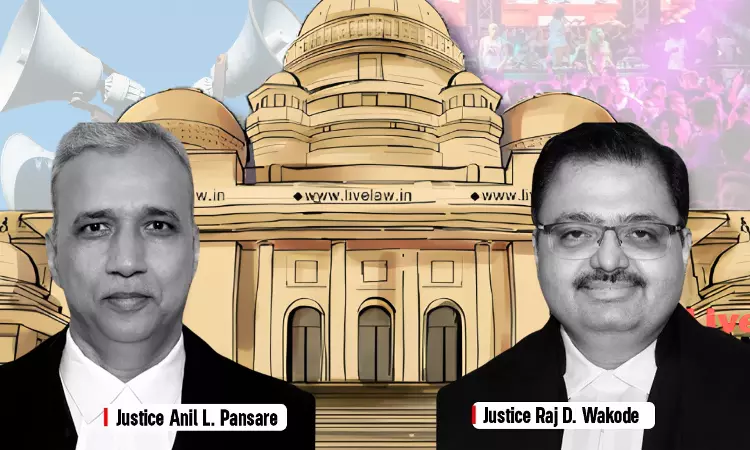
The Bombay High Court (Nagpur Bench) recently took Suo Moto cognizance of the 'recurring' issue of noise pollution in Nagpur city and explicitly named prominent clubs, temples and Dargahs adding that activities like 'bhajans', 'azans' and various celebrations and events are conducted in violation of the law. A bench of Justice Anil L Pansare and Justice Raj D Wakode said that state...
This is a premium content
Available exclusively to
Our subscribers
Subscribe Premium 
INR 1099+GST
Your support helps us to bring you more content at
an affordable subscription scheme !!!
All payment options available
The Bombay High Court (Nagpur Bench) recently took Suo Moto cognizance of the 'recurring' issue of noise pollution in Nagpur city and explicitly named prominent clubs, temples and Dargahs adding that activities like 'bhajans', 'azans' and various celebrations and events are conducted in violation of the law.
A bench of Justice Anil L Pansare and Justice Raj D Wakode said that state orders on noise control would stand as an "eye wash" unless an effective mechanism is evolved.
With these observations, the bench also dismissed a petition seeking the restoration of loudspeaker use in a mosque, observing that the installation of such devices is not a mandatory requirement for practicing religion.
The petitioner (Masjid A. Gousiya) in Gondia had sought directions to the State to restore the use of loudspeakers in the mosque.
However, the counsel for the petitioner could not place on record any legal document demonstrating that loudspeakers are essential to the practice of Islam.
Consequently, the Court held that the petitioner could not seek the relief of installation of loudspeakers "as of a right".
In this regard, the bench referred to the Supreme Court's judgment in the case of God (Full Gospel) In India Vs. K.K.R. Majestic Colony Welfare Association & Ors 200, to reiterate that no religion prescribes that prayers should be performed by disturbing the peace of others nor does it preach that they should be through voice amplifiers or beating of drums.
The bench also referred to Supreme Court's decision in In Re Noise Pollution – Implementation of the Laws for Restricting use of Loudspeakers and High-Volume Producing Sound Systems, to emphasized nobody can be compelled to listen and nobody can claim that he has a right to make his voice trespass into the ears or mind of others.
Though the prayer of the petitioner was dismissed, the Bench expressed deep concern over the ineffective implementation of the Environment (Protection) Act, 1986 and the Noise Pollution (Regulation and Control) Rules, 2000. The HC noted that despite clear laws, noise pollution remains a serious threat to public health.
"It causes “fight to flight” syndrome, releasing cortisol and other harmful chemicals into the flood stream. Over time, these chemicals built up in the body, leading to a host of health problems, including cardiovascular disease, aggression, chronic fatigue, headaches, high blood pressure, mental illness and anxiety. Noise pollution caused in between levels of 80 to 110 decibels (dB) can cause hearing damage. Noise pollution above 120 dB can exceed human pain threshold and noise pollution in between 140 to 160 dB can cause ear drum rupture", the Court observed.
The Court further expanded the scope of its observations and turned to the recurring issue of Pollution in Nagpur. It specifically named prominent venues/clubs/marriage halls in the district noting that they violate the 1986 Act as well as Rules of 2000.
The Court further noted that sound systems are deployed "far beyond the permissible decibel volume" and continue past the 10:00 PM deadline, often accompanied by the bursting of firecrackers at midnight.
The Court stressed that while permitting various celebrations, these venues should take responsibility of ensuring adherence to the provisions of the 1986 Act and the Rules of 2000.
The Court also took into account the activities happening in religious places of different faiths. Naming certain prominent temples and Dargahs of Nagpur, the HC noted that activities such as bhajans and azans are performed on loudspeakers in "complete violation" of the law.
Not just that, the Court also observed that Civil Lines area of the district is also a hub for bikes and motor vehicles with bursting sound of silencers.
The Court observed that the existing mechanism works with police taking action only after a complaint is received. However, the bench opined that police and the other responsible authorities should take suo moto cognizance of sound pollution.
Interestingly, the Bench pointed out the irony that these violations occur in areas housing the Commissioner of Police and other high-ranking officials.
Unless effective mechanism is evolved for implementation of the Rules of 2000 and directions given by various Courts, the order dated 21-7-2025 issued by the State Government will stand as an eye wash, the Court added.
The Court lamented that the exhaustive directions issued by the Supreme Court as far back as 2005 regarding firecrackers, loudspeakers and vehicular noise "remain on paper".
The HC advised the state to consider issuing a fresh order with consequence of failure to implement the order.
However, to monitor the issue effectively, the High Court took suo moto cognizance of the noise pollution issue (pertaining to Nagpur City) and directed Registry to register it as Suo Moto Public Interest Litigation.
Click Here To Read/Download Order
Tags

Sparsh Upadhyay
Sparsh Upadhyay is an Associate Editor with LiveLaw.

