



- Home
- /
- High Courts
- /
- Calcutta High Court
- /
- Calcutta High Court Orders Closure...
Calcutta High Court Orders Closure Of M-Bazaar Operating Inside Former Cinema Hall, Says Trade Licence Cannot Authorise Illegal Change Of Use
Srinjoy Das
19 Aug 2026 5:15 PM IST
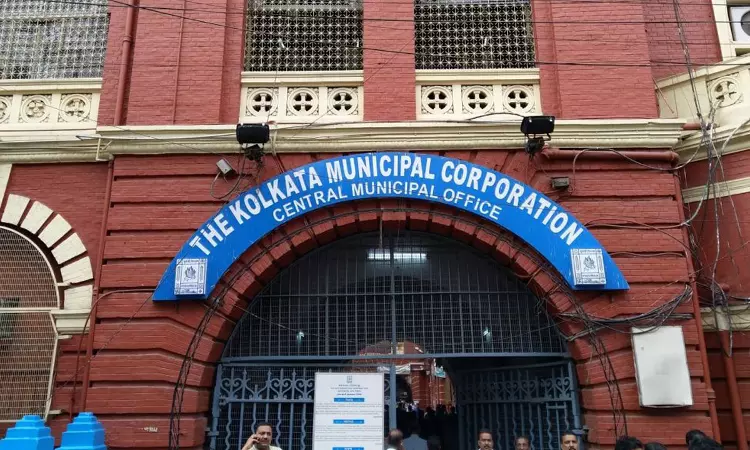
The Calcutta High Court has directed the Kolkata Municipal Corporation (KMC) to immediately stop the operation of a mega garment store, M-Bazaar, being run from the premises of the erstwhile Paradise Cinema Hall at 39 Bentinck Street, Kolkata, holding that a garment business could not be operated from an assembly building without obtaining the requisite permission for change of use under...
This is a premium content
Available exclusively to
Our subscribers
Subscribe Premium 
INR 1099+GST
Your support helps us to bring you more content at
an affordable subscription scheme !!!
All payment options available
The Calcutta High Court has directed the Kolkata Municipal Corporation (KMC) to immediately stop the operation of a mega garment store, M-Bazaar, being run from the premises of the erstwhile Paradise Cinema Hall at 39 Bentinck Street, Kolkata, holding that a garment business could not be operated from an assembly building without obtaining the requisite permission for change of use under Section 416 of the Kolkata Municipal Corporation Act, 1980.
A Division Bench comprising Justice Shampa Sarkar and Justice Smita Das De set aside the judgment of the Single Bench which had declined to interfere with the Certificate of Enlistment issued to Metro Retail Private Limited for operating a garment store from the premises.
The Bench directed the Corporation to ensure that the garment business is stopped immediately and remains closed until permission to operate it is granted in accordance with law.
"The business cannot be run from the said premises," the Court held, adding that the premises had originally been used as a cinema hall, which was an assembly building, whereas M-Bazaar was being operated as a mercantile establishment.
The Court further directed the Municipal Building Tribunal to dispose of the pending appeal filed by the private respondents against the order refusing permission for change of use within two months.
Dispute Over Conversion Of Cinema Hall Into Garment Store
The appeal arose from proceedings concerning premises No. 39 Bentinck Street, formerly known as Paradise Cinema Hall. The appellant, Bhagwatdas Jaiswal, had challenged the Certificate of Enlistment dated April 7, 2025 issued in favour of Metro Retail Private Limited for operating a garment departmental store from the premises.
The appellant had alleged that the former cinema hall, which was an assembly building, had been converted into a large-format garment store akin to a shopping mall without obtaining the mandatory permission for change of use under Section 416 of the KMC Act.
The Division Bench noted that the Corporation's own inspection had revealed that the ground floor of the three-storeyed building had been converted into a shopping mall operating under the name M-Bazaar. The Corporation had also recorded that no sanction plan had been granted for the change in use.
Earlier, the High Court had directed the Municipal Commissioner or his delegate to determine whether the business was being operated in accordance with law and, if the necessary documents were not produced, to take steps to stop the business.
'Merely Obtaining Fire Licence Or Certificate Of Enlistment Is Not Sufficient'
The Division Bench traced several proceedings in which the Corporation had itself questioned the legality of the conversion.
In September 2024, while dealing with contempt proceedings, the Single Bench had observed that the premises was classified as a cinema hall and that the application for change of use was still pending. The Court had specifically held that until conversion was permitted, the premises ought not to be used for another purpose.
It had further clarified that merely obtaining a fire licence or Certificate of Enlistment was insufficient to lawfully operate the business.
The Division Bench relied upon this history to reject the argument that the only deficiency was proof of occupancy. The record, it observed, showed that proceedings under Sections 400(1) and 416 of the KMC Act had been initiated against the respondents.
Special Officer Had Disallowed Change Of Use
The Special Officer (Building), KMC, subsequently examined the alleged conversion and recorded several violations relating to the building.
The order noted that the ground floor, earlier used as a cinema hall, had been converted into a garment shop. The building was found to have deficiencies concerning front, rear and side open spaces as well as ground coverage.
The Special Officer concluded that the change of use had been carried out without the requisite permission and was also contrary to the terms of the head lease and sub-lease, which permitted use of the premises for cinema and allied activities.
The conversion from a cinema hall to a garment shop was accordingly disallowed.
Following this decision, the earlier Certificate of Enlistment was cancelled by the Corporation.
Fresh Enlistment Certificate Issued Despite Earlier Cancellation
The Division Bench took strong exception to the subsequent issuance of another Certificate of Enlistment on April 7, 2025.
The Court noted that applicants seeking an Enlistment Certificate were required to declare that their business was not prohibited or restrained by any law, court order or competent authority and that the premises was free from violations.
However, by the time the fresh application was made, the Special Officer (Building) had already disallowed the change of user.
The Bench held that the Corporation failed to take into consideration the order disallowing the conversion when accepting the fresh online application.
It also noted that the respondents had not disclosed these proceedings in the declaration accompanying their application.
The Court observed that the Corporation's subsequent stand that Enlistment Certificates were issued on a year-to-year basis and that earlier cancellation did not prevent issuance of a fresh certificate was "thoroughly misconceived".
"The corporation has played fraud on the statute," the Bench observed.
Trade Licence Cannot Substitute Mandatory Permission For Change Of Use
The Court rejected the argument that change of use was merely a matter involving payment of additional municipal tax or charges.
Referring to Section 416 of the KMC Act, the Bench held that a building cannot be changed from one occupancy or use group to another without written permission of the Municipal Commissioner.
The Court emphasised that such permission "cannot be deemed to be granted by judicial interpretation."
It further held that merely because the Corporation assessed property tax treating the premises as a mercantile building, that did not amount to permission for change of use or absolve the occupants from complying with the law.
"Such permission is not available in law even upon payment of money alone. There has to a proper order by the appropriate authority," the Bench held.
Appellant Had Locus To Challenge Illegal Use
The private respondents had argued that Jaiswal had no locus to challenge the Certificate of Enlistment as he was a third party.
The Division Bench rejected the objection.
The Court noted that Jaiswal was himself operating a food stall from the premises and that his right to carry on business could be affected by the conversion of the building into a large-format garment store.
The Bench held that a person using the premises could object to an allegedly illegal conversion and approach the Court where the municipal authorities had failed to enforce the statutory requirements.
"We are of the view that the appellant had the locus to file the writ petition atleast on the ground that the grant of the Certificate of Enlistment would permit unauthorized use of the premises as a big format garment shop allegedly akin to a mall," the Court held.
The Bench also considered the effect of proceedings before the Supreme Court concerning the respondents' right to continue business from the premises.
The Division Bench noted that the Supreme Court had stayed the portion of an earlier Calcutta High Court order which had permitted the lessee to carry on business in the usual course pending consideration of interim relief.
The Supreme Court had subsequently directed that the interim proceedings before the Single Bench should continue in accordance with law.
The Calcutta High Court held that the stay granted by the Supreme Court had not become infructuous merely because another connected special leave petition had subsequently been disposed of.
The Bench held that the earlier Division Bench order concerning the fire safety certificate could not override the Corporation's decision disallowing the change of use, particularly in view of the subsisting Supreme Court order.
M-Bazaar Must Remain Closed Until Permission Is Granted
Concluding that the premises could not lawfully be used for the mega garment business in its present form, the Bench directed the KMC to ensure immediate stoppage of the M-Bazaar operation.
"Under such circumstances, we direct the corporation to ensure that the garment business from the shopping arcade/shopping format M-Bazaar should be immediately stopped, until the permission to run the same is granted in accordance with the law."
The Court clarified that the order of the Special Officer (Building) continued to operate and set aside the judgment of the Single Bench.
The Municipal Building Tribunal was requested to dispose of the respondents' pending appeal within two months.
The Bench also refused the respondents' prayer for stay of the judgment.
Case No: APOT/114/2026
Case: BHAGWATDAS JAISWAL vs. KOLKATA MUNICIPAL CORPORATION AND ORS.

Srinjoy Das
Srinjoy Das is a Principal Correspondent with LiveLaw, covering the Calcutta High Court

