



- Home
- /
- High Courts
- /
- Calcutta High Court
- /
- 'Encroachers On Road Outside Port...
'Encroachers On Road Outside Port Trust Hospital Cannot Claim Protection Under Public Premises Act': Calcutta High Court Upholds Eviction
Srinjoy Das
5 Feb 2026 1:30 PM IST
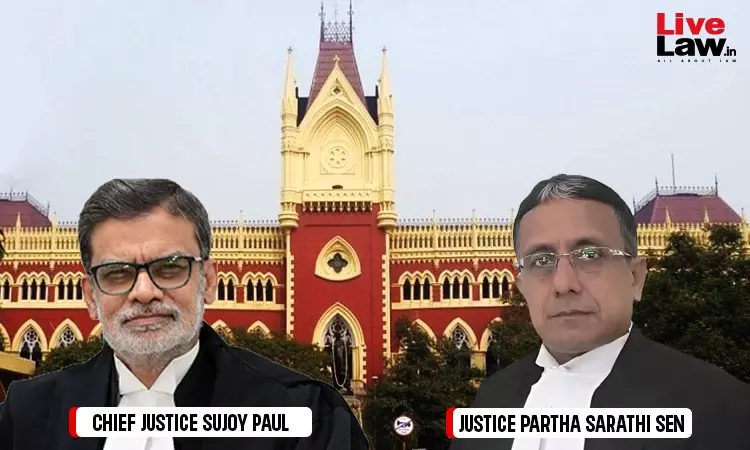
In a judgment delivered on February 4, 2026, a Division Bench of the Calcutta High Court, comprising Chief Justice Sujoy Paul and Justice Partha Sarathi Sen, dismissed an intra-Court appeal filed by Chandeswhwar Shaw and others challenging the eviction order passed in WPA 15989 of 2024. The appellants had sought to overturn an order of a Single Bench dated June 20, 2024, which had granted...
This is a premium content
Available exclusively to
Our subscribers
Subscribe Premium 
INR 1099+GST
Your support helps us to bring you more content at
an affordable subscription scheme !!!
All payment options available
In a judgment delivered on February 4, 2026, a Division Bench of the Calcutta High Court, comprising Chief Justice Sujoy Paul and Justice Partha Sarathi Sen, dismissed an intra-Court appeal filed by Chandeswhwar Shaw and others challenging the eviction order passed in WPA 15989 of 2024.
The appellants had sought to overturn an order of a Single Bench dated June 20, 2024, which had granted police assistance to the writ petitioner—the Syama Prasad Mookerjee (SMPK) Port Authority—for the removal of unauthorised occupants from land adjacent to the Port, specifically the approach road to the SMPK Centenary Hospital in Kolkata.
The appellants contended that they had been unlawfully removed without due process of law, asserting that they were in settled possession of the land for over 35 years. They argued that the learned Single Bench erred in granting police assistance for eviction, claiming that the Port Authority had alternative remedies under the Public Premises (Eviction of Unauthorised Occupants) Act, 1971 (the “Public Premises Act”) to recover possession.
The appellants relied on Supreme Court judgments, including Meghmala & Ors. v. G. Narasimha Reddy & Ors. (2010) 8 SCC 383 and M/s. Annamalai Club v. Government of Tamil Nadu (AIR 1997 SC 3650), to assert that even unlawful occupants cannot be evicted forcibly or unilaterally, and that proper legal procedures must be followed. They further submitted that the Port Authority had obtained the eviction order by misrepresenting facts, ignoring their long-standing occupation.
The Port Authority and State respondents countered that the appellants were encroachers who had occupied the approach road to the SMPK Centenary Hospital for hawking and other informal commercial purposes. They argued that the appellants had no legal right, title, or jural relationship with the Port Authority. The respondents highlighted that the appellants were actually residents of a nearby locality, Madhu Busty, and had failed to produce any documentary or prima facie evidence to prove settled possession of the land.
The Division Bench examined the definitions under the Public Premises Act—specifically, Sections 2(c), 2(e), and 2(g). Section 2(c) defines “premises” as land or buildings, while Section 2(e) defines “public premises” as property belonging to or under the control of specified government entities, including Boards of Trustees under the Major Port Trusts Act. The Court observed that the approach road in question did not qualify as “premises” under the Act, and thus, the appellants could not claim protection as unauthorized occupants of public premises.
The Court further distinguished the case from the precedents cited by the appellants. For instance, in Lallu Yeshwant Singh v. Rao Jagdish Singh (1967 SCC OnLine SC 327), the Supreme Court dealt with eviction after the expiry of a lease, which involved a jural relationship between the parties—whereas in the present case, no such relationship existed, and the appellants could not prove possession of public premises. Similarly, the Annamalai Club judgment concerned eviction of licensees, again a legally recognized relationship absent in the current case.
The Division Bench also noted that the appellants did not formally intervene before the Single Bench with a proper vakalatnama or application claiming rights over the property. The Court emphasized that factual disputes regarding possession cannot be adjudicated in an intra-Court appeal, which is limited to legal errors in the prior order.
Given the lack of evidence establishing any legal or constitutional rights, the Court held that the Port Authority was under no obligation to follow the eviction procedure under the Public Premises Act. The status of the appellants as mere encroachers on a public road was distinct from an “unauthorised occupant” of public premises under the Act. Consequently, the Division Bench dismissed the appeal, upheld the Single Bench's order granting police assistance for eviction, and also dismissed all pending interlocutory applications.
Case: CHANDESWHWAR SHAW AND ORS. -VS- STATE OF WEST BENGAL AND ORS.
Case No: MAT 1244 OF 2024

Srinjoy Das
Srinjoy Das is a Principal Correspondent with LiveLaw, covering the Calcutta High Court

